
Best Outdoor Self‑Heating LiFePO4 Batteries for Off‑Grid & Vanlife in Freezing Climates (2026)
Posted by Liniotech Energy on Feb 3rd 2026
Best Outdoor Self‑Heating LiFePO4 Batteries for Off‑Grid & Vanlife in Freezing Climates (2026)
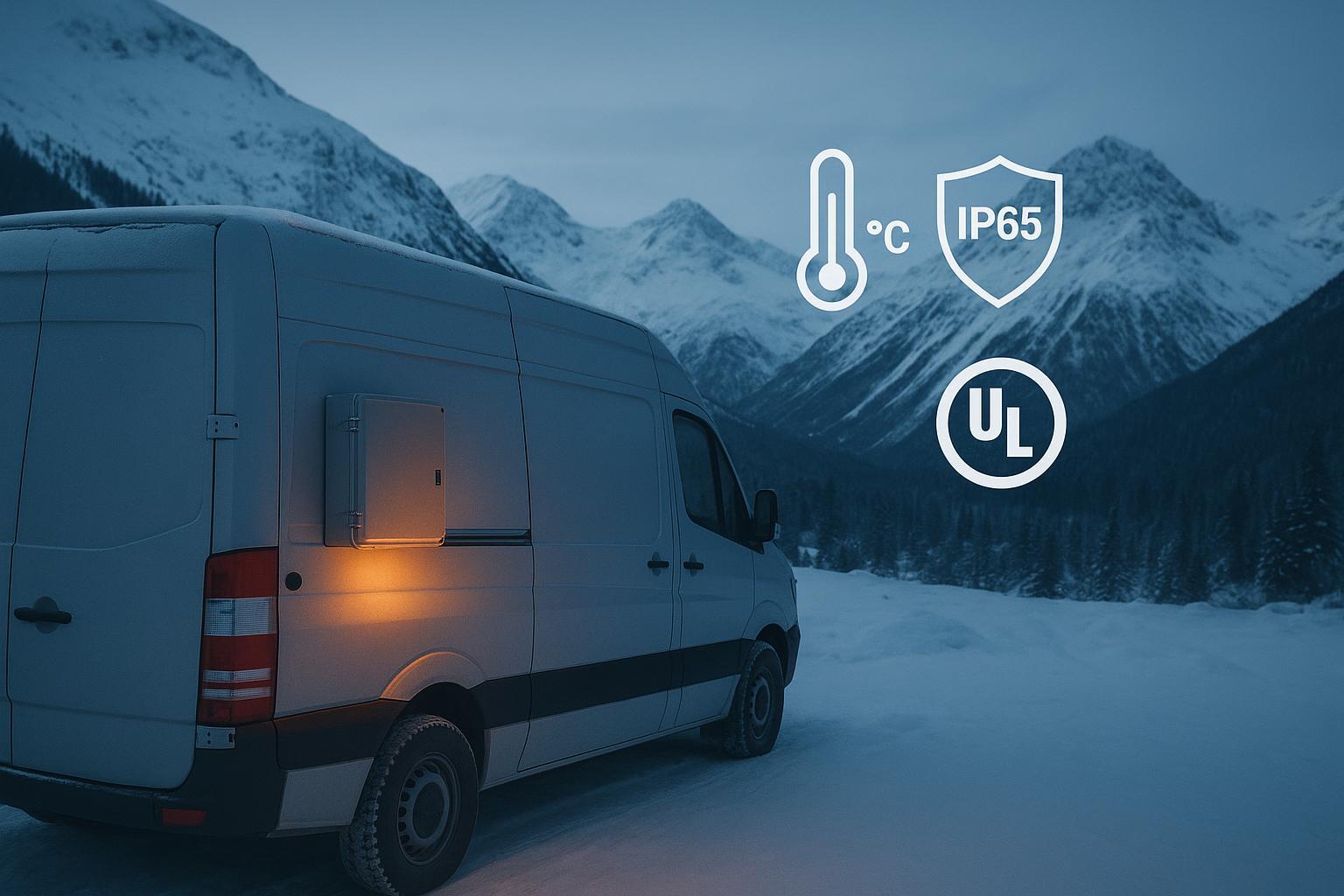
When temperatures dip below freezing, most LiFePO4 batteries refuse to accept a charge to protect their cells. For off‑grid homeowners and vanlife travelers who park outdoors, that means cold mornings with solar watts going to waste—unless your system can preheat the cells and your enclosure can actually survive the weather.
This buying guide prioritizes what matters most outside: verifiable outdoor readiness (IP/NEMA), safety certifications (UL1973/UL9540A where applicable), and real cold‑charge behavior from self‑heating batteries. Only then do we look at capacity, power delivery, integration with common inverters, and overall value.
Soft CTA: If you’re mapping a winter‑ready system, this short integration primer can help you set realistic charging setpoints and heater behavior for hybrid inverters: how to choose the best hybrid inverter for home.
How we chose the best outdoor self‑heating LiFePO4 battery (criteria & weights)
We scored each pick against a transparent blueprint (weights total 100):
- Outdoor durability & enclosure readiness — 22% (IP/NEMA rating, gasketed design, condensation/venting, operating temperature range)
- Cold‑weather charging & self‑heating performance — 22% (minimum charge temperature, heater trigger window, ramp rate/power draw, BMS low‑temp charge behavior)
- Safety & certifications — 16% (UL1973, UL9540/UL9540A, IEC; model‑ or system‑level applicability)
- System integration & support — 14% (charger/inverter compatibility, wiring kits, monitoring, cold‑climate guidance)
- Value over lifecycle — 14% (price per usable kWh, warranty, cycles at rated DoD/temperature)
- Capacity & power delivery — 12% (Ah/kWh, continuous/peak current, surge handling, scalability)
Data sources: official product pages/datasheets, certification listings, and reputable manufacturer documentation. Prices are shown as indicative ranges and are subject to change.
Disclosure: LINIOTECH is our product. We evaluated it using the same criteria and evidence standards as every other item in this list.
Top picks (ranked)
1) RELiON RB100‑LT — Best IP‑rated heated 12V for vanlife winters
- 1‑line positioning: A 12V 100Ah pack with integrated self‑heating and an IP65 enclosure for harsher outdoor exposure.
- Cold‑weather specs: Self‑heating auto‑activates below 0°C (heater powered by the charger); charging permitted down to around −20°C (manufacturer guidance). Heating power: 100W (published).
- Outdoor readiness: IP65 enclosure; suitable for splash/rain and dust; still mount to limit condensation.
- Safety & certifications: Manufacturer publishes compliance details; confirm model‑level listings for your AHJ.
- Capacity & BMS: 100Ah, common Group 31 form factor; BMS manages heater logic during charge.
- Pros: IP65, published 100W heating spec, straightforward use in winter.
- Cons: Heater demands adequate input current; enclosure still benefits from sheltered mounting.
- Best for / Not for: Best for vanlife/RV owners who park in snow and need dependable cold‑charge. Not for ultra‑budget builds.
- Price / Warranty: ~US$900 MSRP class; ~10‑year warranty typical; subject to change.
- Evidence: See the manufacturer’s page for RB100‑LT details: RELiON RB100‑LT product page.
2) Renogy Pro 12V 100Ah (Self‑Heating) — Best IP67 12V with app monitoring
- 1‑line positioning: Self‑heating 12V 100Ah with Bluetooth and IP67 protection for mobile and outdoor mounts.
- Cold‑weather specs: Auto heater activation when cold; minimum input current required; charging below 0°C assisted by heater.
- Outdoor readiness: IP67 ingress protection on supported SKUs (verify per region/SKU).
- Safety & certifications: See Renogy policy pages for warranty/cert details.
- Capacity & BMS: 100Ah class; Bluetooth/app options; robust BMS protections.
- Pros: IP67 rating, ecosystem of accessories, app visibility.
- Cons: Trigger/wattage can vary by region/SKU; verify the exact model.
- Best for / Not for: Best for users who want a high‑ingress‑protection 12V with monitoring. Not for those needing published heater wattage.
- Price / Warranty: Pricing varies by region; subject to change.
- Evidence: Renogy’s U.S. product page provides self‑heating/IP references: Renogy Pro 12V 100Ah self‑heating.
3) SOK SK12V100H (Built‑in Heater) — Best budget heated 12V
- 1‑line positioning: A budget‑friendly 12V 100Ah with a documented 60W heating pad.
- Cold‑weather specs: Integrated 60W heater assists charging below freezing; heater draws from charger.
- Outdoor readiness: No formal IP/NEMA published; plan an insulated, weatherproof mount.
- Safety & certifications: Review manufacturer specs and warranty terms.
- Capacity & BMS: 100Ah, DIY‑friendly design and support community.
- Pros: Clear 60W heater spec, compelling price, 7‑year warranty.
- Cons: No IP rating; depends on the quality of your enclosure.
- Best for / Not for: Best for value‑minded van builds that can add weather protection. Not for exposed outdoor wall mounts.
- Price / Warranty: ~US$630; 7‑year warranty; subject to change.
- Evidence: Manufacturer page lists heater and warranty info: SOK 12V 100Ah LiFePO4.
Soft CTA: Want a quick wiring and setpoint sanity check before buying your battery? Walk through inverter/charger basics in this short guide: how to choose the best hybrid inverter for home.
4) LINIOTECH Power Storage Wall (10kWh class) — Best for certified outdoor‑rated installs
- 1‑line positioning: An outdoor‑rated IP65 wall‑mount LiFePO4 enclosure for homes and cabins that require weather protection and a clear compliance path.
- Cold‑weather specs: Model page does not publish heater trigger/wattage; for sub‑zero charging, pair with heated modules or a preheat strategy.
- Outdoor readiness: IP65 enclosure with wall‑mount design and documented outdoor use.
- Safety & certifications: Model page lists MSDS/UN38.3; system‑level certification path is available when paired with a compatible hybrid inverter.
- Capacity & BMS: 10kWh class; system‑oriented configuration for residential/off‑grid use.
- Pros: Outdoor‑rated enclosure; clear path to compliant system configurations.
- Cons: Heating specifics not listed on the model page; confirm module‑level behavior.
- Best for / Not for: Best for fixed outdoor residential or cabin installs prioritizing enclosure rating and system compliance. Not for minimal van builds.
- Price / Warranty: Around US$3,299 noted on the site; subject to change.
- Evidence and internal resources: 10kWh IP65 Waterproof Outdoor Rated Power Storage Wall and certified system context via the LINIOTECH 14.33kWh + Sol‑Ark 15K kit.
5) Pytes E‑Box V5 51.2V 100Ah (via LINIOTECH) — Best modular 48V with self‑heating option
- 1‑line positioning: A rackable 51.2V module with documented self‑heating logic that enables preheating near/below freezing.
- Cold‑weather specs: Self‑heating activation typically around 0–5°C with staged heating/charging; verify exact trigger window in the current manual.
- Outdoor readiness: Module IP depends on enclosure; plan an outdoor‑rated cabinet if mounting outside.
- Safety & certifications: UL1973/UL9540A/UL9540 (with compatible inverters) documented in Pytes manuals; confirm model‑level applicability.
- Capacity & BMS: 100Ah (5.12kWh); stackable; robust BMS integrations.
- Pros: Documented heating behavior; proven in modular 48V systems.
- Cons: Requires a suitable enclosure for outdoor mounting; heater timing varies with ambient temperature.
- Best for / Not for: Best for off‑grid racks and whole‑home systems needing cold‑charge capability. Not for exposed, no‑cabinet installs.
- Price / Warranty: Varies by distributor; subject to change.
- Evidence (internal page): Pytes V5 51.2V 100Ah on LINIOTECH.
FAQ
Can LiFePO4 batteries charge below 0°C and how does self‑heating work?
Short answer: Not safely without preheating. Many BMSs block charge below 0°C to protect the cells. Self‑heating models use internal heaters or charge‑powered heating pads to warm cells into a safe window (typically a few degrees above 0°C) before allowing charge. Think of it like warming up a frozen windshield so the defroster can do its job.
Is an IP65 battery enough for true outdoor mounting?
Often, yes—with caveats. IP65 protects against dust and water jets, but outdoor mounting still benefits from a sheltered location, drip‑loops, and condensation control. For direct exposure or heavy spray, IP67+ offers more headroom. In fixed installs, consider cabinet design, gaskets, and drain/vent paths.
Do I still need an external heater in sub‑zero?
Sometimes. Integrated heaters draw power (e.g., 60–100W typical when published) and need adequate input current. In deep cold or limited‑sun conditions, an insulated enclosure plus a small external heater on a thermostat can shorten preheat time and protect packs when idle.
How do UL1973/UL9540A impact installations?
UL1973 focuses on stationary battery safety; UL9540A is a thermal‑runaway test method often required to demonstrate system behavior. Many AHJs look for UL9540 (system‑level) pairing with a compatible inverter. Always verify whether your site needs model‑level vs. system‑level listings before you buy.
What size (Ah) is right for vanlife winter use?
A common starting point is 200–300Ah at 12V for light winter loads (fridge, lights, fans, charging) with room for preheat overhead. Heavy use (induction cooktops, inverters >2kW) often benefits from 300–400Ah or a 24V/48V architecture. Right‑size for your cold‑weather duty cycle and available charging.
Closing: build a winter‑ready plan
Cold‑weather charging isn’t only about heaters and spec sheets—it’s about the whole system: enclosure IP rating, condensation control, inverter/charger behavior, and the current you can spare on a freezing morning. If you want a quick, practical next step, review setpoint guidance and integration basics here: how to choose the best hybrid inverter for home. Then pick the model that matches your mounting reality, certification needs, and winter load profile.