
Luxpower Off-Grid Solar Inverter vs Hybrid Inverter: Which One Is Better for Home Backup?
Posted by Liniotech Energy on Dec 22nd 2025
Choosing the right inverter for home solar backup isn’t a small decision. It determines how reliable your power will be, how much independence you get from the utility grid, and in many cases, how much money you’ll save over time. Off-grid solar inverter vs hybrid inverter isn’t just a buzz phrase. For homeowners considering a solar investment, understanding these options in a real context, such as a Lux power inverter system, matters.
Both types of inverters convert DC (direct current) from solar panels into usable AC (alternating current) for your home. But they take very different approaches to energy storage, grid interaction, and backup power delivery. Let’s break it down in practical terms so anyone can understand which makes more sense for a home backup setup.
Understanding How Off-Grid Solar Inverter vs Hybrid Inverter Differs
An off-grid solar inverter is designed for systems that operate independently from the utility grid. It converts DC from solar panels or batteries into AC for household use. If the batteries are charged, power can be maintained even without a grid connection.
This type of inverter is most useful in areas without a grid or where the grid is highly unreliable. It’s a self-contained system that puts energy independence front and center. Still, it means you’re fully responsible for ensuring you have sufficient solar generation and battery capacity to keep operations running. When your batteries run out of stored energy, power stops until they recharge.
A hybrid inverter combines grid-tied and off-grid features in a single system. It integrates solar panels, battery storage, and the utility grid simultaneously. This gives homeowners flexibility: it uses solar when available, charges batteries for later use, and can even export excess power back to the grid in areas that support net metering.
In a home backup context, a hybrid inverter delivers power even when the grid goes down by switching to battery energy without interruption. A hybrid split-phase solar inverter system takes this a step further by handling both 120V and 240V household loads, and some models switch in milliseconds, fast enough to keep lights, refrigerators, and critical electronics running seamlessly.
How They Work: Side by Side
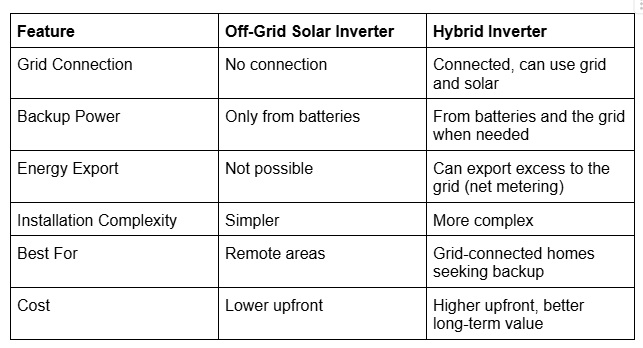
To clearly compare off-grid solar inverters and hybrid inverters, here’s a table that outlines their core mechanics and benefits.
Significant Key Gaps in Off-Grid Solar Inverter vs Hybrid Inverter
-
Grid Interaction
Here’s the practical takeaway: off-grid solar inverters don’t talk to the grid at all. They run your house entirely from solar panels and batteries. That’s great if you don’t have grid access, but it means you miss out on net metering, where you get credits for sending excess energy back to the utility.
A hybrid inverter, on the other hand, works with the grid. That matters because when your solar panels produce more power than your house uses, excess power can be fed back into the utility grid. In regions with supportive policies, hybrid solar inverters can reduce your energy bill through net metering and more innovative grid use. Homeowners often see long-term reductions in utility costs.
-
Backup Power Capability
For home backup, hybrid inverters handle outages more smartly. They use solar first, then store battery energy; if that runs out, they can draw from the grid. This layered approach means fewer blind spots in power delivery.
Off-grid systems only rely on batteries and stored energy; once those are depleted, backup stops until they’re recharged.
-
Installation and Cost
Off-grid systems are typically cheaper upfront and easier to install because they don’t require grid integration or complex control systems. However, they require careful planning for battery capacity and may require larger battery banks to ensure reliability.
A hybrid solar inverter split-phase is more expensive upfront because it integrates multiple energy streams and often includes advanced energy management features. Still, they can pay off over the long term with savings and reliability.
Conclusion
In the off-grid solar inverter vs. hybrid inverter debate, hybrid systems generally offer a better fit for homes seeking reliable backup, grid interaction, and long-term value. Off-grid setups still play a key role where grid connection isn’t available or desired.
Choosing the right inverter is just one part of building a dependable solar system. Working with a trusted solar installation company ensures your panels, batteries, and inverters are sized and configured correctly for your home’s needs.
If homeowners want tailored advice and professional installation, Liniotech stands apart. We focus on innovative solar solutions with real-world reliability, advanced energy monitoring, and systems built to match each home’s unique load profile. Contact us today to explore which inverter system best fits your home backup needs and receive a customized plan that ensures energy security, efficiency, and peace of mind year-round.