
Powering Efficiency: Lithium-ion Energy Storage for Electric Forklift Battery Replacement
Posted by LinioTech on Aug 23rd 2023
In today’s fast‑paced industrial and logistics environments, efficiency, productivity, and sustainability are no longer optional; they’re competitive differentiators. With rising labor costs, increased emphasis on green operations, and the rapid shift toward automation, material handling fleets, especially electric forklifts, must adopt smarter, longer‑lasting power solutions. This is where lithium‑ion energy storage is rewriting the rules of electric forklift battery replacement and redefining what industrial energy systems can do.
In this comprehensive guide, we explore the latest advancements in lithium‑ion batteries for energy storage, the benefits of electric forklift lithium‑ion battery systems, and why forward‑looking companies are transitioning from traditional lead‑acid technology to integrated, long‑life, high‑performance lithium solutions.
The Evolution of Forklift Batteries: From Lead‑Acid to Lithium‑Ion
For decades, industrial forklifts used lead‑acid batteries due to low upfront cost and familiarity. But these batteries come with inherent limitations:
- Heavy weight
- Shorter lifecycle
- Slow recharge
- Periodic watering and maintenance
- Reduced efficiency with partial discharge
Contrast this with today's lithium‑ion batteries for electric forklifts:
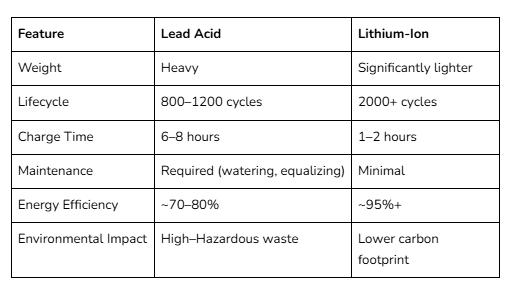
Lithium‑ion energy storage isn’t just a battery swap; it’s a transformative upgrade that enhances performance, reduces cost, and supports future‑ready operations across logistics, warehousing, manufacturing, and distribution.
2. Key Advantages of Lithium‑Ion Battery Energy Storage for Forklifts
Enhanced Operational Efficiency
One of the most significant shifts is the energy performance profile of lithium‑ion batteries. Unlike lead‑acid batteries that steadily lose voltage through discharge, lithium‑ion batteries maintain consistent voltage, providing:
- Stable power throughout the run
- Predictable performance regardless of load
- Higher usable capacity per cycle
- Extended runtime with partial discharge
This improved energy consistency directly translates to greater forklift uptime and less operational variability.
Reduced Downtime and Increased Productivity
In traditional forklift operations, downtime often results from:
- Battery swaps
- Cooling and equalizing lead‑acid cells
- Extended recharge periods
- Maintenance stops
Lithium‑ion batteries sharply reduce these pain points by offering:
✔ Fast charging, reach 80% capacity in under 2 hours.
✔ Opportunity charging, charge during breaks or between shifts to avoid downtime.
✔ Longer lifecycle, fewer battery purchases over time.
Case Study Example:
A multi‑shift warehouse that switched to lithium‑ion forklift batteries saw a 20% increase in operational uptime and a 30% reduction in energy costs within six months due to decreased battery swap cycles and quicker recharge sessions.
Battery Management Systems (BMS) Enable Intelligence
Modern electric forklift lithium‑ion battery systems integrate sophisticated Battery Management Systems (BMS), delivering:
- Real‑time conditions monitoring
- Individual cell balancing
- Temperature regulation
- Predictive maintenance analytics
- Optimized charging profiles
Just as IoT (Internet of Things) powers smart devices, BMS empowers forklift battery systems with intelligence, enabling maintenance teams to anticipate issues before they occur.
Sustainability and Environmental Impact
Lithium‑ion batteries are not only more efficient, but they’re also inherently more eco‑responsible:
- Lower manufacturing emissions compared to lead‑acid
- No hazardous acid or water handling
- Enhanced recyclability
- Longer life reduces total waste
For sustainability‑focused facilities or companies committed to ESG (Environmental, Social, and Governance) goals, lithium‑ion represents a meaningful step toward reducing greenhouse gas emissions and hazardous waste.
Lightweight Design Improves Vehicle Performance
Lithium‑ion batteries are lighter than equivalent lead‑acid packs. This weight reduction leads to:
- Better forklift maneuverability
- Reduced chassis stress
- Less wear and tear on tires and suspension
In high‑rate logistics, where every second counts, even small performance improvements compound into significant productivity gains.
Latest Advances in Lithium‑Ion Energy Storage Technology
The lithium‑ion battery landscape has matured rapidly in recent years. Here’s what’s new and now driving advanced performance in industrial material handling:
Faster Charging & Higher Power Density
Next‑generation lithium‑ion chemistries (such as NMC and LFP variants optimized for performance) now allow:
✔ Super‑fast charging, up to 80% in under 30 minutes for certain systems
✔ High power density, more energy stored in smaller, lighter units
✔ Load adaptability, consistent performance even at higher amp draw
These improvements create opportunities for dual‑shift or 24/7 operations without the traditional concerns of battery cycling.
Modular & Stackable Battery Architectures
Leading lithium‑ion systems now feature modular stackable designs, enabling:
- Flexible capacity scaling
- On‑the‑fly battery replacements
- Simplified warehouse energy management
- Ability to add battery bricks without system overhaul
This modular approach aligns with modern warehouse automation strategies and future‑proofs investments.
AI‑Driven Predictive Energy Optimization
Some advanced lithium‑ion battery platforms now use AI and machine learning to:
✔ Predict failure points
✔ Optimize charging behavior depending on usage patterns
✔ Diagnose battery health trends
✔ Reduce operational overhead and maintenance costs
This trend marks a shift toward self‑learning battery ecosystems, a truly next‑generation milestone in industrial energy storage.
Use Cases: Why Industries Are Switching to Lithium‑Ion Forklift Batteries
Warehouses & Distribution Centers
In environments where uptime is everything:
- Multiple shifts
- Peak seasonal demand
- High‑turn throughput
Lithium‑ion systems ensure forklift fleets remain powered with less downtime and fewer replacements, a decisive advantage for large logistics hubs.
Cold Storage Facilities
Cold environments degrade traditional batteries faster. Lithium‑ion batteries, with smart thermal management and advanced BMS, maintain performance even in sub‑optimal temperatures, making them ideal for:
✔ Cold chain supply
✔ Freezer warehouses
✔ Refrigerated logistics
High‑Intensity Manufacturing Floors
Manufacturers with automated guided vehicles (AGVs), pick‑and‑pack lines, or continuous supply chain operations benefit from:
- Fast battery swaps
- Quick recharge during short breaks
- Enhanced consistency under heavy loads
Industry leaders estimate a 10–35% efficiency improvement when migrating to lithium‑ion power.
Eco‑Focused Enterprises
Companies committed to sustainability, including those pursuing LEED certification, carbon‑neutral operations, or reduced landfill impact, often adopt lithium‑ion solutions first, due to:
- Lower total emissions
- Minimal hazardous waste
- Longer lifecycle = fewer replacements
The Role of Lithium‑Ion Batteries in Broader Energy Storage
While this article focuses on mix forklifts, it’s essential to understand how lithium‑ion batteries expand across energy applications:
- Lithium‑ion batteries for energy storage act as the backbone of renewable integration
- Solar energy storage systems increasingly use lithium‑ion chemistries for dependable output
- Commercial battery energy storage systems leverage lithium‑ion to balance grid demand
- Industrial energy storage systems now rely on lithium‑ion for mission‑critical backup
At Liniotech, we leverage the same robust lithium‑ion architectures in forklift applications as we do in commercial energy storage systems, ensuring consistent performance, longevity, and reliability across sectors.
Comparing Lithium‑Ion Chemistry Types
Not all lithium‑ion batteries are identical, industrial applications, like forklift power and energy storage, often choose specific chemistries:
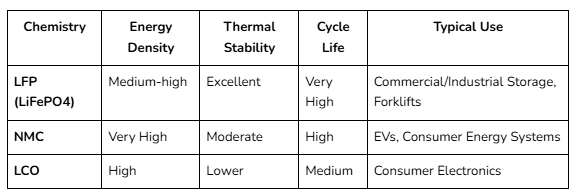
For industrial forklift applications, LFP chemistry has emerged as the most balanced option due to its:
✔ High safety
✔ Excellent lifecycle
✔ Superior thermal and voltage stability
✔ Lower cost per cycle
LFP is now the dominant chemistry for lithium‑ion batteries for energy storage in both commercial and industrial contexts.
Lithium‑Ion Forklift Battery Safety Features You Should Know
Safety is paramount in industrial environments. Modern lithium‑ion systems include:
✔ Thermal runaway prevention
✔ Overcharge/discharge protection
✔ Cell balancing technology
✔ BMS diagnostics and alerts
✔ Temperature sensors
✔ Emergency cut‑off circuitry
These features significantly reduce risks associated with charging, storage, and high‑load operations.
Financial Impact: TCO (Total Cost of Ownership)
Although lithium‑ion batteries often cost more upfront, the total cost of ownership (TCO) tells a different story:
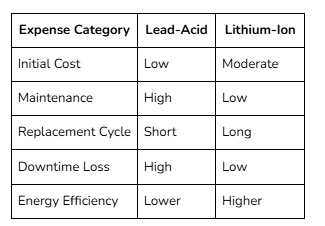
Many businesses find that over 5–7 years, lithium‑ion energy storage offers:
✔ 30–50% lower operating costs
✔ 50–70% fewer replacements
✔ Higher productivity due to reduced downtime
Implementing a Lithium‑Ion Forklift Battery Strategy
Step 1: Capacity Assessment
Determine operational demands:
- Shifts per day
- Forklift duty cycles
- Peak load requirements
Step 2: System Design
Integrate BMS, chargers, and storage modules:
- On‑site charging infrastructure
- Thermal management
- Multiple battery packs
Step 3: Safety & Compliance
Ensure OSHA and local regulation compliance:
✔ NFPA 70 (NEC)
✔ ISO 3691‑1
✔ Equipment grounding and ventilation
Step 4: Training & Onboarding
Empower operators and maintenance staff with:
✔ Charging best practices
✔ Safety training
✔ BMS interface usage
Conclusion
Lithium‑ion energy storage is more than a technological upgrade; it’s a strategic advantage. For material handling fleets, it offers:
- Higher uptime
- Lower total cost
- Faster charging
- Sustainable operations
- Better performance
At Liniotech, we champion high‑quality lithium‑ion batteries for energy storage, including electric forklift lithium‑ion battery systems that fit today’s demanding industrial environments. Whether optimizing warehouse operations or integrating with larger energy storage systems, lithium‑ion remains the most efficient, reliable, and forward‑looking solution.
Frequently Asked Questions
Are lithium‑ion forklift batteries safe?
Yes. With built‑in BMS, overcharge protection, thermal management, and safety certifications, modern lithium‑ion systems are reliable and safe for industrial use.
How long do lithium‑ion forklift batteries last?
Depending on usage, a well‑managed lithium‑ion battery can exceed 2000 charge cycles , up to 5× longer than lead‑acid equivalents.
Can lithium‑ion batteries be used with existing forklifts?
Yes. Many manufacturers now offer drop‑in replacement systems or retrofit kits to upgrade legacy fleets.
Are lithium‑ion batteries better for off‑grid energy storage?
Yes. Lithium‑ion batteries are widely used in solar energy storage systems, commercial energy storage systems, and hybrid grid applications due to their efficiency and performance.
Do lithium‑ion forklift batteries require maintenance?
Maintenance is minimal compared to lead‑acid batteries. There is no watering, no corrosion monitoring, and fewer service intervals.