Why Your Home Is Losing Power More Often in 2026 (And How Solar Storage Fixes It)
Posted by Liniotech on May 15th 2026
If it feels like your lights are flickering off more than they used to, you are not imagining it. Power outages across the United States are becoming more frequent, longer, and more disruptive than at any point in modern history.
In March 2026 alone, over 210,000 power outage events hit 46 states. That is roughly 7,000 grid disturbances every single day, spread across more than 2,000 counties. Texas led all states with nearly 32,000 events in just 30 days. California's outages impacted nearly 1.5 million customers in the same period.
This is not a temporary glitch. It is a structural problem, and it is getting worse. In this article, Liniotech breaks down exactly why your home keeps losing power in 2026, what is driving it, and how a solar + battery storage system is the most reliable long-term solution available to homeowners today.
Why Are Power Outages Increasing in 2026? The 5 Real Causes
The U.S. power grid is facing what experts are calling a "perfect storm" of vulnerabilities. Let us break down each cause clearly.
1. America's Power Grid Is Dangerously Old
Much of the U.S. electrical grid was built in the mid-20th century, decades past its intended lifespan. Aging transmission lines, outdated transformers, and deteriorating substations are failing at an accelerating rate. Equipment failure is currently the leading identified cause of power outages in 2026, with equipment-related outages averaging 9.2 hours to restore and affecting an average of 89 customers per event.
According to Wikipedia's overview of electrical grid infrastructure, the average age of large power transformers in the U.S. exceeds 40 years, with a designed lifespan of 40 years. Many are operating well past their safe service window.
2. AI Data Centers Are Straining the Grid to Its Limits
This is the most significant new factor in 2026. The explosion of artificial intelligence has triggered an unprecedented surge in electricity demand. A single AI task can use up to 1,000 times more electricity than a traditional web search, and new AI data centers are being built faster than the grid can accommodate them.
The numbers are staggering:
- The Lawrence Berkeley National Laboratory projects that data center electricity demand will grow from 176 terawatt-hours (TWh) in 2023 to between 325 and 580 TWh by 2028
- PJM, the nonprofit that coordinates electricity for 67 million people across 13 states, projects electricity demand will climb nearly 5% per year over the next decade, largely driven by AI data centers
- Capacity market clearing prices for PJM's 2026–2027 delivery year surged to $329.17/MW, over ten times the $28.92/MW seen in 2024–2025
Northern Virginia's "Data Center Alley" alone has 153 facilities in the town of Ashburn. When demand keeps climbing, and older power plants retire faster than new ones are built, residential customers bear the blackout risk. A former chair of the Federal Energy Regulatory Commission summed it up bluntly: "The reliability risk is across the street."
3. Extreme Weather Is Hitting Harder and More Often
Severe storms, heatwaves, wildfires, and polar vortex events are not anomalies anymore; they are calendar events. High winds topple power lines. Flooding destroys substations. Wildfires take out entire transmission corridors. Vegetation contact (tree limbs on power lines) remains one of the most common outage triggers, averaging 6 hours per restoration event.
Experts have specifically named Texas, Louisiana, Alabama, Tennessee, and Mississippi as states facing elevated blackout risk in 2026, driven by extreme weather combined with grid stress from rising demand.
4. Soaring Electricity Demand from Electrification
Electric vehicles, heat pumps, and electrified appliances are replacing gas-powered equivalents across millions of homes simultaneously. Without major infrastructure upgrades, expanded substations, new transmission lines, and more transformers, EV charging and home electrification are creating new stress points in local distribution networks.
ICF International estimates that America's total power demand will go up 25% by 2030 and 78% by 2050 compared to 2023 levels. The grid was not built for this.
5. Cybersecurity Threats to Grid Infrastructure
Ransomware attacks, malware injections, and system intrusions targeting power grid control systems are increasing in sophistication. Legacy grid components lack modern security protections, and successful attacks can trigger regional outages with cascading effects. The U.S. Department of Energy identifies grid cybersecurity as one of the most pressing national energy challenges of 2026.
What This Means for Your Home Right Now
Power outages are no longer a rural or coastal problem; they are happening everywhere, to everyone. Here is the real-world impact on American households:
- Food spoilage: The average American family loses $200–$400 in food during a single extended outage
- Work-from-home disruption: With 30%+ of the workforce operating remotely, losing power means losing income
- Medical equipment: Millions of households depend on powered medical devices, CPAP machines, nebulizers, and refrigerated medications
- HVAC failure: During a Texas summer heatwave or a polar vortex, losing heating or cooling is not an inconvenience; it is dangerous
- Security systems: Most home security systems and smart devices go offline without power, leaving homes vulnerable
The gap between a 3-hour outage and a 10-hour outage is the gap between an inconvenience and a homeowner searching "whole home battery backup" on their phone. Millions of Americans are at that point right now.
How Solar + Battery Storage Fixes the Problem Permanently
Here is the key insight that changes everything: a solar panel system paired with a LiFePO4 battery storage system does not just reduce your electricity bill. It removes your home from the grid's vulnerability entirely — or reduces your dependence on it to near zero.
Let us look at exactly how it works.
What Happens During a Grid Outage — With and Without a Battery
Without a battery: Even if you have solar panels on your roof, a standard grid-tied solar system automatically shuts down during a power outage. This is a required safety feature to protect utility workers. Your panels are producing energy, but you cannot use it.
With a solar + battery system from Liniotech: Your hybrid inverter detects the grid failure instantly and switches your home to battery power, typically in milliseconds, with zero interruption to your lights, appliances, HVAC, and devices. Your solar panels continue charging your battery during the day, and the stored energy powers your home through the night.
What Can a Solar Battery System Power?
A properly sized solar + LiFePO4 battery system can power your entire home, including:
- Refrigerator and freezer — running continuously
- HVAC system — heating and cooling during extreme weather
- Lights, fans, and all standard outlets
- Home office equipment — computers, routers, monitors
- Medical devices — CPAP, nebulizers, refrigerated medications
- Electric vehicle charging — slow charge overnight
- Security systems and smart home devices
Sizing matters. A small home typically needs 10–15 kWh of battery storage for a full day of backup. A medium home requires 15–25 kWh. For storm-prone regions, sizing for 3–5 days of autonomy is recommended, especially when paired with solar panels that recharge the battery each day.
Why LiFePO4 Chemistry Is the Right Choice for Home Storage
Not all batteries are equal. Liniotech uses and recommends LiFePO4 (Lithium Iron Phosphate) battery chemistry for home and commercial storage and for good reason:
- Lifespan of 6,000 to 10,000+ charge cycles — equivalent to 15–20 years of daily use
- Completely non-flammable — no thermal runaway risk, safe for indoor installation
- 80–90% depth of discharge — you use nearly all the stored energy, not just half
- Flat discharge curve — consistent power output from 100% to near 0% charge
- No toxic cobalt or heavy metals — environmentally responsible chemistry
- Performs reliably across wide temperature ranges — works in Texas heat and northern winters
To understand the full technical comparison, read our in-depth guide: LiFePO4 vs Lithium-Ion Battery: Which One Should You Put in Your Home?
Solar Storage vs. Gas Generator: Why Batteries Win
Many homeowners default to a gas generator as a backup power solution. Here is a direct comparison:
|
Factor |
Gas Generator |
Solar + LiFePO4 Battery |
|
Fuel needed |
Yes — gas supply required |
No — charged by solar panels |
|
Noise level |
Very loud — 65–80 dB |
Silent — zero noise |
|
Indoor use |
Never — toxic fumes |
Yes — safe indoors |
|
Starts automatically |
Most require a manual start |
Instant — 0ms switchover |
|
HVAC compatible |
Depends on kW size |
Yes — with proper sizing |
|
Ongoing fuel cost |
$500–$1,500+/year |
$0 — solar recharged |
|
Lifespan |
10–15 years with maintenance |
15–20 years — minimal maintenance |
|
Reduces the electricity bill |
No |
Yes — daily savings |
The verdict is clear: a solar + battery system is quieter, safer, cheaper to operate, and more reliable over its lifetime, while simultaneously reducing your monthly electricity bill every single day, not just during outages.
How Liniotech's Solar Storage Systems Keep Your Home Powered
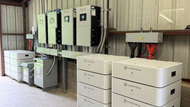
Liniotech provides complete home and commercial energy storage solutions, including premium LiFePO4 wall batteries, rack batteries, hybrid inverters, bifacial solar panels, and full ESS (Energy Storage System) packages designed to work together seamlessly.
Here is what makes Liniotech's solar storage systems the right choice for outage protection in 2026:
- Instant transfer — hybrid inverters switch from grid to battery in milliseconds, no interruption to your home
- Whole-home backup — properly sized systems keep HVAC, refrigerator, home office, and all circuits running
- Scalable and modular — start with one battery unit and expand as your needs grow
- LiFePO4 chemistry — 6,000 to 10,000+ cycles, non-flammable, 15–20 year lifespan
- Compatible with all major solar panel brands and inverter types
- Suitable for residential, commercial, and industrial applications
Whether you are a homeowner tired of losing power during storms or a business that cannot afford costly downtime, Liniotech engineers the right system for your specific load requirements.
Not sure what size system you need? Read our complete guide: How to Size a Solar Energy Storage System for Your Business or Home
Which States Are Most at Risk in 2026? (Is Your State on the List?)
Based on current grid stress data and expert warnings, these states face the highest blackout risk in 2026 and are the strongest candidates for solar + storage investment:
- Texas — 31,919 outage events in March 2026 alone; the ERCOT grid remains uniquely vulnerable to extreme heat and weather events
- California — 19,777 events in March 2026, nearly 1.5 million customers affected; wildfire risk and NEM 3.0 changes make storage even more valuable
- Louisiana, Alabama, Tennessee, Mississippi — elevated blackout risk cited by grid experts due to rising demand and aging infrastructure
- New Jersey, Pennsylvania, Virginia, Maryland — PJM grid strain from AI data centers creating price surges and capacity pressure
Florida, hurricane season grid vulnerability; homeowners need multi-day backup capacity
To learn more about grid reliability ratings by state, visit the U.S. Department of Energy's Office of Electricity.
Beyond Backup: The Daily Financial Benefits of Solar Storage
Solar battery storage is not just an emergency solution, it pays dividends every single day, outage or not.
- Time-of-Use (TOU) savings: Store cheap solar energy during the day and use it during expensive evening peak hours instead of buying from the grid
- Self-consumption maximization: With declining net metering rates in many states, storing your solar energy yourself is worth more than selling it back
- Bill reduction: Most homeowners with a properly sized solar + storage system reduce their electricity bill by 70–100%
- Home value increase: Owned solar + storage systems add 3–4% to home resale value in most markets
- Energy cost predictability: Lock in your energy costs today, immune to future utility rate increases
Want the full breakdown of savings potential? Read: How Much Can You Really Save with a Home Solar Battery System in 2026?
The Bottom Line: Stop Waiting for the Next Outage
The U.S. power grid is not going to get more stable in the near term. AI data center demand is accelerating. Aging infrastructure is failing. Extreme weather is intensifying. And utilities are raising rates to fund upgrades that will take years to complete.
The homeowners who act now, installing solar + battery storage before the next major outage, are the ones who stay powered, comfortable, and financially protected while their neighbors wait days for the lights to come back on.
A Liniotech solar + LiFePO4 battery storage system is not just a backup device. It is a complete energy independence system that protects your home, your family, and your finances, every single day.
Contact Liniotech today for a free consultation and system sizing, and stop leaving your home's power supply in the hands of an aging, overloaded grid.
Also from Liniotech:
- Is Solar Still Worth It in 2026 Without the Federal Tax Credit?
- LiFePO4 vs Lithium-Ion Battery: Which One Should You Put in Your Home?
- How to Size a Solar Energy Storage System for Your Business or Home
- How Much Can You Really Save with a Home Solar Battery System in 2026?
FAQs
Why are power outages getting worse in the U.S. in 2026?
There are five main reasons: aging grid infrastructure that is operating past its designed lifespan, an unprecedented surge in electricity demand from AI data centers, increasing frequency and severity of extreme weather events, rapid growth in EV charging and home electrification, and rising cybersecurity threats targeting grid control systems. Together, these forces are creating the most strained U.S. power grid in decades.
Will a solar battery system keep my HVAC running during a power outage?
Yes, with proper sizing. HVAC systems are among the highest-load appliances in a home, requiring significant power output and surge capacity at startup. A Liniotech hybrid inverter paired with adequate LiFePO4 battery capacity and solar panel input can power a central air conditioning system during an outage. The key is correct system sizing based on your HVAC unit's wattage and your home's total load. Liniotech provides free sizing consultations to ensure your system is built for whole-home backup.
How long can a solar battery system power my home during an outage?
It depends on your battery capacity and daily energy use. A 10–15 kWh system is sufficient for essential loads in a small home for 1–2 days. A 15–25 kWh system covers most medium homes for a full day of normal use. In storm-prone areas, sizing for 3–5 days of autonomy is recommended. Because your solar panels recharge the battery each sunny day, a properly sized solar + storage system can sustain your home indefinitely through extended outages — without a single trip to the gas station.
My neighborhood loses power every time there is a bad storm. Will solar actually help?
Yes, and it is one of the best use cases for solar + storage. A Liniotech hybrid inverter system detects grid failure and switches your home to battery power automatically in milliseconds. Your solar panels then continue generating electricity during and after the storm, recharging your battery as sunlight returns. Unlike a gas generator, the system runs silently, needs no fuel, produces no fumes, and can power your entire home, HVAC included, for days.
What states are at highest risk for power outages in 2026?
Based on current grid stress data, Texas, California, Louisiana, Alabama, Tennessee, Mississippi, and states within the PJM grid (New Jersey, Pennsylvania, Virginia, Maryland) face the highest blackout risk in 2026. Florida homeowners also face an elevated risk due to hurricane season vulnerability. If you live in any of these states, a solar + LiFePO4 battery system from Liniotech is not a luxury, it is essential infrastructure for your home.