

48V vs 51.2V LiFePO4 Battery: What Changes?
Posted by LINIOTECH on Jul 13th 2026
If you shop for solar batteries, you will quickly run into a confusing pair of labels: 48V and 51.2V. One product may be advertised as a 48V LiFePO4 battery, while its technical specifications list a nominal voltage of 51.2V. Another battery may truly be rated at 48V. So, are these the same thing?
Often, a 51.2V LiFePO4 battery is used in what the solar industry calls a 48V battery system. But the labels are not automatically interchangeable in every case. The difference can affect stored energy, charging settings, inverter compatibility, current flow, battery management system communication, and whether two battery models can safely operate together.
This guide explains what actually changes between 48V and 51.2V LiFePO4 batteries, why both labels appear in solar energy storage, and what homeowners, installers, and system designers should check before connecting a battery to an inverter.
Quick Answer: Is a 51.2V Battery the Same as a 48V Battery?
In many modern solar and energy-storage systems, yes in terms of system class: a 51.2V nominal LiFePO4 battery is commonly used as a battery for a 48V system. The 48V label often describes the broader low-voltage system category, while 51.2V describes the battery pack’s actual nominal voltage.
A common 51.2V LiFePO4 pack uses 16 cells in series. With an approximate nominal cell voltage of 3.2V, the calculation is:
16 cells × 3.2V = 51.2V nominal
However, not every battery sold as “48V” is necessarily a 16-cell 51.2V pack. Different battery architectures and voltage windows exist. That is why the inverter manual, battery datasheet, BMS requirements, and approved compatibility list matter more than the front-label wording alone.
Why Is a 51.2V LiFePO4 Battery Often Called 48V?
Solar power systems have long been grouped into familiar voltage classes such as 12V, 24V, and 48V. These class names describe the electrical architecture of the system rather than promising that the battery will sit at exactly that voltage at every moment.
LiFePO4 chemistry introduced a common pack design that does not land on exactly 48.0V nominal when 16 cells are connected in series. A 16-series, or 16S, pack is nominally 51.2V. Even so, it is commonly integrated into equipment designed around the 48V low-voltage battery class, provided the inverter and battery are compatible.
This is why a product title may say “48V LiFePO4 battery” while the specification table lists “51.2V nominal voltage.” LINIOTECH itself uses this type of labeling on relevant solar battery products, reflecting the difference between the common system class and the actual nominal pack voltage.
48V vs 51.2V LiFePO4 Battery at a Glance
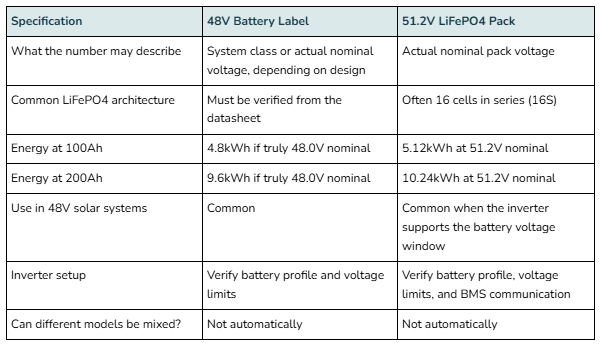
The key takeaway is simple: compare the technical specifications, not only the marketing label.
1. Nominal Voltage Changes
The most obvious difference is nominal voltage. Nominal voltage is a reference value used to describe the battery, not a guarantee that the pack remains at that exact voltage during charging and discharging.
A 51.2V LiFePO4 pack can operate across a wider voltage window defined by its cells, BMS, and manufacturer settings. The exact minimum, maximum, recommended charge voltage, and discharge cutoff vary by product. Therefore, a 48V-class inverter must be checked against the battery’s actual operating range.
Do not assume that “48V inverter” plus “51.2V battery” automatically means plug-and-play. Many combinations are compatible, but compatibility should be confirmed from manufacturer documentation or an approved battery list.
2. Stored Energy Changes at the Same Ah Rating
Battery energy is commonly estimated with this formula:
Energy (Wh) = Nominal Voltage (V) × Capacity (Ah)
That means two batteries with the same amp-hour rating can store different amounts of nominal energy if their nominal voltages differ.
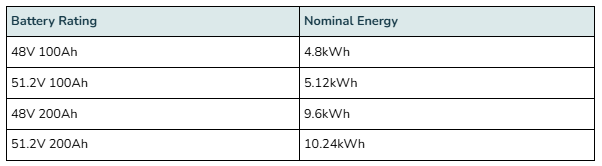
For example, a 51.2V 100Ah battery has about 6.7% more nominal energy than a truly 48.0V 100Ah battery. This does not automatically mean it will deliver 6.7% more usable runtime in every real system, because usable depth of discharge, efficiency, reserve settings, temperature, and BMS limits also matter.
3. DC Current Changes for the Same Power
For a given power level, a higher DC voltage generally requires less current. The simplified relationship is:
Current (A) = Power (W) ÷ Voltage (V)
Ignoring conversion losses for a moment, compare a 5kW load:
- At 48V: 5,000W ÷ 48V ≈ 104.2A
- At 51.2V: 5,000W ÷ 51.2V ≈ 97.7A
At 10kW, the simplified comparison becomes:
- At 48V: 10,000W ÷ 48V ≈ 208.3A
- At 51.2V: 10,000W ÷ 51.2V ≈ 195.3A
The 51.2V case draws slightly less current for the same idealized power. In real installations, inverter efficiency, battery state of charge, cable resistance, BMS limits, and changing battery voltage alter the actual current. Still, the calculation shows why voltage matters when sizing cables, busbars, overcurrent protection, and battery banks.
4. Charging Settings Can Change
A battery cannot be configured correctly from the nominal label alone. Charging voltage, low-voltage cutoff, reconnect thresholds, current limits, temperature protections, and state-of-charge control should follow the battery manufacturer’s instructions.
This is especially important when comparing a true 48V pack with a 51.2V nominal pack. Their recommended charge windows may differ. An inverter or charger set for the wrong battery profile could trigger nuisance shutdowns, reduce usable capacity, or conflict with BMS protections.
For closed-loop systems, the battery BMS may communicate limits and state information to the inverter over CAN or RS485. In that case, the correct communication protocol, cable pinout, inverter profile, and firmware support are just as important as nominal voltage.
5. Inverter Compatibility Matters More Than the Label
The best question is not simply “Is this a 48V or 51.2V battery?” The better question is “Is this exact battery model compatible with this exact inverter model?”
Check the following before installation:
- Battery operating voltage range
- Inverter battery-input voltage range
- Maximum charge and discharge current
- Battery BMS continuous and peak current limits
- CAN or RS485 communication support
- Required inverter battery profile
- Firmware requirements
- Approved battery list or manufacturer integration guide
- Parallel battery rules and maximum module count
LINIOTECH offers multiple battery and inverter categories for solar storage. For system planning, review the company’s hybrid solar inverter solutions and confirm model-level compatibility before purchasing or commissioning a system.
6. 48V and 51.2V Labels Affect Battery Sizing
Suppose you need roughly 20kWh of nominal storage. The required module count depends on the energy of each battery, not merely the 48V system label.
A common 51.2V 100Ah module stores about 5.12kWh nominal. Four such modules provide:
4 × 5.12kWh = 20.48kWh nominal
By comparison, four truly 48V 100Ah modules would represent 19.2kWh nominal. The difference is not huge, but it can matter when comparing quotes, calculating backup duration, or estimating how many rack modules are needed.
For modular storage, explore LINIOTECH rack LiFePO4 battery modules, which are designed for organized and expandable solar battery installations.
7. Can You Use a 51.2V Battery With a 48V Inverter?
Often, yes. Many 48V-class solar inverters are designed to work with 51.2V nominal LiFePO4 batteries. But this should never be assumed from the voltage label alone.
A compatible combination requires the inverter to support the battery’s full operating voltage range and required charge behavior. For lithium batteries, closed-loop BMS communication may also be required or strongly preferred for proper current limits, state-of-charge reporting, and protection coordination.
As one practical example of how the terminology is used, a LINIOTECH battery product may be described for the 48V system class while listing 51.2V as its nominal voltage. The company’s 10kWh 48V 200Ah LiFePO4 battery brick lists 10.24kWh energy capacity and a 51.2V nominal voltage, making the distinction especially clear.
8. Can You Mix 48V and 51.2V Batteries in One Bank?
Do not mix batteries simply because both are described as part of a 48V system. Batteries with different nominal voltages, cell counts, BMS logic, state of charge, internal resistance, current ratings, firmware, or age can behave differently when connected.
Parallel connection is particularly sensitive because batteries share current. A mismatch can create uneven current flow, circulating current, repeated BMS trips, or poor state-of-charge balance.
Only parallel battery models when the manufacturer explicitly allows the configuration. Follow the approved module count, cabling layout, busbar arrangement, fuse or breaker requirements, communication topology, and commissioning procedure.
9. What Does 16S Mean in a 51.2V LiFePO4 Battery?
The term 16S means 16 cells are connected in series. A series connection adds voltage while the amp-hour capacity of the series string remains based on the cell capacity.
Using the common nominal value of about 3.2V per LiFePO4 cell:
- 4 cells in series ≈ 12.8V nominal
- 8 cells in series ≈ 25.6V nominal
- 16 cells in series ≈ 51.2V nominal
This is why 51.2V appears so frequently in modern LiFePO4 battery specifications. The BMS monitors the cells and applies protection logic according to the pack design.
10. What About a True 48V LiFePO4 Battery?
A battery can genuinely have a 48V nominal rating depending on its cell configuration and product design. That is why it is risky to assume every “48V LiFePO4” product is just another name for 51.2V.
The correct approach is to inspect the datasheet for:
- Nominal voltage
- Cell configuration is provided
- Operating voltage range
- Maximum charge voltage
- Low-voltage protection threshold
- Recommended inverter settings
- Communication requirements
The exact battery architecture determines how it should be charged and integrated.
48V vs 51.2V: Which Is Better for Solar Storage?
There is no universal winner based on the number alone. A 51.2V LiFePO4 battery is extremely common in modern 48V-class solar storage and offers a clear energy calculation for 16S LFP architecture. But the best battery is the one that matches the inverter, required power, runtime target, installation environment, certifications, communication protocol, and expansion plan.
For many home energy-storage systems, buyers should prioritize:
- Verified inverter compatibility
- Adequate usable kWh capacity
- Sufficient continuous discharge power
- Appropriate BMS current rating
- Safe installation and protection equipment
- Required indoor or outdoor enclosure rating
- Clear warranty terms
- Scalability for future battery expansion
To compare wall-mounted storage options, visit LINIOTECH power storage wall battery collection. For broader home backup planning, review the company’s residential energy storage systems.
How to Choose Between 48V and 51.2V Batteries
Use this practical decision process before buying a battery:
- Start with the inverter model. Confirm its battery voltage range and approved battery options.
- Check the battery datasheet. Record nominal voltage, operating range, charge limits, current limits, and BMS requirements.
- Calculate energy in kWh. Do not compare batteries by amp-hours alone.
- Calculate the required battery power. Make sure the battery bank can support the inverter load without exceeding BMS limits.
- Confirm communications. Verify CAN or RS485 support, cable pinout, protocol selection, and firmware requirements.
- Plan expansion. Confirm how many identical modules can be connected and how they should be wired.
- Check installation requirements. Review enclosure rating, temperature limits, disconnects, overcurrent protection, and local code requirements.
Common Mistakes to Avoid
Mistake 1: Comparing Ah Without Comparing Voltage
A 100Ah battery does not tell you total energy by itself. Multiply nominal voltage by amp-hours to estimate nominal watt-hours.
Mistake 2: Assuming Every 48V Battery Is 51.2V
Many are used in the same system class, but product architectures differ. Read the datasheet.
Mistake 3: Using Generic Charger Settings
Charging parameters should match the exact battery and inverter configuration, not a random online profile.
Mistake 4: Ignoring BMS Current Limits
A large inverter can demand more DC than a single battery module can safely provide. Multiple compatible modules may be needed for power capability, not only for runtime.
Mistake 5: Mixing Different Batteries
Different voltage windows, BMS behavior, age, capacity, or firmware can make mixed banks problematic. Follow manufacturer-approved configurations.
A Practical LINIOTECH Example
LINIOTECH’s stackable 10kWh battery brick shows exactly why buyers see both voltage labels. The product is positioned as a 48V LiFePO4 solar battery for the common system class, while its listed nominal voltage is 51.2V. At 200Ah, the nominal energy calculation is:
51.2V × 200Ah = 10,240Wh = 10.24kWh
This is a useful example of how system-class terminology and battery-pack specifications can coexist without being contradictory. The important part is to design the inverter, battery, cabling, current limits, and communications as one integrated system.
Final Thoughts
So, what changes between a 48V and 51.2V LiFePO4 battery? Sometimes less than the labels suggest, and sometimes enough to affect the entire system design.
A 51.2V nominal battery is commonly used in a 48V-class solar energy system, especially when the pack uses a 16S LiFePO4 architecture. But not every battery labeled 48V is automatically identical to a 51.2V pack.
The practical differences can include:
- Nominal energy capacity
- Operating voltage window
- Charging parameters
- DC current for a given power level
- Inverter compatibility
- BMS communication
- Parallel connection rules
Before buying or connecting a battery, verify the exact battery datasheet and inverter integration requirements. A well-matched system will always perform better than one designed around a label alone.
Explore LINIOTECH energy storage solutions to compare LiFePO4 batteries, rack modules, wall-mounted storage, hybrid inverters, and broader solar energy equipment for home and commercial applications.
FAQs
Is 51.2V considered a 48V battery?
Often, yes, in terms of system class. A 51.2V nominal LiFePO4 battery is commonly used in 48V solar and energy-storage systems when the inverter supports the battery’s operating range and communication requirements.
Why is a 51.2V LiFePO4 battery called 48V?
The 48V label often refers to the established low-voltage system class. A common 16S LiFePO4 pack has a nominal voltage of 51.2V, so the technical pack rating and system-class label can both appear.
How many kWh is a 51.2V 100Ah battery?
Nominal energy is approximately 5.12kWh because 51.2V × 100Ah = 5,120Wh.
How many kWh is a 51.2V 200Ah battery?
Nominal energy is approximately 10.24kWh because 51.2V × 200Ah = 10,240Wh.
Can I connect a 51.2V battery to a 48V inverter?
Often, but only when the inverter supports the battery’s full operating range and requires BMS integration. Confirm the exact inverter and battery models.
Is 51.2V better than 48V?
Not automatically. A 51.2V pack may provide slightly more nominal energy at the same Ah rating and slightly lower current for the same idealized power, but compatibility and system design matter more than the number alone.
Can I mix 48V and 51.2V batteries in parallel?
Do not assume you can. Only combine batteries when the manufacturer explicitly approves the models, configuration, communication method, and wiring arrangement.
What does 16S mean in a LiFePO4 battery?
16S means 16 cells are connected in series. Using about 3.2V nominal per LiFePO4 cell gives approximately 51.2V nominal for the pack.
Does a 51.2V battery need a special charger?
It needs charging equipment or an inverter/charger configured for the exact battery voltage window and manufacturer requirements. Use the approved battery profile or documented settings.
What should I check before buying a 48V LiFePO4 battery?
Check nominal voltage, operating range, kWh capacity, continuous discharge power, BMS limits, inverter compatibility, communication protocol, expansion rules, certifications, enclosure rating, and warranty.