
48V vs High-Voltage Battery: Which Is Better for Solar Storage?
Posted by Liniotech on Jul 15th 2026
Choosing between a 48V battery system and a high-voltage battery system is one of the most important decisions in a solar storage project. Both can store solar energy, support backup power, and work with modern lithium iron phosphate batteries, but they are not designed for the same type of installation.
A 48V LiFePO4 battery is usually the practical choice for homes, smaller off-grid systems, retrofit projects, and modular storage banks. A high-voltage battery is usually better for larger homes, three-phase systems, commercial buildings, and industrial energy storage, where higher power, lower current, and stronger scalability matter.
The best choice is not simply the battery with the highest voltage. It depends on your inverter, load size, backup goals, installation environment, safety requirements, and future expansion plan.
|
Quick Answer |
48V vs High-Voltage Battery: The Main Difference
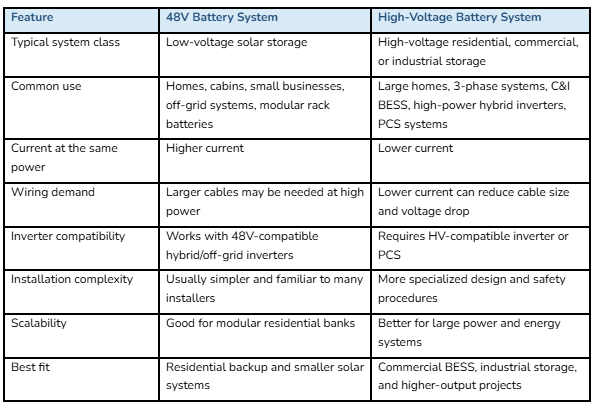
The core difference is how much voltage the battery bank uses to deliver power. A lower-voltage battery system delivers the same power with more current, while a higher-voltage battery system delivers the same power with less current.
That matters because current affects heat, wiring size, voltage drop, component stress, installation complexity, and system efficiency.
The basic relationship is simple:
Power (W) = Voltage (V) × Current (A)
If the power demand stays the same, increasing voltage reduces current. This is the main reason high-voltage battery systems are common in larger solar storage and commercial energy storage projects.
What Is a 48V Battery System?
A 48V battery system is a low-voltage energy storage setup commonly used with off-grid inverters, hybrid inverters, server-rack batteries, wall-mounted batteries, and smaller solar backup systems.
In LiFePO4 storage, many products are described as 48V class batteries even when the nominal voltage is 51.2V. That is normal. A 51.2V LiFePO4 battery usually uses sixteen cells in series, often called a 16S configuration. It is commonly paired with inverters designed for 48V battery platforms.
For example, LINIOTECH offers a 10.24kWh battery brick with a 48V / 51.2V platform, 200Ah capacity, and a stackable design for solar and backup systems. You can review the product here: LINIOTECH 10kWh 48V LiFePO4 Battery Brick
A 48V battery system is often preferred when the project needs practical installation, modular expansion, and straightforward compatibility with residential solar equipment.
- Home backup systems
- Off-grid cabins and rural properties
- 48V hybrid inverter systems
- Server-rack battery banks
- Wall-mounted and floor-mounted LiFePO4 batteries
- Small commercial backup systems
- Retrofit solar storage projects
What Is a High-Voltage Battery System?
A high-voltage battery system uses a higher DC voltage than a traditional 48V battery bank. Instead of relying on one low-voltage battery platform, high-voltage systems usually connect multiple battery modules in series to reach the required operating voltage range for the inverter, PCS, or commercial energy storage system.
High-voltage battery architecture is common in larger solar-plus-storage systems because it reduces current for the same power output. Lower current can improve efficiency, reduce voltage drop, and make high-power operation more practical.
LINIOTECH positions its high-voltage LiFePO4 battery solutions for large-scale energy storage applications where efficiency, power density, and system scalability are critical. For commercial projects, LINIOTECH also offers a 61.44kWh high-voltage battery system designed for Sol-Ark 60K-3P-480V integration.
High-voltage storage is not automatically better for every project, but it becomes increasingly attractive as system power, energy capacity, and commercial requirements increase.
- Commercial and industrial energy storage systems
- Three-phase battery storage projects
- High-power hybrid inverter systems
- PCS-based battery energy storage systems
- Large solar backup systems
- Peak shaving and demand charge management
- Facilities that need higher output and scalable capacity
Why Voltage Matters: A Simple 10kW Example
Voltage becomes easier to understand when you compare the current needed to deliver the same amount of power.
For a 10kW load, the current requirement looks very different at low voltage versus high voltage.
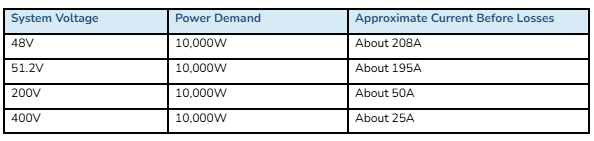
This does not mean a 48V system cannot support strong output. It can, when the inverter, batteries, cables, busbars, breakers, and BMS are correctly sized. However, it shows why low-voltage systems can require heavy DC-side current when power demand rises.
In high-power systems, high current can create more heat, more voltage drop, and larger conductor requirements. Higher voltage helps reduce that current, which is one reason commercial BESS and large hybrid systems often move beyond 48V architecture.
Inverter Compatibility Comes First
The most important rule is simple: the battery voltage must match the inverter or PCS input requirements.
A 48V battery should be used with an inverter designed for a 48V battery bank. A high-voltage battery should be used only with an inverter, PCS, or energy storage system specifically designed for that high-voltage operating range.
This is not an area for guessing. Battery voltage, BMS communication, charging limits, discharge limits, firmware compatibility, and safety certifications all matter.
For residential and commercial setups that need integrated solar and storage control, review LINIOTECH hybrid solar inverter options and confirm the supported battery voltage before choosing a storage bank.
- Battery nominal voltage and operating voltage range
- Maximum charge and discharge current
- Inverter battery voltage range
- CAN, RS485, or other BMS communication protocol
- Approved battery list or compatibility documentation
- Maximum number of battery modules in parallel or series
- Required breakers, fuses, busbars, disconnects, and cable size
Efficiency: Why High Voltage Can Win in Larger Systems
High-voltage battery systems can be more efficient in larger installations because they deliver the same power with less current. Lower current can reduce resistive losses in cables and conductors. It can also make it easier to move higher power through the system without oversized low-voltage DC wiring.
For a small home backup system, the efficiency difference may not be the deciding factor. The simplicity and cost structure of a 48V system may matter more.
For a commercial building, industrial site, farm, warehouse, or three-phase solar project, the benefits of high voltage become more important because the system may need to deliver high power for longer periods or support a larger capacity.
This is why the decision should match the system scale. Do not choose high voltage only because it sounds more advanced. Choose it when the electrical design, inverter platform, and energy goals justify it.
Cost: Which Battery System Is More Affordable?
A 48V battery system is often more affordable for residential and small off-grid projects because the equipment is widely available, modular, and familiar to many installers. The system may also be easier to expand by adding compatible rack or wall-mount batteries in parallel, subject to manufacturer limits.
High-voltage systems can cost more at the beginning because they usually require more specialized equipment, stricter design controls, HV-compatible inverters, and trained installation practices. However, for larger systems, high voltage may reduce wiring complexity, improve performance, and support better long-term scalability.
The better question is not “Which one is cheaper?” The better question is “Which voltage architecture gives the lowest total cost for the required power, capacity, safety, and future expansion?”
Safety and Installation Complexity
Both 48V and high-voltage LiFePO4 battery systems must be installed correctly. LiFePO4 chemistry is widely used for solar storage because of its strong thermal stability and long cycle life, but battery safety still depends on system design, BMS protection, wiring, overcurrent protection, ventilation, enclosure rating, and code-compliant installation.
A 48V battery system is generally more approachable for residential installations, but it can still carry very high current. High current can be dangerous if cables, breakers, busbars, terminals, and torque specifications are not handled properly.
A high-voltage battery system adds a different type of risk because the DC voltage can be much higher. That usually means more specialized training, clear disconnect procedures, appropriate personal protective equipment, and strict manufacturer guidance.
For permitted installations, always follow the manufacturer documentation, local electrical codes, AHJ requirements, and qualified installer recommendations.
Scalability: Parallel Batteries vs High-Voltage Strings
Scalability works differently in each architecture.
With 48V systems, expansion often happens by adding more compatible battery modules in parallel. This can increase total kWh capacity and, in some cases, increase available discharge current. This approach is common with server-rack and wall-mounted batteries. LINIOTECH’s rack LiFePO4 battery module category is a natural fit for modular battery-bank planning.
With high-voltage systems, battery modules are often arranged in series to meet the operating voltage range required by the inverter or PCS. Capacity and power expansion may involve adding additional battery racks, cabinets, or strings, depending on the system architecture.
The key point: do not mix expansion logic between battery types. A 48V parallel bank and a high-voltage series battery stack follow different rules, hardware requirements, and safety procedures.
When a 48V Battery System Makes More Sense
A 48V battery system is often the better choice when simplicity, serviceability, and residential compatibility matter most.
- You are building a home backup or off-grid system.
- Your inverter is designed for a 48V battery bank.
- You want modular LiFePO4 batteries that are easier to expand.
- Your loads are moderate and do not require large three-phase output.
- You want a common platform for installers and service teams.
- You are comparing wall-mounted, floor-mounted, or server-rack battery options.
- You need a practical storage bank for solar self-consumption or outage backup.
For homeowners comparing storage options, LINIOTECH home energy storage systems include LiFePO4-based solutions for residential backup, solar storage, and energy control.
When a High-Voltage Battery System Makes More Sense
A high-voltage battery system is often the better choice when the project needs higher power, stronger scalability, and commercial-grade performance.
- The system supports a commercial building or industrial facility.
- The inverter or PCS is designed for high-voltage battery input.
- The project involves three-phase power.
- The goal includes peak shaving, load shifting, or demand charge management.
- The site needs a larger battery capacity and higher discharge power.
- Cable runs, voltage drop, and DC-side current need to be managed efficiently.
- The system must support mission-critical loads or operational uptime.
For larger projects, explore LINIOTECH industrial and commercial energy storage systems, which are built around scalable battery energy storage for peak shaving, solar backup, and uptime support.
Can a 48V Battery Run a Whole House?
Yes, a 48V battery system can support whole-home backup in some situations, but it depends on the inverter output, battery capacity, discharge current, load management, HVAC demand, and surge requirements.
A large 48V battery bank paired with the right hybrid inverter can support many residential loads. However, high-power appliances such as central air conditioning, electric water heating, electric ranges, well pumps, and EV chargers need careful planning.
If the system requires very high output for long periods, a high-voltage design may become more practical. The correct answer depends on actual load calculations rather than the phrase “whole-home backup.”
Can a High-Voltage Battery Be Used for a Home?
Yes, some high-voltage battery systems are designed for residential use, especially with modern hybrid inverters. However, they are not interchangeable with 48V batteries. A home high-voltage battery must be matched with the correct inverter, BMS communication, installation method, and safety documentation.
For a simple backup system, a 48V battery may be more practical. For a larger home with high output demands, a properly designed high-voltage battery system may offer stronger performance and better scalability.
Common Mistakes to Avoid
Mistake 1: Choosing Battery Voltage Before Choosing the Inverter
The inverter or PCS determines the supported battery voltage range. Always verify inverter compatibility before buying batteries.
Mistake 2: Assuming High Voltage Is Always Better
High voltage can improve efficiency and scalability in larger systems, but it may add unnecessary complexity to smaller residential projects.
Mistake 3: Ignoring Current in 48V Systems
A 48V battery can deliver strong power, but high-power loads require high DC current. Cables, busbars, breakers, terminals, and battery discharge limits must be sized correctly.
Mistake 4: Mixing Battery Types or Voltages
Do not mix 48V batteries with high-voltage battery systems, and do not combine different battery models without manufacturer approval. Mixing batteries can create performance, communication, and safety problems.
Mistake 5: Treating kWh and kW as the Same Thing
Battery energy capacity is measured in kWh. Power output is measured in kW. A system needs enough energy for runtime and enough power for simultaneous loads.
Decision Guide: Which Battery Voltage Should You Choose?
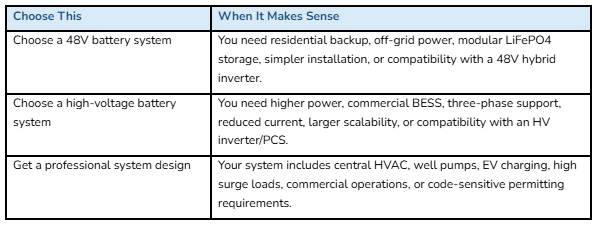
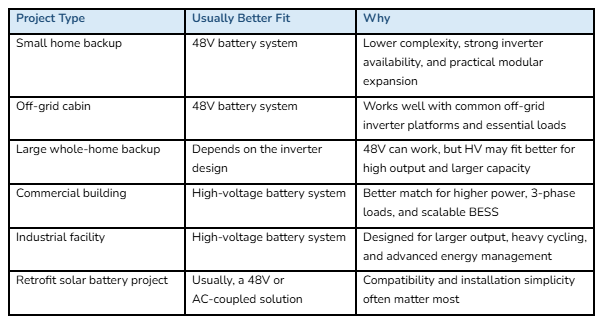
A good storage system starts with load analysis. List the equipment you need to power, calculate simultaneous demand, decide your backup duration, confirm inverter requirements, and then choose the battery architecture that supports those goals.
Final Thoughts
So, which is better: 48V or high voltage?
For most standard residential solar storage systems, a 48V LiFePO4 battery is often the better practical choice. It is modular, familiar, widely supported, and well-suited for home backup, off-grid power, and smaller solar installations.
For commercial energy storage, industrial backup, three-phase systems, large hybrid inverters, and high-output projects, a high-voltage battery system is often the stronger choice because it can deliver more power with lower current and better scalability.
The right battery is the one that matches your inverter, load profile, safety requirements, and long-term energy goals. Before choosing between 48V and high voltage, compare the complete system: battery bank, inverter, solar array, wiring, protection devices, BMS communication, and installation environment.
To build a properly matched solar storage system, explore LINIOTECH LiFePO4 battery and energy storage solutions and choose a voltage architecture that fits the real power demands of your home or business.
FAQs
Is 48V the same as 51.2V in LiFePO4 batteries?
Not exactly, but they are closely related in solar storage. Many LiFePO4 batteries described as 48V systems have a 51.2V nominal voltage because they use a 16-cell series configuration. They are still commonly used with 48V-compatible inverters.
Is a high-voltage battery more efficient than a 48V battery?
In larger systems, high voltage can improve efficiency by reducing current for the same power output. In smaller systems, the practical difference may be less important than cost, compatibility, and installation simplicity.
Can I connect a 48V battery to a high-voltage inverter?
No. A 48V battery should only be used with an inverter designed for a 48V battery bank. A high-voltage inverter requires a compatible high-voltage battery system.
Can I connect high-voltage batteries to a 48V inverter?
No. High-voltage batteries are not compatible with 48V inverters unless the manufacturer specifically provides an approved conversion or system architecture. Never guess on battery voltage compatibility.
Which battery type is better for home backup?
For many homes, a 48V LiFePO4 battery system is the more practical choice. Larger homes with high output requirements may benefit from a high-voltage battery system if the inverter and installation are designed for it.
Which battery type is better for commercial BESS?
High-voltage battery systems are usually better suited for commercial BESS because they support higher power, lower current, three-phase integration, and larger scalable capacity.
Is 48V safer than high voltage?
A 48V system is generally easier to handle from a voltage perspective, but it can still carry very high current. Both 48V and high-voltage systems require proper design, protection, and qualified installation.
Does high voltage mean more kWh?
No. Voltage and energy capacity are different. A battery system’s kWh depends on voltage and amp-hour capacity. High voltage does not automatically mean more stored energy.
Can a 48V battery system be expanded?
Yes, many 48V LiFePO4 systems are modular and can be expanded by adding compatible batteries in parallel, subject to manufacturer limits and proper system design.
Should I choose battery voltage based on price alone?
No. Price matters, but battery voltage should be chosen based on inverter compatibility, load demand, system size, safety requirements, installation complexity, and long-term scalability.