
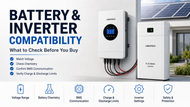
Battery and Inverter Compatibility: What to Check Before You Buy
Posted by LINIOTECH on Jul 22nd 2026
Battery and inverter compatibility is one of the most important parts of building a reliable solar storage, backup power, or off-grid energy system. A battery may have the right capacity, and an inverter may have the right output rating, but the system can still underperform if the two products are not designed to work together.
The biggest compatibility checks include battery voltage, chemistry, charge and discharge current, BMS communication, inverter settings, battery capacity limits, operating modes, safety protections, and expansion rules. In simple terms, the inverter must know how to charge, discharge, monitor, and protect the battery correctly.
For homeowners and installers comparing solar storage equipment, LINIOTECH offers hybrid inverter solutions and lithium battery options designed for residential, off-grid, and commercial energy applications.
Quick Answer: How Do You Know If a Battery and Inverter Are Compatible?
A battery and inverter are compatible when the battery voltage range, battery chemistry, charge profile, discharge power, communication protocol, inverter settings, and safety requirements all match the manufacturer's specifications. The easiest way to confirm compatibility is to check the inverter manual, approved battery list, battery datasheet, BMS communication protocol, and installation requirements before purchasing.
At a minimum, confirm these points:
- Battery voltage range matches the inverter input range.
- Battery chemistry is supported by the inverter charge profile.
- Battery discharge current can support the inverter output demand.
- Inverter charge current does not exceed the battery charging limit.
- CAN or RS485 communication is supported if the system uses closed-loop control.
- Firmware, cable pinout, and inverter battery profile are correct.
- The number of battery modules is allowed by the manufacturer.
- Protection devices, wiring, breakers, and certifications match the application.
Battery and Inverter Compatibility Checklist
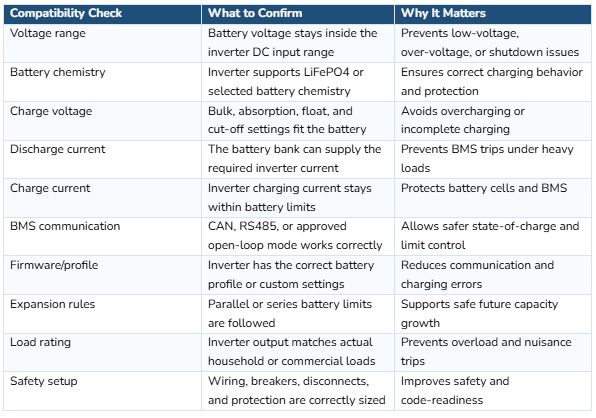
1. Match the Battery Voltage to the Inverter Voltage Range
Voltage is the first compatibility checkpoint. A 48V inverter is not automatically compatible with every battery that uses the word 48V in the product title. Many modern LiFePO4 batteries used in 48V system classes have a nominal voltage of 51.2V because they use a 16-cell series configuration.
That is normal in solar storage, but the inverter must still support the full battery operating range, not only the nominal number. For example, the battery may operate across a higher or lower voltage window during charging and discharging. The inverter should be able to charge, discharge, and protect the battery across that full voltage range.
For example, the LINIOTECH 10kWh 48V LiFePO4 battery brick is commonly used as a 48V 200Ah solar battery, while its nominal voltage is listed as 51.2V. That is exactly why system-class voltage and actual datasheet voltage should both be checked.
2. Confirm the Battery Chemistry and Charge Profile
Battery chemistry affects how the inverter should charge and protect the battery. A LiFePO4 battery has different voltage behavior and charging requirements than lead-acid, AGM, gel, or other lithium chemistries. If the inverter does not support the correct battery type, the system may charge incorrectly, reduce usable capacity, trigger battery protection, or shorten service life.
When checking chemistry compatibility, review the inverter settings for:
- Lithium or LiFePO4 battery mode
- Bulk and absorption voltage settings
- Float voltage behavior
- Low-voltage cut-off and restart voltage
- Maximum charge current
- Temperature-related charging restrictions
- Battery communication settings
A good inverter does not simply turn DC power into AC power. It also manages charging behavior in a way that matches the battery system.
3. Check Discharge Current Before Pairing a Large Inverter
This is where many buyers make a mistake. They see a battery with enough kWh capacity and assume it can run a large inverter. But energy capacity and discharge power are not the same thing.
A simple current estimate is:
DC = inverter power/battery voltage
For a 10kW inverter on a 51.2V battery system:
10,000W / 51.2V = about 195A before losses
After conversion losses and safety margin, the real battery-side current requirement can be higher. If one battery module cannot supply enough continuous discharge current, the BMS may shut down under heavy load. The solution is often to use more battery modules in parallel, reduce the load, or choose a battery system designed for higher discharge output.
4. Make Sure the Inverter Charge Current Fits the Battery
The inverter is not only drawing power from the battery. It may also charge the battery from solar, grid, or generator input. If the inverter charge current is too high for the battery, the battery BMS may reduce charging or disconnect to protect the cells.
Check both sides of the system:
- Maximum inverter battery charge current
- Maximum battery charging current per module
- Total charge current allowed when multiple batteries are paralleled
- Battery temperature charging limits
- Whether the charge current should be reduced for longer battery life
A powerful inverter should be configured around what the battery bank can safely accept, not simply set to maximum output.
5. Understand CAN, RS485, and Closed-Loop Communication
Modern LiFePO4 systems often use a BMS to monitor cell voltage, temperature, state of charge, charge limits, discharge limits, and protection status. In a closed-loop setup, the battery communicates with the inverter using a protocol such as CAN or RS485.
Closed-loop communication can help the inverter adjust charging and discharging behavior based on live battery data. But the presence of a CAN or RS485 port is not enough by itself. The inverter and battery must speak the same communication language, use the correct cable pinout, and support the correct profile or firmware.
This is also why compatibility between batteries and inverters should be checked at the profile level. LINIOTECH inverter products, such as the 15kVA Hybrid Inverter All-in-One System, list advanced integration features including battery support, RS485, and CAN interfaces.
6. Check Approved Battery Lists and Firmware Support
If the system uses closed-loop communication, the inverter brand may publish an approved battery list or compatibility chart. This matters because the same physical port may support different communication profiles depending on firmware, region, or inverter model.
Before ordering equipment, check:
- The exact inverter model number
- The exact battery model number
- The inverter firmware version
- The battery BMS firmware version
- The required communication cable or pinout
- The correct inverter battery profile setting
Whether the setup is approved for warranty coverage
For off-grid and backup systems, this step prevents a lot of frustration. A system can be electrically close to correct but still fail to communicate because the wrong profile, firmware, or cable was used.
7. Compare Battery Capacity With Real Runtime Needs
Compatibility is not only about whether the system turns on. It is also about whether the battery bank is large enough to support the inverter in real use.
For example, a 5kWh battery may technically connect to a 6kW inverter, but that does not mean it can run a heavy 6kW load for long. Likewise, a 10kW inverter paired with too little battery capacity may work for short bursts but feel disappointing during overnight backup or extended outages.
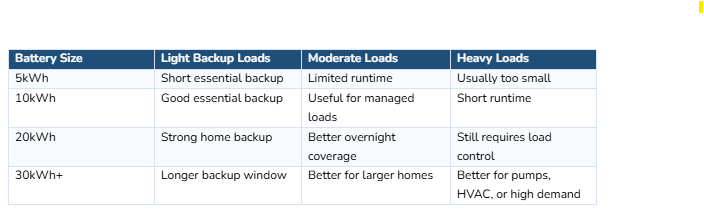
For scalable storage planning, review LINIOTECH rack LiFePO4 battery modules and compare module capacity, discharge rating, communication features, and expansion limits before designing the battery bank.
8. Confirm Parallel and Series Expansion Rules
Many battery systems are expandable, but expansion must follow the manufacturer's rules. Some batteries are designed to operate in parallel only. Others may support series operation or high-voltage stacking when used with specific equipment. Mixing batteries incorrectly can create an imbalance, communication issues, and safety risks.
Before expanding a battery bank, confirm:
- Maximum number of batteries in parallel
- Whether a series connection is allowed
- Whether all batteries must be the same model and capacity
- Whether the firmware must match across modules
- How the master and slave battery roles are assigned
- Whether the inverter can see the full battery bank correctly
For most residential low-voltage systems, parallel expansion is common because it increases energy capacity and available current while staying in the same voltage class. However, the rules are product-specific, so never assume.
9. Match the Inverter Output to the Actual Load Profile
A compatible battery bank must support the inverter, but the inverter must also support the loads. A system that is perfect for lighting, refrigeration, Wi-Fi, and laptops may not be enough for central air conditioning, well pumps, EV charging, large ovens, welders, or other high-surge equipment.
Review the inverter output specs for:
- Continuous AC output power
- Surge output and surge duration
- 120V, 240V, or split-phase output
- Single-phase or three-phase support
- Transfer time for backup applications
- Generator input support if needed
- Parallel inverter support for future expansion
For home projects, LINIOTECH residential energy storage solutions can be used as a starting point to think through backup loads, battery size, inverter power, and solar charging needs together.
10. Check Solar PV Input Limits Separately
Battery compatibility and solar-panel compatibility are related, but they are not the same. A hybrid inverter may support a certain battery voltage while also having separate PV input limits for solar strings.
For the PV side, check:
- Maximum PV input power
- Maximum PV voltage
- MPPT voltage range
- Maximum input current per MPPT
- Short-circuit current limits
- Number of strings per MPPT
Temperature-adjusted string voltage
A battery and inverter may be compatible, but the solar array can still be designed incorrectly if the PV string voltage or current falls outside the inverter input limits. Treat battery matching, inverter output sizing, and solar string design as three connected but separate calculations.
11. Choose the Right Operating Mode
Hybrid and off-grid inverters may support several operating modes. The correct choice depends on whether the system is used for backup power, daily solar self-consumption, off-grid living, time-of-use savings, generator support, or commercial peak management.
Common operating goals include:
- Backup mode for outage protection
- Self-consumption mode to use more solar energy onsite
- Battery priority mode for off-grid systems
- Time-of-use mode to charge and discharge around electricity rates
- Grid sell or export limiting where permitted
- Generator charging for remote or emergency use
A system that is compatible on paper should still be configured for the user’s actual goal. Otherwise, the battery may not charge or discharge when expected.
12. Do Not Ignore Safety, Protection, and Warranty Requirements
A battery-inverter pair should be selected with safety and warranty in mind. Even a technically compatible pair can be installed poorly if wiring, over-current protection, disconnects, grounding, spacing, ventilation, or local electrical rules are ignored.
Important safety checks include:
- Correct cable size for maximum current
- Proper DC breakers or fuses
- Battery disconnects and emergency access
- Surge protection and short-circuit protection
- Manufacturer-approved installation environment
- Installer qualification and local code compliance
- Warranty requirements for charging equipment and system design
For business-scale projects, LINIOTECH industrial and commercial energy storage solutions should be evaluated with professional system design, especially when three-phase loads, high energy capacity, or commercial demand management are involved.
Battery and Inverter Compatibility Example
Here is a simplified example. Suppose a buyer wants to pair a 10kW inverter with a 51.2V LiFePO4 battery bank.
The buyer should not only ask, “Is this a 48V battery?” They should ask:
- Does the inverter support the battery’s full voltage range?
- Can the battery bank deliver the current needed for a 10kW load?
- Does the inverter charge current stay within the battery limit?
- Does the battery BMS communicate with the inverter through CAN or RS485?
- Is there an approved battery profile in the inverter settings?
- How many battery modules are needed for both capacity and discharge power?
- Will the installation support future expansion?
This is why compatibility should be checked as a complete system, not as a single yes-or-no label.
Open-Loop vs Closed-Loop Battery Setup
Some systems can run in open-loop mode using manual voltage settings. In this setup, the inverter charges and discharges based on programmed voltage thresholds rather than live BMS communication. This can work for certain systems when configured carefully, but it requires accurate settings and conservative limits.
Closed-loop systems use communication between the BMS and inverter. The battery can share state-of-charge, voltage, temperature, warnings, and charge/discharge limits. This can improve system behavior, especially when multiple batteries are used or when the system is expected to operate automatically during backup events.
Neither option should be guessed. Use the battery manual, inverter manual, and manufacturer support before changing communication or voltage settings.
Common Battery and Inverter Compatibility Mistakes
- Choosing a battery only by kWh without checking the discharge current.
- Assuming every 48V battery works with every 48V inverter.
- Using the wrong CAN or RS485 cable pinout.
- Ignoring firmware and approved battery profiles.
- Using too few batteries for a high-power inverter.
- Mixing old and new battery models without manufacturer approval.
- Setting charge voltage too high for LiFePO4 chemistry.
- Overloading the inverter with HVAC, pumps, and heating loads at the same time.
- Expanding a battery bank beyond the allowed parallel limit.
- Forgetting that the warranty may require approved charging equipment.
Best Way to Build a Compatible Solar Storage System
The best approach is to design the battery, inverter, solar array, and loads together. Start with the load profile, then size the inverter output. After that, size the battery bank for both runtime and discharge power. Finally, design the solar array within the inverter’s PV input limits.
A practical order looks like this:
- List essential and heavy loads.
- Calculate peak simultaneous power demand.
- Choose inverter output capacity and voltage configuration.
- Choose battery chemistry and voltage class.
- Calculate the required battery capacity in kWh.
- Check battery discharge current against inverter output.
- Confirm communication protocol and approved profiles.
- Design solar strings within PV input limits.
- Add proper protection, wiring, breakers, and monitoring.
- Verify installation and warranty requirements before commissioning.
For complete product planning, explore LINIOTECH energy solutions and compare inverter, battery, solar, and storage options as one integrated system.
Final Thoughts
Battery and inverter compatibility is not just about matching a 48V label or buying a battery with enough kWh. A reliable system must match voltage range, chemistry, charge current, discharge current, BMS communication, inverter profiles, solar input limits, safety requirements, and the real load profile.
For residential backup, the biggest mistakes are usually undersized battery banks and overlooked communication settings. For off-grid and commercial systems, the bigger risks are high surge loads, current limitations, expansion mistakes, and incomplete system design.
Before buying, compare datasheets carefully and confirm the full compatibility path: battery to BMS, BMS to inverter, inverter to loads, inverter to solar array, and system to the user’s actual energy goal. When these pieces match, the result is safer, smoother, and far more reliable.
FAQs
How do I know if my inverter is compatible with my battery?
Check the inverter manual and battery datasheet for voltage range, chemistry support, charge settings, discharge current, communication protocol, approved battery profiles, and installation requirements.
Can I use a 51.2V LiFePO4 battery with a 48V inverter?
Often yes, because many 51.2V LiFePO4 batteries are designed for 48V system classes. However, the inverter must support the battery’s full voltage range and charging requirements.
What happens if the battery and inverter are not compatible?
The system may fail to communicate, charge incorrectly, reduce output, trigger BMS protection, shut down under load, or create warranty and safety problems.
Do all lithium batteries work with hybrid inverters?
No. The inverter must support the battery chemistry, voltage range, charging limits, and communication method. Always check manufacturer documentation.
Is CAN better than RS485 for battery communication?
Neither is automatically better in every system. The right choice is the protocol supported by both the battery BMS and the inverter profile.
Can an inverter work without BMS communication?
Some systems can operate in open-loop mode using voltage settings, but this depends on the battery and inverter. Closed-loop communication is often preferred when supported.
Can one battery run a large inverter?
Only if the battery can supply enough continuous discharge current and surge demand. For large inverters, multiple batteries in parallel are often needed.
Can I mix different battery brands with one inverter?
Only if the inverter and batteries are approved for that setup. Mixing different battery brands or models can cause imbalance, communication problems, and warranty issues.
Does battery capacity affect inverter compatibility?
Yes. Capacity affects runtime, but battery current output also affects whether the bank can support the inverter’s power demand.
What should I check before buying a battery for solar storage?
Check voltage, chemistry, kWh capacity, max charge current, max discharge current, BMS communication, cycle life, expansion rules, certifications, warranty, and inverter compatibility.