

Best Home Solar Battery Systems for Texas Homeowners: Beat Outages and High Bills
Posted by Liniotech on Jun 10th 2026
Texas homeowners know better than most what it feels like when the grid fails. Whether it's a February freeze, a summer heat wave that pushes ERCOT to the edge, or a Gulf Coast hurricane knocking out power for days, the question of energy independence hits differently here than in most other states.
A home solar battery system isn't just a backup plan in Texas. For a growing number of homeowners across Houston, Dallas, San Antonio, Austin, and beyond, it's become a core part of how they manage energy costs and protect their families.
Here's what you need to know to make the right choice for your home.
Why Texas Is Different From Every Other State (For Energy)
Texas operates on its own power grid, ERCOT (Electric Reliability Council of Texas), which is not interconnected with the rest of the US national grid. That isolation has advantages, but it also means that when ERCOT struggles, there's no external grid to pull from.
The events of Winter Storm Uri in February 2021 made that reality painfully clear. Millions of Texas homes lost power for days in below-freezing temperatures. Many had no heat, no water (frozen pipes), and no way to charge devices or refrigerate medication.
Since then, grid investments have improved, but ERCOT's reliability remains a real concern, particularly during:
- Summer heat waves that push statewide demand to record highs
- Severe winter storms that stress both generation and delivery infrastructure
- Hurricane season for coastal communities (Houston, Corpus Christi, Galveston area)
- High wind events that damage transmission lines across West Texas and the Panhandle
A solar battery system for your Texas home is direct protection against all of these scenarios.
The Texas Electricity Market Adds Another Layer
Texas also has a deregulated electricity market, which means you can choose your retail electricity provider and your rate plan. That's actually an advantage for battery storage owners.
Many Texas electricity plans now offer Time-of-Use (TOU) pricing, where rates vary by time of day. Peak hours (typically 3 PM–8 PM in summer) can be 2–3x more expensive than off-peak hours.
With a solar battery system:
- You generate and store solar energy during the day
- You discharge your battery during expensive peak hours instead of drawing from the grid
- You avoid the highest-rate periods entirely
Over a Texas summer, this alone can meaningfully reduce your monthly electricity bill even without a major outage ever occurring. The battery pays for itself through daily optimization, not just emergency backup.
What to Look for in a Solar Battery System for a Texas Home
Texas has specific demands that should shape your system design. Here's what matters most:
Heat Tolerance
Texas summers are brutal and battery storage systems need to operate reliably in high-ambient-temperature environments. LiFePO4 (Lithium Iron Phosphate) batteries handle heat significantly better than older NMC lithium chemistries. They have superior thermal stability, a lower risk of thermal runaway, and maintain consistent performance across a wider temperature range.
For Texas installations, LiFePO4 is the only chemistry worth considering for outdoor or garage-mounted systems.
Capacity for AC Loads
Air conditioning is the dominant energy consumer in Texas homes. A solar battery system sized without accounting for AC load will fall short during an outage exactly when you need it most.
For meaningful whole-home backup in Texas, plan for at minimum 20 kWh of usable capacity. Homes with larger square footage, multiple HVAC zones, or pool equipment should plan for 30 kWh or more.
Hybrid Inverter Compatibility
Your battery is only as good as the inverter managing it. A hybrid inverter handles solar production, battery charging, home loads, and grid interaction in one unit. For Texas homes where the goal is both outage protection and bill management, a well-matched hybrid inverter is essential.
Prioritize inverters with fast transfer times (under 20ms) so the transition to battery power during an outage is seamless for sensitive electronics.
Scalability
Given Texas weather unpredictability, many homeowners start with a core system and expand later. Choose a battery platform that supports adding modules so your system can grow with your needs without replacing the inverter or starting over.
How Much Solar Battery Storage Do Texas Homes Typically Need?
Here's a practical sizing guide based on common Texas home profiles:
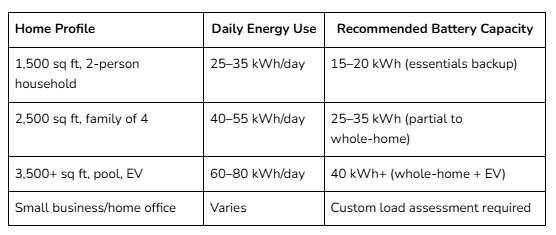
These figures assume central AC as the primary high-draw appliance. Actual sizing should always be based on your last 12 months of utility bills plus a peak-load calculation.
Texas Incentives for Solar Battery Storage
The financial case for solar battery storage in Texas is strong, and several incentive programs make it even more compelling.
Federal Investment Tax Credit (ITC): The federal ITC currently offers a 30% tax credit on the total cost of a solar + battery system. This applies to the full installed cost, including equipment and labor. If your battery is installed alongside solar (or the battery is charged primarily by solar), it qualifies.
Utility Rebates: Some Texas utilities offer battery storage rebates. CPS Energy (San Antonio) has offered rebate programs for qualifying storage installations. Check with your specific utility provider for current availability.
Property Tax Exemption: Texas offers a property tax exemption for the added value that a solar energy system adds to your home. Your property taxes won't increase because you installed solar and battery storage, a meaningful benefit given Texas property tax rates.
No State Income Tax: While not a direct solar incentive, Texas has no state income tax, which means the full value of the federal tax credit goes further here than in states where income tax applies to rebates or credits.
Texas Cities Where Battery Storage Makes the Most Sense
While solar battery storage is a smart investment statewide, certain Texas markets have particularly strong cases:
Houston / Gulf Coast: Hurricane risk, high summer demand, and frequent severe weather make Houston one of the strongest markets for residential battery storage in the country. Extended outages after major storms are common enough that "when" is a more relevant question than "if."
Dallas / Fort Worth: Severe ice storms (Uri hit DFW hard) and extreme summer heat both stress the grid. DFW homeowners who experienced 2021 are driving strong adoption of battery storage as a direct response.
San Antonio: CPS Energy territory with active utility battery programs. San Antonio's hot summers and growing population put consistent demand pressure on the grid.
Austin: Austin Energy territory. Strong environmental awareness and a high solar adoption rate make Austin a natural fit for adding storage to existing solar systems. Many Austin homeowners already have panels battery is the logical next step.
West Texas / Rural Areas: Long distances from grid infrastructure mean outages can last longer and be harder to restore. Off-grid and grid-edge battery systems are particularly valuable here.
Real Questions Texas Homeowners Ask Before Buying
Will my battery keep my AC running during an outage?
It depends on system size. A 10 kWh battery running a 3-ton central AC (roughly 3,000–3,500W) will last 3–4 hours on AC alone. A 30 kWh system paired with solar panels can run AC indefinitely in good weather. Sizing for AC is the most important variable in Texas.
How does it work if I already have solar panels?
Adding battery storage to an existing solar system is straightforward, though it may require upgrading your inverter to a hybrid model if you currently have a standard string inverter. Contact our team for a compatibility assessment.
How long does installation take?
A standard residential solar + battery installation typically takes 1–3 days depending on system complexity, permitting, and utility interconnection requirements. Texas permitting timelines vary by municipality.
What happens to my battery during a power outage in summer heat?
LiFePO4 batteries are rated to operate safely in ambient temperatures up to 45–55°C (113–131°F). For outdoor or garage installations in Texas, proper ventilation and shade placement are important; your installer should address this during system design.
Why Liniotech for Texas Homeowners
Liniotech supplies and installs residential and commercial energy storage systems across Texas, with projects completed in the Dallas, Houston, San Antonio, and Austin metro areas.
Our systems are built around LiFePO4 battery technology paired with compatible hybrid inverters designed specifically for the heat tolerance, capacity demands, and grid conditions that Texas homeowners face.
Whether you're starting from scratch or adding storage to an existing solar system, explore our residential energy storage systems or request a quote to get a system recommendation based on your home's actual energy profile and location.
The Bottom Line
Texas is one of the best states in the country to invest in home solar battery storage and one of the places where it matters most. Between ERCOT's isolation, extreme weather patterns, deregulated electricity pricing, and strong federal incentives, the financial and practical case is hard to argue against.
The right system, properly sized for Texas conditions, will keep your home powered through outages, cut your peak-hour electricity costs every month, and give you the kind of energy independence that the Texas grid simply can't promise on its own.