
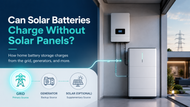
Can Solar Batteries Charge Without Solar Panels? Explained
Posted by LINIOTECH on Jun 8th 2026
One of the most common misconceptions about home battery storage is that you need solar panels to use it. You don't.
Solar batteries, more accurately called home energy storage systems, can charge from multiple sources. Solar panels are the most popular and cost-effective charging method, but they're not the only one. If you don't have panels yet, or you're not ready to install them, a battery system can still deliver real value from day one.
Here's a complete breakdown of how solar batteries charge, what your options are without panels, and how to decide which setup makes the most sense for your home.
First: What "Solar Battery" Actually Means
The term "solar battery" is a bit of a misnomer that stuck because most home battery systems are marketed alongside solar panels. In reality, a home battery storage system is simply a large rechargeable battery bank, typically using LiFePO4 chemistry, connected to an inverter that manages how power flows in and out.
The battery itself doesn't care where the electricity comes from. It stores DC energy and delivers it when needed. What determines the charging source is the inverter and how the system is configured, not the battery itself.
So when people ask, "Can a solar battery charge without solar panels?" the more precise answer is: the battery absolutely can, and the method depends on your inverter setup and energy goals.
How Solar Batteries Charge: All the Methods
1. Solar Panels (The Most Common Method)
Solar panels generate DC electricity during daylight hours. A hybrid inverter converts this to usable power for your home and simultaneously directs excess production into the battery bank for storage.
This is the most efficient charging method because you're generating your own electricity, often at near-zero marginal cost once the system is paid off. It's also the method that enables true energy independence, since you're not dependent on the grid for your stored energy.
Best for: Homeowners who want maximum bill savings, energy independence, and backup power that can sustain itself during extended outages.
2. Grid Charging (AC Charging)
A hybrid inverter can charge your battery directly from the utility grid, no solar panels required. You program the inverter to charge the battery during specific time windows, typically overnight or during off-peak hours when electricity rates are lowest.
During peak hours (when rates are high), the inverter discharges the battery to power your home instead of drawing from the expensive grid supply.
This is called time-of-use (TOU) arbitrage, and in markets with significant rate differences between peak and off-peak periods, it's a legitimate strategy for reducing electricity bills even without a single solar panel on your roof.
How it works in practice:
- Off-peak hours (e.g., 10 PM–6 AM): battery charges from the grid at low rates
- Peak hours (e.g., 3 PM–8 PM): battery discharges to power your home, avoiding high grid rates
- During an outage, the battery powers your home regardless of the grid status
Best for: Homeowners in deregulated electricity markets (like Texas) with TOU rate plans, renters who can't install solar, or homeowners who want battery backup now and plan to add solar later.
3. Generator Charging
Some hybrid inverters support charging from a generator input. This is particularly relevant in areas with extended power outages where solar production may be limited (overcast weather, storm conditions) and you need a way to top up the battery.
A generator charges the battery via AC input the inverter handles the conversion and regulates the charge rate. This isn't a primary charging strategy for most homeowners, but it's a valuable backup-to-backup layer for households that already own a generator and want to extend its utility.
Important: Not all hybrid inverters support generator input charging. Confirm this capability before purchasing if it's a priority for your setup.
Best for: Rural homes, off-grid setups, or coastal homeowners in hurricane-prone areas where extended outages are a real risk.
4. Wind Turbine (Less Common)
Small residential wind turbines can charge a battery bank in the same way solar panels do; the turbine generates DC power that the inverter routes into storage. This is far less common in residential applications than solar, but it's technically viable and used in some rural or off-grid installations where wind resources are stronger than solar.
For most suburban and urban homeowners, solar panels remain the practical choice. But it's worth knowing that the battery system itself isn't limited to solar as a renewable input.
Best for: Rural or off-grid properties with strong wind resources and limited rooftop solar potential.
5. AC-Coupled Systems (Existing Solar + Separate Battery Inverter)
If you already have a solar system with a standard string inverter and you want to add battery storage, an AC-coupled configuration is one approach. In this setup, a separate battery inverter is added to the system. The existing string inverter continues to handle solar conversion, and the battery inverter manages charging and discharging the battery bank.
The battery charges from the AC output of the existing solar system, hence "AC-coupled." It can also charge from the grid.
This works, but it's less efficient than a DC-coupled hybrid inverter setup, because the energy goes through two conversion steps (DC→AC from the solar inverter, then AC→DC into the battery). Each conversion step involves some energy loss, typically 3–5% per step.
Best for: Homeowners with an existing solar investment who want to add storage without replacing their current inverter.
Grid-Only Battery Storage: Does It Actually Make Financial Sense?
This is the question most homeowners have when they realize they don't need solar panels to use a battery system.
The honest answer: it depends on your electricity market and rate structure.
In states with significant TOU rate differentials, grid-only battery storage can generate meaningful savings. Texas is a prime example with deregulated electricity; some rate plans have off-peak rates of $0.06–0.09/kWh and peak rates of $0.18–0.35/kWh during summer afternoons. A battery system that arbitrages and spreads over hundreds of cycles per year adds up.
In states with flat electricity rates (same price all day regardless of time), the financial case for grid-only charging is much weaker because there's no rate differential to exploit. In those markets, pairing with solar is what makes the economics work.
Grid-only battery storage makes financial sense when:
- Your electricity plan has significant peak vs. off-peak rate differences
- You frequently experience outages and value backup power independent of bill savings
- You're planning to add solar in 1–2 years and want battery infrastructure in place now
Grid-only battery storage is harder to justify when:
- Your electricity rates are flat throughout the day
- Your outages are rare and short
- You're not planning to add solar in the foreseeable future
The Hybrid Path: Start Grid-Only, Add Solar Later
One underutilized strategy is installing a hybrid inverter and battery system now, charging from the grid with the explicit plan to add solar panels later.
This approach has a few advantages:
Lower upfront cost. Solar panels represent a significant portion of the total system cost. Installing battery storage first lets you spread the investment over time.
Immediate backup protection. You get outage protection from day one, even before the panels go on the roof.
Correct infrastructure from the start. A hybrid inverter installed for grid charging is the same inverter you'll use when you add solar. You're not duplicating equipment or paying for a separate battery inverter later.
Flexibility to optimize. Living with a grid-charged battery for 6–12 months gives you real data on your energy usage patterns before you size a solar array, which leads to a better-designed solar system when you're ready.
This is the approach Liniotech often recommends for homeowners who want to move toward energy independence in stages rather than all at once.
What Equipment Do You Need for a Battery-Only (No Solar) Setup?
For a grid-charged battery system without solar panels, the core components are:
- LiFePO4 Battery Bank: The storage component. Size based on how many hours of backup you want and which loads you need to cover. For basic outage protection (lights, fridge, WiFi, phone charging), 10–15 kWh is a reasonable starting point. For whole-home coverage, 20–30 kWh+.
- Hybrid Inverter: Even without solar panels connected, a hybrid inverter is the right choice for a battery-only setup because it's already configured to add solar later when you're ready. It manages grid charging, battery discharging, and outage switchover in one unit.
- Electrical Panel Integration: Depending on your backup goals, your installer may configure the system to back up your entire home (whole-home backup) or specific critical circuits (partial backup). Whole-home backup requires a transfer switch or automatic transfer switch (ATS) integrated with your main panel.
- Battery Management System (BMS): Built into quality LiFePO4 battery systems, the BMS monitors cell voltage, temperature, and state-of-charge, protecting the battery from overcharging, over-discharging, and thermal events. Always confirm BMS is included; it's non-negotiable for safe, long-life operation.
LiFePO4 vs. Other Battery Chemistries for Grid Charging
When you're charging primarily from the grid (daily cycling), battery chemistry and cycle life matter more than in a solar-primary system where the battery might only cycle a few hundred times per year.
Grid-charged batteries that support TOU arbitrage can cycle once or more per day, meaning 300–365 cycles per year. Over a 10-year system life, that's 3,000–3,650 cycles.
LiFePO4 batteries are rated for 6,000–8,500 cycles at 80% depth of discharge. That comfortably covers daily cycling for 15+ years with minimal capacity degradation.
Older lead-acid batteries are rated for 500–1,000 cycles; they'd be worn out in 2–3 years of daily grid cycling. Not viable.
NMC lithium batteries offer higher energy density but lower cycle counts (1,500–3,000 cycles) and higher thermal sensitivity, a concern for high-ambient-temperature environments like Texas garages.
For any application involving frequent grid cycling, LiFePO4 is the right chemistry. Full stop.
Frequently Asked Questions
Can I charge a solar battery with a regular wall outlet?
Not directly, home battery systems operate at much higher voltages and require proper inverter integration with your electrical panel. This isn't a plug-in device; it's a permanent installation managed by a licensed electrician and certified installer.
Will a grid-charged battery work during a power outage?
Yes, provided the system is configured for backup operation. A hybrid inverter with backup mode will automatically isolate your home from the grid during an outage and power your home from the battery. The stored energy is available regardless of how it got into the battery (solar or grid).
Does charging from the grid eliminate the environmental benefit?
Partially, if your grid runs on fossil fuels, grid-charged storage has a smaller environmental benefit than solar-charged storage. However, as the US grid gets cleaner (more renewable generation), grid-charged batteries become progressively greener over time. And if you're on a renewable energy plan through your utility, grid charging can still be largely clean.
Can I add solar panels to a grid-charged system later?
Yes, this is one of the main reasons to start with a hybrid inverter even if you're not ready for solar. When you're ready to add panels, the inverter is already in place. Your installer simply connects the solar array to the existing system.
The Bottom Line
Solar batteries don't need solar panels to function. They can charge from the grid, from a generator, from wind, or from solar, and a well-configured hybrid inverter manages all of these sources intelligently.
Whether you start with solar and storage together, add batteries to existing solar, or go battery-first with grid charging and add panels later, the battery technology is the same. What changes is the charging source and the financial case for each configuration.
If you're ready to explore what a home battery system looks like for your specific situation with or without solar panels, browse Liniotech residential energy storage systems, explore our LiFePO4 battery options and hybrid inverter lineup, or contact our team for a configuration recommendation based on your home's energy goals.