
Can You Run an Entire House on Battery Power? Everything Homeowners Should Know
Posted by LINIOTECH on Jun 5th 2026
It's one of the most common questions homeowners ask when they start looking into solar and battery storage: Can I actually run my entire house on battery power?
The short answer is yes, but with some important context. The real question isn't whether it's possible. It's whether your system is sized correctly for your home's actual energy needs. Get that right, and a whole-house battery backup can power everything from your lights and refrigerator to your HVAC and EV charger.
Here's what you need to know before making any decisions.
Yes, Batteries Can Power a Whole House. Here's the Honest Version
Modern home battery storage systems, particularly those using LiFePO4 (Lithium Iron Phosphate) chemistry, are capable of powering an entire household. But "running your house" means different things depending on:
- How much energy does your home consume daily
- Which appliances do you need to power during an outage
- Whether you're pairing the battery with solar panels
- How long do you need backup power to last
A well-designed whole-home battery system paired with solar can theoretically power your house indefinitely as long as the sun keeps recharging it. Without solar, you're working with whatever stored capacity you have, which makes sizing the system correctly even more critical.
How Much Battery Capacity Does a Whole House Actually Need?
This is where most homeowners get lost. Let's break it down simply.
The average American home uses around 30 kWh of electricity per day. That number varies significantly based on climate, home size, and lifestyle. A 2,000 sq ft Texas home running central AC in July will use far more than a 1,200 sq ft home in a mild climate.
Here's a rough capacity guide:
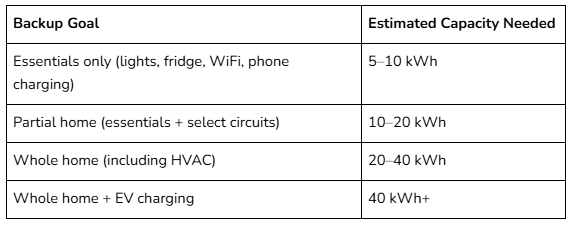
These are starting points, not hard rules. Your actual number depends on a proper load assessment, which any reputable installer should walk you through before recommending a system.
The Role of Your Inverter
Your battery doesn't work alone. A hybrid inverter is the brain of the system it manages the flow of power between your solar panels, battery bank, and home circuits. Without the right inverter, even a large battery bank won't perform efficiently.
For whole-home coverage, you need a hybrid inverter that:
- Matches or exceeds your home's peak power demand (measured in watts or kilowatts)
- Supports the battery chemistry and voltage of your chosen battery bank
- Handles seamless switchover during a grid outage, ideally in milliseconds, so sensitive electronics don't notice
Pairing a high-capacity LiFePO4 battery system with a compatible hybrid inverter is the setup that makes whole-home battery backup genuinely reliable. Mismatched components are one of the most common reasons homeowners end up disappointed with their system.
Off-Grid vs. Grid-Tied with Backup: What's the Difference?
A lot of homeowners confuse these two configurations. Here's the practical distinction:
Grid-tied with battery backup: Your home stays connected to the utility grid. The battery charges from solar or the grid and kicks in automatically during an outage. When the battery is full and solar is producing, excess power can be exported back to the grid. This is the most common setup for homeowners who want backup power and bill savings without going fully off-grid.
Off-grid: Your home is completely disconnected from the utility grid. You rely entirely on solar production and battery storage. This requires a significantly larger system, more panels, more battery capacity, and careful energy management. It's most common in rural areas where grid connection isn't practical or cost-effective.
For most suburban and urban homeowners, grid-tied with battery backup delivers the best combination of reliability, cost, and flexibility.
What Appliances Draw the Most Power?
Understanding your biggest energy consumers helps you size the system correctly and make informed decisions about what you want covered during an outage.
High-draw appliances to plan for:
- Central HVAC: 3,000–5,000W while running
- Electric water heater: 4,000–5,500W
- Electric dryer: 5,000–7,500W
- EV charger (Level 2): 7,200W+
- Refrigerator: 100–400W (runs intermittently)
- Lighting (LED throughout): 200–500W total
The key insight here: HVAC is the make-or-break appliance for whole-home battery coverage. If you're in Texas or another hot-climate state, your AC alone can consume 30–50% of your daily energy use. Any whole home battery system in a hot climate needs to account for this.
How Long Will a Whole Home Battery System Last During an Outage?
Duration depends on two variables: how much capacity you have stored and how much power you're drawing.
A practical example:
- System: 20 kWh battery bank
- Usage: Running essentials (fridge, lights, WiFi, a few outlets) at roughly 500W average draw
- Runtime: ~40 hours (nearly two full days)
Add central AC cycling on and off, and that same 20 kWh might last 8–12 hours.
This is why pairing battery storage with solar panels changes everything. During daylight hours, your panels are continuously recharging the battery, turning a finite backup supply into a potentially indefinite one, as long as the sun is shining.
Solar + Battery vs. Battery Alone
You can install a home battery storage system without solar panels, and there are valid reasons to do so, especially if you're primarily interested in time-of-use optimization or outage protection. The battery charges from the grid during off-peak hours and discharges when you need it.
However, combining solar with battery storage is where the real long-term value is:
- Solar keeps the battery topped up during the day
- Excess solar production charges the battery instead of being wasted
- During extended outages, solar + battery provides indefinite coverage in good weather
- The system pays for itself faster through both reduced utility bills and energy independence
If you have solar panels already and no storage, you're leaving a significant portion of your investment's potential untapped.
Is a Whole House Battery Backup Worth It?
For most homeowners asking this question, the answer comes down to a few factors:
It's worth it if:
- You experience regular outages (once a month or more)
- You live in a severe weather zone (Texas, Florida, tornado-prone states)
- You have solar and want to maximize your investment
- You work from home or have medical equipment that requires power
- You're planning to add an EV and want to manage charging costs
You might start smaller if:
- Your outages are rare and short
- Your budget is limited, and starting with essential circuit coverage is a smart first step
- You're renting or plan to move within a few years
The good news is that battery storage is modular. You can start with a system that covers your essentials and expand capacity later as your needs or budget grow.
Getting the Sizing Right: Don't Skip This Step
The single biggest mistake homeowners make is buying a battery system without a proper load assessment. The right system for your neighbor's home isn't necessarily right for yours.
A proper sizing process looks at:
- Your last 12 months of utility bills (kWh usage per month)
- Your peak demand moments (what's running simultaneously)
- Your backup goals (essentials only vs. whole-home coverage)
- Your solar production capacity if panels are involved
Liniotech team can walk you through this process. Explore our whole-home energy storage systems and hybrid inverter options, or contact us directly to get a system recommendation based on your home's actual energy profile.
The Bottom Line
Can you run an entire house on battery power? Yes, with the right system, properly sized, and ideally paired with solar. The technology is mature, the products are reliable, and for millions of homeowners, whole-home battery backup has moved from a futuristic idea to a practical reality.
The question isn't really if it's possible. It's whether your system is built to match your home's real energy demands. Get that right, and you'll wonder how you ever felt comfortable without it.