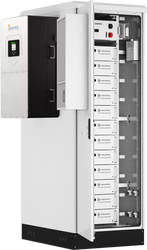
How Sol-Ark Commercial Hybrid Inverters and Liniotech C&I Energy Storage Solutions Are Solving Energy Challenges Across Critical Industries
Posted by Liniotech Energy on Jun 5th 2026
Commercial buildings need power every hour of the day. Restaurants need refrigeration. Hotels need HVAC and guest comfort. Gas stations need pumps and POS systems. Farms need irrigation and cold storage. Manufacturers need stable power to keep production moving.
However, many businesses now face the same problems: rising electricity costs, high demand charges, grid instability, outage risk, and pressure to use more renewable energy. Because of this, more commercial and industrial facilities are investing in commercial battery energy storage systems, also called C&I energy storage systems or commercial BESS.
A commercial battery storage system helps a business store energy, reduce grid demand, support backup power, and use solar energy more efficiently. When paired with the right hybrid inverter, it becomes a smarter energy platform that can manage solar panels, batteries, utility power, generators, and building loads.
At LINIOTECH, we provide commercial energy storage products, solar batteries, Sol-Ark hybrid inverter solutions, and scalable C&I battery systems for businesses that need stronger energy control and long-term reliability.
What Is a Commercial Battery Energy Storage System?
A commercial battery energy storage system is a power system that stores electricity in batteries and releases it when the business needs it most. It can charge from solar panels, the grid, or other approved power sources. Then, it can discharge stored energy during outages, high-cost utility periods, or demand spikes.
A C&I battery storage system usually includes:
- Battery modules or battery cabinets
- Hybrid inverter or power conversion system
- Energy management controls
- Monitoring software
- Safety protection equipment
- Grid and load connection equipment
- Optional solar PV and generator integration
Unlike small residential batteries, commercial storage systems are designed for higher power, larger capacity, longer runtime, and more complex energy needs.
Why Businesses Are Investing in Commercial BESS
Commercial battery storage is not only about backup power. It can support several business goals at the same time.
1. Lower Demand Charges
Many commercial electricity bills include demand charges. These charges are based on the highest power demand reached during a billing period, not just total energy used.
For example, a business may only hit a high peak for a short time, but that spike can increase the monthly bill. A commercial BESS can discharge during those peak moments and reduce how much power the facility pulls from the grid.
This is called peak shaving.
2. Better Backup Power During Outages
Outages can stop operations fast. A restaurant can lose food inventory. A hotel can lose guest comfort. A gas station can lose fuel sales. A manufacturer can lose production time.
A battery energy storage system can help keep critical loads running during grid outages. When paired with solar and a generator, it can also extend backup time and reduce fuel use.
3. More Solar Self-Consumption
Many businesses install solar panels but do not use all the solar energy during production hours. Without storage, extra solar may export to the grid at a lower value.
With battery storage, the business can store excess solar energy and use it later. This improves solar self-consumption and can increase the value of the solar investment.
4. Energy Cost Control
Commercial energy rates can change by time of day, season, and demand level. A battery system gives the business more control. It can charge when energy is cheaper and discharge when energy is expensive.
This helps the business reduce exposure to high utility rates.
5. Energy Resilience and Business Continuity
For critical industries, power is not optional. Healthcare, cold storage, agriculture, hotels, gas stations, data centers, and manufacturing facilities need reliable electricity to operate safely.
Commercial battery storage helps protect revenue, inventory, equipment, customers, and operations.
How Sol-Ark Commercial Hybrid Inverters Support C&I Energy Storage
A commercial battery system needs the right inverter to work properly. The inverter manages power flow between solar panels, batteries, the utility grid, the generator, and building loads.
Sol-Ark commercial hybrid inverters are designed for commercial solar-plus-storage applications. They support grid-tied operation, backup power, solar integration, battery charging, generator support, and energy management.
LINIOTECH offers Sol-Ark inverter options for businesses that need scalable commercial energy storage systems.
Sol-Ark 30K-3P-208V: Best for Light Commercial Energy Storage
The Sol-Ark 30K-3P-208V commercial hybrid inverter is designed for small and mid-size commercial projects. It is a strong fit for buildings with 120/208V three-phase service and moderate energy storage needs.
It can support businesses that want to reduce demand charges, add battery backup, integrate solar, and improve energy resilience.
Best Applications for Sol-Ark 30K
The Sol-Ark 30K is a good fit for:
- Restaurants
- Pharmacies
- Small hotels
- Convenience stores
- Small offices
- Retail buildings
- Farms
- Light commercial facilities
- Small warehouses
- Medical clinics
Key Benefits
- 30kW commercial hybrid inverter output
- Native 120/208V three-phase support
- AC and DC coupling support
- Solar and battery integration
- Generator compatibility
- Peak shaving capability
- Grid-tied and off-grid operation
- Scalable system design
- Useful for light commercial backup power
For businesses comparing Sol-Ark options, explore LINIOTECH Sol-Ark hybrid inverter collection.
Sol-Ark 60K-3P-480V: Best for Larger C&I Energy Storage
The Sol-Ark 60K-3P-480V commercial hybrid inverter is designed for larger commercial and industrial energy systems. It supports native 277/480V three-phase output and works well for facilities with higher load demand.
This inverter is useful for businesses that need stronger power capacity, larger solar integration, and scalable battery storage.
Best Applications for Sol-Ark 60K
The Sol-Ark 60K is a strong fit for:
- Manufacturing facilities
- Large hotels
- Warehouses
- Cold storage facilities
- Agricultural operations
- Industrial buildings
- Data centers
- Large retail sites
- Commercial microgrids
- Facilities with 480V three-phase service
Key Benefits
- 60kW three-phase hybrid inverter output
- Native 277/480V commercial service support
- AC and DC coupling capability
- Battery and solar integration
- Generator support
- Scalable commercial power design
- Peak shaving and load shifting support
- Remote monitoring and energy management
- Useful for large C&I battery storage projects
For larger business systems, the Sol-Ark 60K-3P-480V all-in-one hybrid inverter is a strong product match for commercial and industrial solar storage applications.
LINIOTECH C&I Energy Storage Solutions
LINIOTECH provides commercial battery storage solutions for businesses that need safe, scalable, and practical energy storage. These systems can support backup power, peak shaving, solar energy storage, load shifting, and energy resilience.
C&I battery storage can be designed in different sizes based on the building load, backup runtime, available solar capacity, and business goals.
Common Commercial Battery Storage Sizes
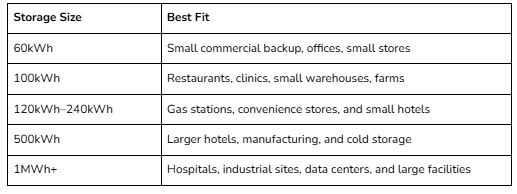
Businesses can start with a smaller battery system and expand later if the system design allows it.
For ready commercial storage options, visit the Industrial & Commercial Energy Storage System collection.
60kWh Commercial Battery Storage with Sol-Ark 60K
A 60kWh commercial energy storage system is a practical starting point for many businesses. It can support backup power, demand charge reduction, solar storage, and energy management.
LINIOTECH offers a commercial high-voltage 60kWh battery storage system with Sol-Ark 60K for businesses that want an integrated commercial solar battery solution.
This type of system is useful for businesses that need:
- Backup power for critical loads
- Solar energy storage
- Demand charge reduction
- Outdoor cabinet installation
- High-voltage battery performance
- 480V commercial energy storage support
- Scalable C&I power design
61.44kWh High-Voltage Battery for Sol-Ark 60K Systems
High-voltage battery storage can improve efficiency in larger commercial systems because it reduces current and supports better power handling. For Sol-Ark 60K projects, a high-voltage battery can be a strong match.
The LINIOTECH 61.44kWh high-voltage battery is designed for commercial solar and industrial energy storage applications. It is built for use with Sol-Ark 60K-3P-480V systems and supports larger C&I energy projects.
This makes it a good option for businesses that need commercial-grade storage with safer architecture, better scalability, and strong inverter compatibility.
How Commercial Battery Storage Reduces Demand Charges
Demand charges can be one of the most painful parts of a commercial utility bill. A business may pay a large charge based on the highest 15-minute or 30-minute demand peak during the billing cycle.
A battery storage system helps by watching the building load. When demand starts to rise above a target level, the battery discharges power. This reduces the amount of power pulled from the grid.
This process is called peak shaving.
Simple Peak Shaving Example
A facility normally peaks at 500kW during busy hours.
With a battery energy storage system, the battery discharges 100kW during the peak period.
Now the utility meter may only see 400kW instead of 500kW.
That lower peak can reduce demand charges and help control monthly energy costs.
Businesses That Benefit from Peak Shaving
Peak shaving is especially useful for:
- Facilities with high demand charges
- Buildings with short power spikes
- Restaurants with kitchen equipment peaks
- Hotels with HVAC peaks
- Cold storage with compressor loads
- Manufacturers with machine startup loads
- Warehouses with EV charging or refrigeration
- Farms with irrigation pumps
- Gas stations with pumps and refrigeration
Industry Applications for Commercial Energy Storage
Different industries have different energy challenges. A good C&I battery system should be designed around the actual loads, outage risks, operating hours, and utility tariff.
Hospital and Healthcare Backup Power
Hospitals, clinics, and healthcare facilities need reliable power for patient care, refrigeration, communication, lighting, and critical equipment.
Commercial battery storage can help support:
- Medical equipment
- Emergency lighting
- Pharmacy refrigeration
- Lab equipment
- IT systems
- Critical circuits
- Backup power coordination
A commercial BESS can also reduce generator runtime by supporting selected loads during short outages or helping bridge power during generator startup.
Hotel Battery Storage Solutions
Hotels operate all day and night. They also use large amounts of power for HVAC, lighting, kitchens, laundry, elevators, and guest services.
A commercial battery storage system can help hotels:
- Reduce demand charges
- Support HVAC loads
- Protect guest comfort during outages
- Store solar energy
- Reduce generator dependence
- Improve energy cost predictability
For hotels, battery size usually depends on occupancy, HVAC demand, number of rooms, kitchen loads, and backup runtime goals.
Gas Station and Convenience Store Backup Power
Gas stations and convenience stores lose revenue quickly during outages. Fuel pumps, refrigeration, lighting, POS systems, ATMs, and security systems all need power.
A battery energy storage system can help keep important systems running, especially when paired with solar or generator support.
Commercial storage can protect:
- Fuel pumps
- Refrigerated products
- POS systems
- Security cameras
- Lighting
- Communication systems
- Customer service operations
Restaurant Battery Backup and Energy Storage
Restaurants use refrigeration, freezers, ovens, HVAC, dishwashers, lighting, and POS equipment. A short outage can lead to spoiled food, lost sales, and customer disruption.
A commercial battery storage system can help restaurants:
- Protect walk-in coolers and freezers
- Keep POS systems online
- Support lighting and basic operations
- Reduce demand charges from kitchen peaks
- Store solar energy for evening use
- Improve backup readiness
Cold Storage Energy Storage Systems
Cold storage facilities need stable power because temperature-sensitive inventory can be expensive to lose. These facilities often have high energy demand from compressors, refrigeration systems, fans, and loading operations.
A C&I battery energy storage system can help:
- Reduce peak demand charges
- Support refrigeration during outages
- Improve power quality
- Protect inventory
- Store solar energy
- Reduce generator runtime
For cold storage, system design must account for compressor startup loads, runtime requirements, and temperature protection priorities.
Manufacturing Energy Storage
Manufacturers face high demand charges, machine startup loads, power quality issues, and downtime risks. Even a short outage can stop production and create expensive delays.
Commercial battery storage can help manufacturers:
- Reduce demand peaks
- Smooth machine startup loads
- Support critical production lines
- Improve power resilience
- Lower utility costs
- Use solar energy more effectively
- Support microgrid operation
For manufacturing, the system should be sized based on real load profiles, production schedules, peak demand history, and backup priorities.
Farm and Agricultural Energy Storage
Modern farms use electricity for irrigation pumps, refrigeration, processing equipment, lighting, livestock systems, and remote operations. Many farms also have space for solar panels, making solar-plus-storage a strong option.
A commercial battery system can help farms:
- Reduce generator fuel use
- Store daytime solar energy
- Support irrigation pumps
- Protect cold storage
- Improve power availability in remote areas
- Reduce grid dependence
Warehouse and Distribution Center Battery Storage
Warehouses and distribution centers increasingly use automated equipment, refrigeration, EV chargers, forklifts, high-bay lighting, and HVAC systems. These loads can create high demand peaks.
Commercial battery storage can help warehouses:
- Reduce demand charges
- Support refrigeration or cold rooms
- Manage EV charging loads
- Improve backup power
- Use solar energy on-site
- Support operational continuity
How to Size a Commercial Battery Storage System
A commercial battery system should never be sized only by guessing. It should be based on real load data, backup goals, solar production, and utility rates.
Key Sizing Questions
Before choosing a system, ask:
- What is the facility’s average daily energy use in kWh?
- What is the peak demand in kW?
- How high are the demand charges?
- Which loads need backup power?
- How many hours of backup are needed?
- Does the site have solar panels?
- Is the goal peak shaving, backup, solar storage, or all three?
- Is the building 208V, 480V, or another service type?
- Does the site need indoor or outdoor battery cabinets?
- Will the system need to expand later?
kW vs kWh: What Is the Difference?
Commercial battery sizing uses two important numbers:
kW means how much power the system can deliver at one time.
kWh means how much energy the battery can store.
For example, a 60kW / 100kWh system can deliver 60kW of power and store 100kWh of energy. It may support a 60kW load for around 1.5 hours, depending on usable capacity, efficiency, and system settings.
Commercial Microgrids with Solar, Battery Storage, and Hybrid Inverters
A commercial microgrid combines multiple energy sources into one controlled system. It may include solar panels, battery storage, hybrid inverters, utility grid connection, and generator backup.
A commercial microgrid can:
- Generate solar power
- Store energy in batteries
- Power building loads
- Reduce grid demand
- Provide backup during outages
- Use generator power when needed
- Support energy cost control
- Improve energy resilience
For businesses in outage-prone areas, a microgrid can be a strong long-term solution.
Why Choose LINIOTECH for Commercial Energy Storage?
LINIOTECH provides commercial energy storage systems, lithium batteries, Sol-Ark hybrid inverter solutions, and scalable solar storage products for businesses that need reliable power.
When you choose LINIOTECH, you get access to energy storage products designed for real-world applications such as peak shaving, backup power, solar self-consumption, off-grid support, and C&I microgrid design.
LINIOTECH supports businesses across industries, including:
- Hotels
- Restaurants
- Gas stations
- Cold storage facilities
- Farms
- Warehouses
- Manufacturing plants
- Healthcare facilities
- Retail buildings
- Commercial solar projects
Whether your business needs a 60kWh battery cabinet, a Sol-Ark 60K inverter, a high-voltage commercial battery, or a larger C&I energy storage system, LINIOTECH can help you compare the right options.
Final Recommendation
Commercial energy storage is no longer only for large industrial sites. Today, restaurants, hotels, farms, gas stations, warehouses, clinics, and manufacturers can use battery storage to reduce demand charges, protect operations, store solar energy, and improve energy resilience.
For light commercial projects, the Sol-Ark 30K-3P-208V can be a strong fit. For larger 480V commercial systems, the Sol-Ark 60K-3P-480V offers higher power and better scalability. When paired with LINIOTECH C&I battery storage, these hybrid inverter systems can help businesses build smarter, cleaner, and more reliable energy infrastructure.
Ready to improve your business energy system? Explore LINIOTECH’s commercial battery storage products, Sol-Ark hybrid inverters, and C&I energy storage solutions to build a system that matches your facility, load profile, and backup goals.
Frequently Asked Questions
What is a commercial battery energy storage system?
A commercial battery energy storage system stores electricity and releases it when a business needs it. It can support backup power, peak shaving, solar energy storage, load shifting, and energy cost control.
What does C&I energy storage mean?
C&I energy storage means commercial and industrial energy storage. These systems are designed for businesses, factories, warehouses, hotels, farms, restaurants, gas stations, and other non-residential facilities.
How does commercial battery storage reduce demand charges?
Commercial battery storage reduces demand charges by discharging power during peak demand periods. This lowers the amount of power pulled from the grid and can reduce the peak demand value used on the utility bill.
What is peak shaving?
Peak shaving means reducing short periods of high electricity demand. A battery can discharge during load spikes so the facility uses less grid power during expensive peak periods.
Can commercial battery storage provide backup power?
Yes. A properly designed commercial battery storage system can provide backup power for selected loads during outages. Runtime depends on battery size, inverter capacity, load demand, and system design.
Can a commercial BESS work with solar panels?
Yes. Commercial BESS systems can store excess solar energy during the day and use it later during outages, evening hours, or high-rate utility periods.
What size battery storage system does a business need?
The right size depends on daily energy use, peak demand, backup loads, utility rates, solar capacity, and runtime goals. Small businesses may use 60kWh to 120kWh, while larger facilities may need 500kWh to 1MWh or more.
What is the difference between Sol-Ark 30K and Sol-Ark 60K?
The Sol-Ark 30K-3P-208V is better for light commercial 208V three-phase systems. The Sol-Ark 60K-3P-480V is designed for larger commercial and industrial 480V three-phase systems.
Is commercial battery storage good for restaurants?
Yes. Restaurants can use battery storage to protect refrigeration, keep POS systems online, reduce demand charges, and store solar energy for later use.
Is battery storage useful for hotels?
Yes. Hotels can use commercial battery storage to support HVAC loads, reduce peak demand, improve guest comfort during outages, and lower energy costs.
Can commercial battery systems reduce generator use?
Yes. Battery storage can reduce generator runtime by supporting loads during short outages, smoothing demand, and using stored solar energy when available.
Why buy commercial energy storage from LINIOTECH?
LINIOTECH offers commercial energy storage products, Sol-Ark hybrid inverter solutions, high-voltage batteries, and scalable C&I storage systems for businesses that need reliable backup power, peak shaving, and solar energy storage.