
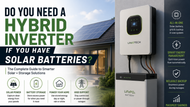
Do You Need a Hybrid Inverter If You Have Solar Batteries?
Posted by LINIOTECH on Jun 9th 2026
If you're adding battery storage to a solar setup or planning both at the same time, the inverter question comes up fast. And it's one of the more confusing parts of the whole process.
Here's the direct answer: if you have solar panels and batteries, a hybrid inverter is almost always the right choice. But understanding why will help you make a smarter decision for your specific setup and avoid paying for the wrong equipment.
What Does an Inverter Actually Do?
Before getting into hybrid inverters specifically, it helps to understand what an inverter does in the first place.
Solar panels generate DC (direct current) electricity. Your home runs on AC (alternating current). An inverter converts DC to AC so your home can actually use the power your panels produce.
That's the basic function. Where it gets more complex is when you add battery storage because now you have a third element in the system that also operates on DC. You need something smart enough to manage the flow of power between all three: your panels, your battery, and your home (plus the grid, if you're grid-tied).
That's exactly what a hybrid inverter does.
Types of Inverters: A Quick Breakdown
There are four main inverter types homeowners encounter. Understanding the differences makes the hybrid inverter's role much clearer.
String Inverter (Standard): The most common type for grid-tied solar systems without batteries. Converts DC from your panels to AC for your home. Simple, cost-effective but has no ability to manage battery storage natively.
Microinverters: Small inverters mounted on each individual panel. Good for shaded roofs or complex roof layouts. Like string inverters, they're not designed for battery integration.
Battery Inverter (Standalone): Specifically designed to charge and discharge a battery bank. Some homeowners use these alongside a separate string inverter, but this two-inverter approach adds complexity, cost, and potential points of failure.
Hybrid Inverter: Combines the functions of a solar inverter and a battery inverter in a single unit. It manages your solar production, charges your battery, powers your home, interacts with the grid, and handles the switchover during an outage all from one device.
For any homeowner with both solar and battery storage, the hybrid inverter is the clean, purpose-built solution.
Do You Need a Hybrid Inverter If You Already Have Solar?
This depends on what inverter you currently have and what you're trying to achieve.
If you have a standard string inverter: You have a few options. You can add a standalone battery inverter alongside your existing setup but this means two separate systems that need to communicate, which adds complexity and can create efficiency losses. The cleaner upgrade path for most homeowners is replacing the string inverter with a hybrid inverter that natively manages both solar and battery storage.
If you have microinverters: Microinverters are panel-level devices and don't directly integrate with battery storage. Adding batteries to a microinverter system typically requires a separate AC-coupled battery system. This works, but it's less efficient than a DC-coupled hybrid inverter setup. If you're starting from scratch or planning a major upgrade, a hybrid inverter with string solar is generally the more efficient architecture.
If you're installing solar and batteries together for the first time: Start with a hybrid inverter. There's no reason to install a standard string inverter and then add complexity later. Design the system correctly from day one.
How a Hybrid Inverter Manages Your Energy
A quality hybrid inverter doesn't just convert power it makes intelligent decisions about where power goes based on rules you (or your installer) define. Here's how a typical day looks with a hybrid inverter system:
Morning (solar production starts): The hybrid inverter detects solar production and begins routing power to your home first. Excess production charges the battery.
Midday (peak solar production): Your home's needs are fully met by solar. The battery is charging. If the battery reaches full capacity and solar is still producing, excess power is exported to the grid (in a grid-tied setup).
Evening (solar production drops): The hybrid inverter switches to the battery to meet your home's energy needs. No interruption, the transition is seamless.
Night: Battery continues discharging to power your home. Depending on your capacity and consumption, it may last through the night, or you may draw from the grid for a portion.
During an outage (any time): The hybrid inverter detects the grid failure and automatically isolates your home from the grid (for safety) while continuing to power your home from the battery and any available solar production.
This entire process happens automatically, you don't manage it manually.
Key Features to Look for in a Hybrid Inverter
Not all hybrid inverters are equal. When evaluating options, these are the specs that actually matter:
Continuous Output Power (kW): This determines how much load the inverter can handle at any given moment. A 5kW inverter can run up to 5,000 watts of appliances simultaneously. For whole-home coverage including HVAC, aim for 8–12kW minimum.
Battery Compatibility: Your inverter must be compatible with your battery's chemistry and voltage. LiFePO4 batteries (the current standard for home storage) require an inverter with the appropriate charge profile and communication protocol. Mismatched pairing reduces efficiency and can shorten battery life.
Battery Communication Protocol: Premium hybrid inverters communicate with the battery via CAN bus or RS485. This allows the inverter to monitor battery state-of-charge, temperature, and cell health and adjust charging behavior accordingly. Always confirm communication compatibility before purchasing.
Grid Interaction Modes: Look for grid-tied mode, off-grid mode, and backup mode. The best hybrid inverters support all three and allow you to switch between them or run them simultaneously.
Transfer Time: During an outage, how quickly does the inverter switch to battery power? For sensitive electronics (computers, medical devices), you want a transfer time under 20 milliseconds, ideally in the 10ms range or less.
Efficiency Rating: Inverter efficiency is measured as a percentage of how much of the input power makes it through as usable output. Look for 97%+ efficiency ratings. Every percentage point of inefficiency is energy (and money) lost.
Common Mistakes Homeowners Make With Inverter Selection
Undersizing the inverter: Buying a 5kW hybrid inverter for a home that regularly draws 8–10kW during peak hours creates bottlenecks. The inverter becomes the weak link in the system. Size for your peak demand, not your average demand.
Prioritizing price over compatibility, A cheaper inverter that isn't properly matched to your battery bank will underperform, charge inefficiently, and potentially void your battery warranty. Compatibility isn't optional.
Not accounting for future expansion if you're planning to add more panels or more battery capacity in the next few years, choose a hybrid inverter that supports expansion. Some units have hard limits on the number of battery modules or panels they can manage.
Skipping professional commissioning, A hybrid inverter has more configuration parameters than a standard string inverter: charge limits, discharge depth, grid export rules, backup priority settings. Improper configuration leads to poor performance. Professional installation and commissioning are worth the investment.
Hybrid Inverter + LiFePO4 Battery: The Right Pairing
The combination of a well-matched hybrid inverter and a LiFePO4 battery bank is the current benchmark for residential energy storage. Here's why this pairing works so well:
LiFePO4 batteries support a high number of charge/discharge cycles (typically 6,000–8,500 cycles), have excellent thermal stability, and communicate detailed state-of-health data to compatible inverters. When a hybrid inverter is properly programmed to work with LiFePO4 chemistry, it charges at the optimal rate, avoids damaging the cells with overvoltage, and monitors battery health over time.
The result is a system that performs reliably for 10–15 years with minimal degradation, provided the components are well-matched from the start.
Browse Liniotech hybrid inverter lineup and LiFePO4 battery systems to explore compatible pairings, or contact our team for a system recommendation tailored to your home's energy needs.
The Bottom Line
If you have solar panels and batteries or you're planning to add both, a hybrid inverter isn't just a nice upgrade. It's the right tool for the job. It manages all three energy sources (solar, battery, grid) from a single intelligent unit, handles outage switchover automatically, and, when properly matched to your battery chemistry, maximizes the lifespan and performance of your entire system.
The alternative of cobbling together separate inverters for solar and battery storage adds cost, complexity, and potential failure points that a hybrid inverter simply eliminates.
Start with the right architecture. The system will reward you for it.