

Honda GX390 Specs, Horsepower, Oil Capacity and Common Uses
Posted by LINIOTECH on Nov 23rd 2026
The Honda GX390 is a 389cc, air-cooled, single-cylinder OHV gas engine rated at 11.7 net horsepower at 3,600 rpm, with 19.5 lb-ft of torque at 2,500 rpm. It holds 1.1 liters (1.16 US quarts) of oil, runs on regular unleaded gasoline and uses a 1-inch horizontal keyed crankshaft. Those numbers have made it one of the most common engines on pressure washers, generators, pumps and log splitters for decades.
Spec sheets only tell part of the story, though. Why did the GX390 go from "13 HP" to "11.7 HP" without losing any power? Which oil should you run in a Texas summer versus a cold snap? And is the much cheaper Predator 420 really a fair swap?
This guide answers all three, using Honda's own published data. If you are repowering equipment and already know you want a genuine engine, our Honda GX390 with electric start and Oil Alert ships from Cypress, Texas.
Honda GX390 Specs at a Glance
| Specification | Details |
|---|---|
| Dimensions (H × W × D) | 35.2 × 20.8 × 11.6 inches |
| Weight | 176 lbs (80 kg) |
| Enclosure Rating | IP65 / NEMA 3R |
| Operating Temperature | -40°C to 60°C, with derating above 45°C |
| Communication | Wi-Fi and LAN |
| Warranty | 10-Year Limited Manufacturer Warranty |
Two numbers on this sheet answer most buying questions. The continuous rated power of 9.4 HP is what the engine can deliver all day, which matters for generators and pumps that run for hours. The fuel consumption figure tells you a full 1.6-gallon tank lasts about 1.7 hours at that continuous load, and noticeably longer at the partial loads most tools see.
The GX390 is also the engine inside a wide range of Honda-powered equipment. You can browse related products in our Honda generator and portable power station.
GX390 Horsepower Explained: 13 HP, 11.7 HP or 9.4 HP?
You will see three different horsepower numbers attached to the same engine. All three are correct; they just measure different things.
13.0 HP gross. For years, Honda marketed the GX390 as a "13 HP" engine. Gross horsepower is measured on a bare engine without the muffler, air cleaner and other parts it needs to actually run in equipment.
11.7 HP net. Honda now rates the GX390 under SAE J1349, which measures power with the muffler and air cleaner fitted, at 3,600 rpm. That is why the number dropped without any change to the engine. Honda also notes that individual production engines can vary slightly from the published rating.
9.4 HP continuous. This is the power the engine can sustain for long periods at 3,600 rpm. For a generator, pump or compressor that runs for hours, this is the number to plan around.
Why torque matters more than horsepower
The GX390 makes its peak torque of 19.5 lb-ft at 2,500 rpm, well below its governed top speed. Strong low-speed torque is what keeps a pressure washer pump, log splitter or trash pump from bogging down when the load spikes. When comparing engines, look at net torque alongside net horsepower, and make sure both are measured to the same standard.
Honda GX390 Oil: Capacity, Type and Change Intervals
Oil capacity: 1.1 liters, or 1.16 US quarts. A standard 1-quart bottle is not quite enough for a full fill, so keep a second bottle on hand.
Oil type: Honda recommends SAE 10W-30 for general use, with an API service category of SJ or later. In consistently warm weather, roughly 50 to 105°F, straight SAE 30 is also acceptable. For regions with very cold winters, follow the viscosity chart in your owner's manual. Use a quality 4-stroke engine oil; never use 2-stroke oil.
First fill: New GX390 engines ship without oil. Fill the crankcase before the first start, or the Oil Alert system will keep the engine from running.
Oil change schedule
Honda's maintenance schedule for the GX390 calls for:
- Before each use: check the oil level.
- After the first month or 20 hours: change the oil to flush out break-in particles.
- Every 6 months or 100 hours after that, whichever comes first: change the oil.
Change it more often if the engine works in dusty conditions or under heavy load all day.
How to check the oil correctly
Park the equipment on level ground with the engine off. Remove the filler cap and dipstick, wipe it clean, then reinsert it without screwing it in. If the level reads low, top up to the upper limit, which on most GX engines is the edge of the oil filler neck.
What Oil Alert does and does not do
Oil Alert uses a crankcase sensor to shut the engine down automatically when the oil level drops too low. It prevents the most common cause of small-engine failure, but it is a safety net, not a substitute for checking the level. An engine that keeps shutting off during use is usually telling you it needs oil.
What the Honda GX390 Powers
The GX390's mix of torque, durability and a standard 1-inch shaft makes it a default choice for heavy-duty equipment:
- Pressure washers, especially commercial units in the 4,000 PSI class
- Portable and job-site generators
- Water pumps and trash pumps for dewatering and irrigation
- Log splitters and hydraulic power units
- Air compressors
- Wood chippers and shredders
- Go-karts, mini bikes and small utility vehicles
- Concrete mixers, tillers and other construction tools
Sizing a GX390 for a generator
The engine's continuous rating is 7.0 kW of mechanical power at 3,600 rpm. Generator alternators lose part of that in conversion, so a GX390-driven generator realistically delivers somewhere around 5 to 6 kW of continuous electrical power. Treat this as a rule of thumb, not a guarantee, and be skeptical of GX390 generators advertising continuous output far beyond that range.
Gas generators and battery backup work better together
For home and business backup, a GX390 generator does its best work alongside battery storage rather than instead of it. The battery covers the instant switchover and quiet overnight hours, while the generator recharges it for a few hours a day during long outages. Our guide to battery backup for your furnace shows how that pairing keeps the heat on in a winter storm, and our comparison of solar battery vs generator backup breaks down when each makes sense. For lighter loads where fuel and noise are a problem, a 1200W portable power station runs silently indoors.
Repowering existing equipment
Most GX390 purchases are repowers, where the engine failed, but the machine is still good. Before you order, check three things on your current engine: a 1-inch keyed horizontal shaft, the bolt pattern on the engine base, and counterclockwise rotation from the shaft side. The model and type code stamped on the engine shroud confirms the match.
Honda GX390 vs Predator 420
Harbor Freight's Predator 420 is the most popular alternative to the GX390. It is built to mimic the Honda GX footprint, which makes it a tempting drop-in replacement at a much lower price. Here is how the two compare on paper.
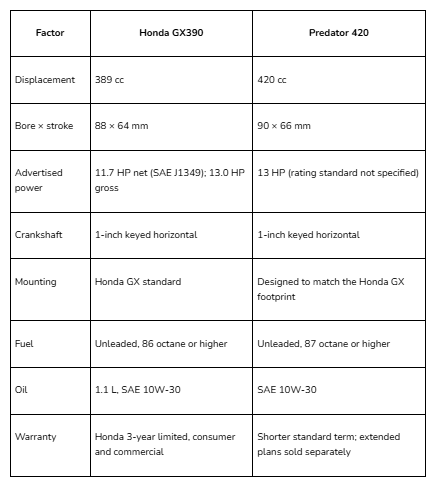
The horsepower gap is smaller than it looks. The Predator's 13 HP figure is not published against the SAE J1349 net standard Honda uses, and Honda's own gross rating for the GX390 is also 13 HP. Comparing 13 HP to 11.7 HP mixes two different measuring methods.
The price gap is real. Harbor Freight's own price comparisons have put the Predator 420 at roughly half the price of a recoil-start GX390.
Which one makes sense?
The Predator 420 is a reasonable choice for hobby builds, go-karts and equipment you use a few times a year, where a lower upfront cost matters most. The Honda GX390 earns its higher price on equipment that makes you money: commercial pressure washers, rental fleets, contractor pumps and generators that run for hundreds of hours a year. There, Honda's longer commercial warranty, nationwide dealer support, parts availability and resale value usually outweigh the savings.
If your machine shipped with a GX390 and you depend on it for work, a genuine replacement keeps the equipment performing the way it was designed to. Our Honda GX390 electric start engine comes with the full Honda warranty.
GX390 Maintenance Schedule
Honda publishes a simple schedule for the GX390. Follow whichever interval comes first, months or operating hours.
| Interval | Service |
|---|---|
| Before each use | Check oil level; check air filter |
| First month or 20 hours | Change oil |
| Every 3 months or 50 hours | Clean air filter (more often in dusty conditions) |
| Every 6 months or 100 hours | Change oil; check and adjust spark plug; clean sediment cup |
| Every year or 300 hours | Replace air filter paper element; replace spark plug; check valve clearance (dealer service) |
| Every 2 years | Check fuel line and replace if needed |
Two habits make the biggest difference. Use fresh fuel, because gasoline left sitting for weeks gums up the carburetor. And keep the air filter clean, because dust that slips past it wears the cylinder and rings quickly.
How to Spot a Genuine Honda GX390
The GX390's popularity has created a market full of look-alikes. Some are honest clones sold under their own brand names. Others borrow the Honda name in listings. A few checks protect you:
- Check the displacement. A genuine GX390 is 389 cc. A listing that calls a 418 cc or 420 cc engine a "Honda GX390" is describing something else.
- Read the wording. "Fits GX390" or "GX390 replacement" means a compatible engine, not a Honda.
- Look for the model and type code. Genuine Honda engines carry a model and type code plus a serial number stamped on the engine, which a Honda dealer can verify.
- Be wary of prices far below market. A genuine GX390 costs roughly twice what a clone does. An offer close to clone pricing deserves a second look.
- Buy from a seller who will confirm fitment. A knowledgeable seller should be able to match your old engine's type code before you buy.
Keep Your Equipment Running on a Genuine GX390
The Honda GX390 earns its reputation with honest numbers: 389 cc, 11.7 net horsepower, 19.5 lb-ft of torque and a 9.4 HP continuous rating built for all-day work. Give it 1.16 quarts of 10W-30, change that oil on Honda's schedule and keep the air filter clean, and it will power a pressure washer, pump or generator for years. When the engine on a good machine finally gives out, a genuine GX390 repower costs far less than replacing the equipment.
LINIOTECH stocks the genuine Honda GX390 electric start engine and ships from Cypress, Texas, usually within 24 hours. Our team will check your old engine's type code, shaft and mounting before you order, so the new engine bolts in the first time. Call 800-978-0161 or email sales@liniotech.com to confirm fitment and get your Honda GX390 on its way today.
Frequently Asked Questions
How much oil does a Honda GX390 take?
The Honda GX390 takes 1.1 liters, or 1.16 US quarts, of engine oil. Honda recommends SAE 10W-30 with an API service category of SJ or later for general use, and SAE 30 is acceptable in warm weather between roughly 50 and 105°F.
How much horsepower does a GX390 have?
The GX390 produces 11.7 net horsepower at 3,600 rpm under the SAE J1349 standard, which equals 13.0 gross horsepower. Its continuous rated power is 9.4 HP, and peak net torque is 19.5 lb-ft at 2,500 rpm.
Can a Honda GX390 run on E10 gasoline?
Yes. Gasoline with up to 10% ethanol is acceptable in Honda GX engines. Avoid higher ethanol blends such as E15, and use fresh fuel to protect the carburetor.
How many hours will a Honda GX390 last?
With regular oil changes, a clean air filter and fresh fuel, GX390 engines commonly run for thousands of hours. Following Honda's maintenance schedule is the biggest factor in reaching that range.
Is the Predator 420 a copy of the Honda GX390?
The Predator 420 is a separate engine built to match the Honda GX mounting footprint and 1-inch shaft, so it can often bolt into the same equipment. It has a larger 420 cc displacement, a different power rating method and a different warranty.
What size generator can a GX390 run?
The GX390's continuous rating is 7.0 kW of mechanical power. After alternator losses, a GX390-powered generator typically delivers around 5 to 6 kW of continuous electrical output.