
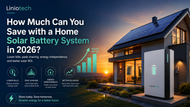
How Much Can You Really Save with a Home Solar Battery System in 2026?
Posted by liniotech on May 22nd 2026
As the world shifts toward renewable energy, more homeowners are choosing Home Solar Battery Systems to make better use of their solar power, cut electricity bills, and increase energy independence. In 2026, with electricity rates continuing to rise, a reliable home solar battery system can offer substantial savings, especially when paired with rooftop solar panels.
At Liniotech, we help homeowners understand how battery storage can reduce grid dependence, improve solar self-consumption, and provide dependable backup power when it matters most.
These systems allow homeowners to store excess energy produced by their solar panels during the day and use it later at night or during expensive peak-rate hours. This is especially important as more utilities shift to Time-of-Use (TOU) billing, where electricity prices change depending on the time of day.
What Is a Home Solar Battery System?
A Home Solar Battery System stores excess electricity generated by your rooftop solar panels during daylight hours, so you can use it later when the sun is not shining. These batteries are usually paired with lithium-ion battery technology and smart inverters, allowing easy charging and discharging based on your household’s energy needs.
Unlike traditional solar systems that export excess power to the grid, battery storage allows you to keep and use more of what your system produces. This can improve your solar system’s financial return, especially when utility rates are high.
With Liniotech home energy storage solutions, homeowners can store clean solar energy, reduce reliance on the grid, and get more value from every kilowatt-hour their solar panels produce.
Why Is a Home Solar Battery Essential in 2026?
As energy prices continue to rise and utility companies move toward more complex billing systems like net metering changes and Time-of-Use rates, the need for a Home Solar Battery System becomes more important.
With net metering benefits declining in some regions, batteries give homeowners more control over their energy consumption. Instead of sending extra solar power back to the grid for lower credits, you can store that energy and use it when electricity is most expensive.
For homeowners looking for long-term savings and energy security, Liniotech solar battery systems provide a smarter way to manage home power in 2026 and beyond.
Average Electricity Bill Reduction with Battery Storage
A properly sized Home Solar Battery System can significantly reduce your electricity bill. Many homeowners may see an average reduction of 60%–80% annually, depending on several factors, including:
- Your household energy consumption
- Local electricity rates
- Solar battery capacity
- Net metering policies in your area
- Time-of-Use rate structure
For example, a homeowner using stored solar energy during peak evening hours can avoid paying high utility rates and reduce monthly electricity costs. In high-rate states like California, annual savings can reach hundreds or even thousands of dollars depending on system size and usage patterns.
Peak Shaving: Maximizing Savings by Reducing Peak Demand
Peak shaving means using your battery to power your home during expensive peak-rate periods, usually in the evening when electricity demand is high.
Instead of buying electricity from the grid at higher rates, your home can use stored solar energy from your battery. This helps reduce your utility costs and improves the return on investment of your solar system.
A smart Liniotech Home Solar Battery System can help homeowners store energy when solar production is high and use it strategically when grid electricity is expensive.
Peak Shaving vs. Grid Export: Where the Savings Really Come From
Grid export means sending excess solar power back to the utility grid for a credit. However, as net metering compensation decreases in many areas, exporting solar energy is becoming less financially rewarding.
Battery storage gives homeowners more control by keeping energy on-site.
Grid Export:
- Lower compensation in many areas
- Limited control over energy value
- No backup power during outages
Battery Storage:
- Maximizes solar self-consumption
- Reduces peak-hour grid usage
- Provides backup power
- Improves long-term savings
When it comes to optimizing savings, battery storage often outperforms grid export by delivering more reliable value and greater energy independence.
Solar Self-Consumption & Time-of-Use Rate Savings
One of the biggest benefits of a Home Solar Battery System is solar self-consumption. This means using more of the energy your solar panels generate instead of sending it back to the grid.
Under Time-of-Use pricing, electricity rates are usually higher during peak afternoon and evening hours and lower during off-peak periods. A solar battery allows you to:
- Store solar energy during the day
- Use stored energy during expensive peak hours
- Avoid buying high-cost grid electricity
- Increase the value of your solar panel system
With Liniotech battery storage, homeowners can make their solar energy work harder and reduce waste by using more clean power directly at home.
Home Energy Storage ROI: What the Numbers Look Like
To estimate the return on investment of your Home Solar Battery System, you need to consider:
- Installation cost
- Electricity savings
- Battery size and performance
- Net metering credits
- Tax incentives and rebates
- Local utility rates
A solar-plus-battery system may cost anywhere from $10,000 to $30,000, depending on system size, battery type, and installation requirements. Many homeowners see payback within 7–12 years, depending on location, energy usage, and available incentives.
Because Liniotech solar battery systems are designed for long-term performance, homeowners can benefit from years of energy savings, backup protection, and improved solar efficiency.
Using a Solar Savings Calculator in 2026
A solar savings calculator can help estimate how much you may save with a home battery system. These calculators usually factor in:
- Your daily energy consumption
- Local electricity rates
- Time-of-Use pricing
- Solar system size
- Battery storage capacity
- Incentives and rebates
Before investing in battery storage, homeowners can use these estimates to understand potential savings and choose the right system size. Liniotech also helps homeowners evaluate their energy needs so they can select a battery solution that fits their home and budget.
What Affects Your Solar Battery Savings?
Several factors influence how much you can save with a Home Solar Battery System.
Local utility pricing:
The higher your peak electricity rates, the more valuable your battery becomes.
Battery size:
A larger battery can store more energy and reduce your need to buy power from the grid.
Solar panel system size:
More solar panels can produce more energy to store, increasing potential savings.
Energy usage habits:
Homes that use more electricity during peak hours may benefit more from battery storage.
Smart energy management:
A smart battery system can optimize charging and discharging automatically, helping homeowners get the most value from stored solar power.
Real-World Example: Peak Savings Strategy
Let’s consider a typical homeowner:
- Daily energy needs: 10 kWh
- Solar battery capacity: 10 kWh
- Peak hours: 4:00 PM to 9:00 PM
- Peak energy use: 4 kWh
By using stored solar energy during peak hours, this homeowner avoids paying high grid rates. If peak electricity costs $0.30 per kWh and off-peak energy costs $0.10 per kWh, shifting 4 kWh of energy use to battery storage could save around $72 per month.
Over one year, that adds up to about $864 in savings from peak shaving alone.
With a properly sized Liniotech Home Solar Battery System, homeowners can use this same strategy to reduce monthly bills and improve long-term solar ROI.
Future Outlook: Solar Battery Economics in 2026 and Beyond
The future of solar batteries looks strong. Battery technology continues to improve, installation costs are becoming more competitive, and more utilities are adopting Time-of-Use pricing.
As net metering benefits decline, home battery systems will become even more valuable for homeowners who want to save money and protect themselves from rising utility costs.
For homeowners planning to invest in solar energy, Liniotech offers practical battery storage solutions designed for long-term savings, reliable backup power, and cleaner energy use.
Conclusion
Yes, investing in a Home Solar Battery System in 2026 can lead to substantial savings. Many homeowners can reduce electricity bills by 60% or more, depending on their location, energy usage, utility rates, and system size.
By combining peak shaving, solar self-consumption, and backup power, a solar battery can significantly improve the value of your solar panel system. Instead of relying fully on the grid, homeowners can store clean energy and use it when it saves the most money.
If you want to reduce energy bills, increase energy independence, and get more value from your solar investment, a Liniotech Home Solar Battery System is a smart solution for 2026 and beyond.
FAQs
1. How much can a home solar battery reduce my average electricity bill?
A solar battery can typically reduce your electricity bill by 60%–80% annually, depending on your electricity rates, solar generation, and usage patterns.
2. Is net metering still valuable in 2026?
Net metering still offers value in some areas, but its benefits have decreased in many states. This makes battery storage a more cost-effective solution for homeowners who want to use more of their own solar energy.
3. What is peak shaving battery storage?
Peak shaving means using stored battery energy during high-cost peak demand periods to reduce grid usage and lower electricity bills.
4. How long until I see a return on a solar battery system?
Most homeowners see payback within 7–12 years, depending on system cost, electricity rates, incentives, and energy consumption.
5. Why choose Liniotech for a Home Solar Battery System?
Liniotech provides reliable home solar battery solutions designed to store clean energy, reduce electricity bills, improve solar self-consumption, and provide backup power during outages.