
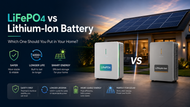
LiFePO4 vs Lithium-Ion Battery: Which One Should You Put in Your Home?
Posted by Liniotech on May 22nd 2026
When homeowners start shopping for a solar battery system, one of the first questions they hit is also one of the most confusing: What is the difference between a LiFePO4 battery and a lithium-ion battery, and does it actually matter?
The short answer is yes, it matters enormously. The battery chemistry you choose determines how safe your system is, how long it lasts, how much it truly costs, and how well it performs in the real conditions of your home.
In this guide, Liniotech breaks down everything you need to know about LiFePO4 vs lithium-ion batteries for home solar storage, in plain English, backed by real technical data. By the end, you will know exactly which chemistry belongs in your home and why.
First: Let's Clear Up the Confusion About "Lithium" Batteries
Here is something that trips people up constantly: LiFePO4 (Lithium Iron Phosphate) IS technically a type of lithium-ion battery. Both use lithium ions moving between electrodes to store and release energy. So when people say "lithium-ion," they typically mean the older, more common cobalt-based lithium-ion chemistry, also called NMC (Nickel Manganese Cobalt) or NCA (Nickel Cobalt Aluminum).
Think of it like this: NMC lithium-ion is what powers your smartphone and laptop. LiFePO4 is what powers home energy storage systems, commercial solar installations, and increasingly, electric vehicles, because it was engineered specifically for applications where safety, longevity, and reliability matter more than compact size.
Here is a simple reference to the battery family tree on Wikipedia: Lithium-ion battery. It covers the broader chemistry family before we dig into the head-to-head comparison.
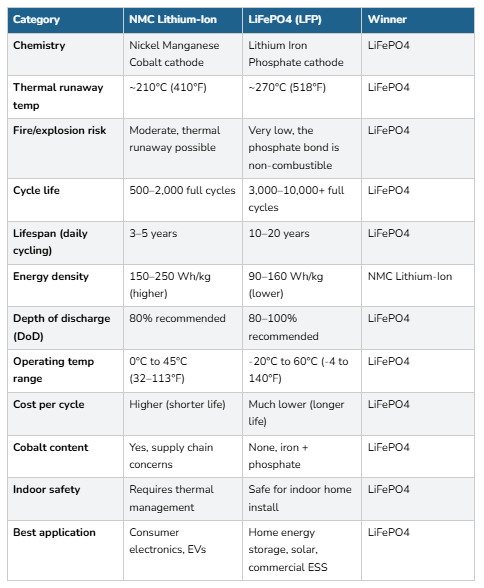
LiFePO4 vs Lithium-Ion (NMC): The Complete Side-by-Side Comparison
Let us compare both chemistries across every factor that matters for a home solar battery system.
Deep Dive: The 6 Factors That Matter Most for Home Energy Storage
1. Safety — The Non-Negotiable Factor
For any battery installed inside or adjacent to your home, safety is the single most important consideration, and this is where LiFePO4 wins decisively.
NMC lithium-ion batteries are prone to thermal runaway, a dangerous chain reaction where a battery overheats uncontrollably, releasing oxygen and potentially igniting. This is the same phenomenon responsible for laptop fires, e-bike incidents, and recalls of consumer electronics. NMC batteries begin to thermally decompose at approximately 210°C (410°F).
LiFePO4 batteries have a fundamentally different and far more stable chemical structure. The phosphate-oxygen bond is exceptionally strong and does not release oxygen when stressed. Their thermal runaway threshold is approximately 270°C (518°F), and even when pushed beyond limits, they do not catch fire or explode. You can puncture a LiFePO4 cell, short-circuit it, or overheat it, and it will not combust.
For a battery system sitting in your garage, basement, or utility room, operating unattended for years, this safety difference is not academic. It is the reason LiFePO4 is the industry-standard chemistry for home energy storage systems in 2026.
2. Cycle Life & Lifespan — The Long Game
A charge cycle is one complete charge and discharge of your battery. Every day, your home solar system charges during the day and depletes at night, that is one cycle.
Here is how dramatically the two chemistries differ:
- NMC Lithium-Ion: 500–2,000 full cycles before significant capacity degradation, approximately 2–5 years of daily use
- LiFePO4: 3,000–10,000+ full cycles before significant degradation, approximately 10–20 years of daily use
Liniotech's LiFePO4 battery systems are rated for a minimum of 6,000 cycles with 80%+ capacity retention, meaning after a decade of daily solar cycling, your battery is still performing at a strong level. Even after 10 years, many LiFePO4 systems still operate at 70–80% of their original capacity.
By comparison, a standard NMC lithium-ion home battery system may require full replacement in 3–5 years, adding thousands of dollars to the total cost of ownership that never appears on the sticker price.
3. True Cost Per Cycle — The Number That Reveals the Real Winner
Upfront price comparisons between LiFePO4 and NMC lithium-ion batteries are misleading. The number that actually tells you which battery is cheaper is the cost per usable cycle.
Here is a real-world example:
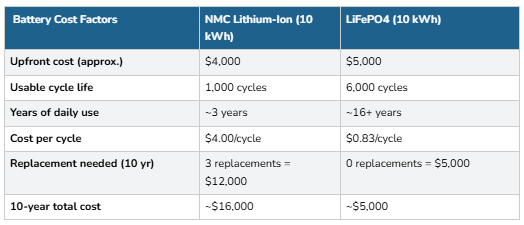
The conclusion is unambiguous: LiFePO4 costs roughly 5x less per cycle than NMC lithium-ion, and over a 10-year period, eliminates thousands of dollars in replacement costs. When homeowners calculate the true cost of ownership, LiFePO4 wins every time for home solar storage.
4. Energy Density — The One Area Where NMC Wins (And Why It Doesn't Matter for Home Storage)
NMC lithium-ion batteries have a higher energy density; they store more energy per kilogram of weight (150–250 Wh/kg vs LiFePO4's 90–160 Wh/kg). This is why your smartphone uses NMC chemistry; every gram matters in a pocket device.
For a home energy storage system, this advantage is largely irrelevant. Your garage or utility room has ample space for a wall-mounted or rack battery. A LiFePO4 battery might be 30–40% larger than an equivalent NMC battery, but that size difference is measured in inches, not in any practical inconvenience.
If you are powering a smartphone or a racing drone, choose NMC. If you are powering your home, choose LiFePO4 every time.
5. Temperature Performance — Critical for Real-World Homes
Battery performance changes with temperature, and not equally between chemistries.
NMC Lithium-Ion: Optimal operating range of 0°C to 45°C (32–113°F). Performance degrades significantly below freezing and above 45°C.
LiFePO4: Operating range of -20°C to 60°C (-4°F to 140°F), significantly wider on both ends.
For homeowners in Texas, where summer temperatures can push garage and attic spaces well above 45°C, or in northern states where temperatures drop below freezing in winter, LiFePO4's wider thermal tolerance directly translates to more reliable power when you need it most.
According to Wikipedia's overview of lithium iron phosphate batteries, the enhanced thermal stability of LiFePO4 chemistry is one of its primary advantages for stationary storage applications in variable climates.
6. Environmental Impact — Clean Energy Should Come from a Clean Supply Chain
NMC lithium-ion batteries require cobalt, a rare earth mineral whose mining has a well-documented history of ethical and environmental concerns. Cobalt is predominantly mined in the Democratic Republic of Congo under conditions that include child labour and severe environmental damage. Cobalt price volatility also creates supply chain risk for battery manufacturers and homeowners alike.
LiFePO4 batteries use iron and phosphate, materials that are abundant, widely available, significantly cheaper to source, and far easier to recycle responsibly. There are no rare earth minerals, no cobalt, and no ethical supply chain concerns.
For homeowners who choose solar energy because they care about a cleaner future, LiFePO4 aligns that commitment all the way down to the raw materials; NMC does not.
Is There Any Situation Where NMC Lithium-Ion Makes Sense for Home Storage?
To be fair, NMC lithium-ion has its legitimate use cases. It is the right choice for:
- Smartphones, laptops, tablets, and wearables, where compact size and light weight dominate all other factors
- High-performance electric vehicles, where energy density translates to driving range
- Very tight installation spaces where even modest size differences are prohibitive
- Short-term backup applications where the battery will be replaced frequently
For home solar energy storage, where the battery cycles daily for a decade or more, operates in a fixed location, and sits inside or adjacent to your living space, NMC lithium-ion is the wrong choice. The safety risk, the shorter lifespan, and the dramatically higher cost per cycle all point decisively toward LiFePO4.
Why Liniotech Uses LiFePO4 Chemistry in All Its Home & Commercial Battery Systems
At Liniotech, every residential and commercial battery storage product uses LiFePO4 chemistry. This is not a marketing decision; it is the result of engineering the right technology for the right application.
Liniotech's LiFePO4 battery lineup includes:
- Wall-mounted home batteries are space-efficient and safe for indoor garage and utility room installation
- Rack batteries, scalable modular systems for larger homes and commercial applications
- Power Storage Bricks, compact, portable LiFePO4 backup units for essential loads
- High-voltage ESS systems, for industrial and commercial-scale energy storage
All Liniotech LiFePO4 battery systems include:
- Built-in Battery Management System (BMS) monitors cell voltage, temperature, and current for safety
- 6,000+ cycle rating at 80% depth of discharge
- UL, CE, IEC, and relevant safety certifications
- Compatibility with all major hybrid inverter brands and solar panel configurations
- Scalable architecture, start with one unit, expand capacity as needs grow
Whether you are building a new solar system from scratch or adding storage to an existing solar installation, Liniotech's LiFePO4 systems are engineered to deliver 15–20 years of reliable, safe, cost-effective energy storage.
Read next: Why Your Home Is Losing Power More Often in 2026 (And How Solar Storage Fixes It)
The Verdict: Which Battery Should You Put in Your Home?
For home solar energy storage in 2026, LiFePO4 is the clear and decisive winner.
It is safer, with a significantly higher thermal runaway threshold and zero fire risk in normal operation. It lasts 3–5 times longer than NMC lithium-ion. It costs far less per cycle when you calculate the true 10-year cost of ownership. It performs reliably in extreme temperatures. And it is free of the ethical and environmental baggage of cobalt mining.
The only scenario where you might consider NMC lithium-ion is if installation space is extremely limited, and even then, the safety, lifespan, and cost arguments for LiFePO4 are compelling enough that most installers still recommend it.
If you are investing in a solar battery system for your home, invest once in the technology built to last. Contact Liniotech today to explore the right LiFePO4 system for your home or business.
FAQs
Is LiFePO4 the same as lithium-ion?
LiFePO4 is technically a subtype of lithium-ion chemistry; both use lithium ions to store and release energy. However, they use fundamentally different cathode materials, which creates dramatic differences in safety, cycle life, and temperature tolerance. When most people say "lithium-ion," they mean NMC (Nickel Manganese Cobalt) chemistry, the type used in smartphones and laptops. LiFePO4 (Lithium Iron Phosphate) uses iron and phosphate instead of cobalt, making it significantly safer, longer-lasting, and better suited for home energy storage.
How many years does a LiFePO4 battery last in a home solar system?
A quality LiFePO4 battery from Liniotech is rated for 6,000+ charge cycles at 80% depth of discharge. For a home solar system that cycles once per day, this translates to 16+ years of useful service before significant capacity degradation. Many systems operate at 70–80% of original capacity even after 10 years. This is 3–5 times longer than standard NMC lithium-ion batteries in the same application.
Can a LiFePO4 battery catch fire or explode?
LiFePO4 batteries are considered non-combustible under normal and most abnormal conditions. Their thermal runaway threshold is approximately 270°C (518°F), and the chemical structure of iron phosphate does not release oxygen when stressed, meaning it cannot fuel its own fire. This makes LiFePO4 the only lithium battery chemistry that can be safely installed indoors in residential settings without advanced thermal management enclosures. NMC lithium-ion batteries carry a measurably higher fire and thermal runaway risk.
Is LiFePO4 worth the higher upfront cost compared to lithium-ion?
Yes, and the math is clear. While LiFePO4 batteries may cost 20–30% more upfront than NMC lithium-ion options, their cost per cycle is 3–5 times lower. Over a 10-year period, a homeowner who chooses NMC and replaces their battery every 3–5 years will spend 2–3 times more in total than a homeowner who chooses LiFePO4 once. When you add in the cost of labour for replacement and the disruption of system downtime, the financial case for LiFePO4 is overwhelming for any long-term home installation.
What LiFePO4 battery products does Liniotech offer for home use?
Liniotech offers a full range of LiFePO4 battery storage solutions for residential and commercial use, including wall-mounted home batteries, modular rack battery systems, Power Storage Bricks for portable backup, and high-voltage ESS systems for larger properties and businesses. All systems include built-in BMS protection, UL/CE safety certifications, and are compatible with major hybrid inverters. Visit liniotech.com or contact the Liniotech team for a free system sizing consultation.