
How to Size a Solar Energy Storage System for Your Business or Home
Posted by LINIOTECH on May 25th 2026
Choosing the right solar battery is not just about buying the biggest battery you can afford. A properly sized solar energy storage system should match your daily energy consumption, backup goals, peak load, inverter capacity, and future expansion plans. This solar battery sizing guide explains how homeowners and business owners can calculate the right battery capacity in kWh without overspending on unused storage.
For many U.S. homes, electricity use can be significant. The U.S. Energy Information Administration says the average U.S. household uses about 10,500 kWh of electricity per year, but actual usage varies widely by region, home type, heating, cooling, and appliance load. That is why solar battery sizing should always start with your own load analysis, not a generic guess.
Whether you are planning a 3 kW to 6 kW solar system home, a larger whole-home backup system, a commercial battery bank, or an off-grid solar sizing project, the same principle applies: calculate what you need to power, how long you need to power it, and how much usable battery capacity is required.
What Is Solar Battery Sizing?
Solar battery sizing is the process of calculating how much storage capacity your system needs. Battery capacity is usually measured in kilowatt-hours (kWh). Power output is measured in kilowatts (kW).
These two numbers are different:
- kWh tells you how long your battery can run your loads.
- kW tells you how much power your battery and inverter can deliver at one time.
For example, a 10 kWh battery can store enough energy to run a 1 kW load for about 10 hours before losses and depth of discharge are considered. But if your inverter can only output 5 kW, the system may not be able to run multiple high-demand appliances at the same time.
This is why battery capacity, inverter output, surge rating, and peak load all matter.
Quick Solar Battery Sizing Formula
Use this simple battery capacity kWh calculator formula:
Required battery capacity = Total backup load kWh ÷ Depth of Discharge ÷ Inverter efficiency
For backup hours, use:
Battery size in kWh = Load in kW × Backup hours ÷ DoD ÷ Inverter efficiency
Example:
If your essential loads use 2 kW and you want 8 backup hours, your usable energy need is:
2 kW × 8 hours = 16 kWh
Now adjust for an 80% depth of discharge and 90% inverter efficiency:
16 ÷ 0.80 ÷ 0.90 = 22.2 kWh
So, you would need around 22 kWh of battery capacity to support that load for 8 hours under real-world conditions.
This is the core of proper backup hours solar battery planning.
Step 1: Start With a Load Analysis Solar System Checklist
A load analysis solar system checklist helps you decide what should run during an outage or when solar production is low.
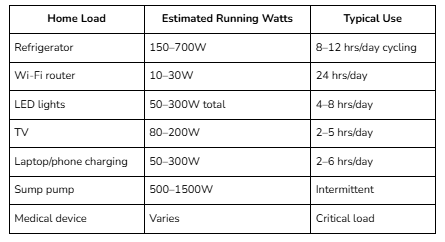
For homes, list essential appliances first:
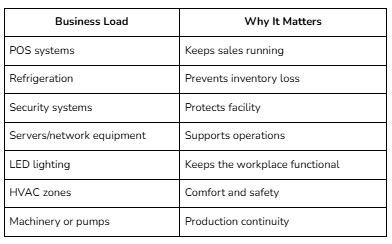
For businesses, your load list may include:
The biggest mistake is assuming that every device runs at full power all day. In reality, many appliances cycle on and off. However, your inverter must still handle the peak load solar battery requirement when multiple devices start up together.
Step 2: Calculate Daily Energy Consumption kWh
Your daily energy consumption in kWh is the foundation of battery sizing. You can calculate it from your power bill or appliance list.
From your electric bill:
Monthly kWh ÷ 30 = Daily kWh
Example:
900 kWh per month ÷ 30 = 30 kWh per day
From appliances:
Watts × Hours per day ÷ 1000 = kWh per day
Example:
A 200W refrigerator running for 10 equivalent hours:
200 × 10 ÷ 1000 = 2 kWh per day
A 100W lighting load for 6 hours:
100 × 6 ÷ 1000 = 0.6 kWh per day
A 20W Wi-Fi router for 24 hours:
20 × 24 ÷ 1000 = 0.48 kWh per day
Total essential load:
2 + 0.6 + 0.48 = 3.08 kWh per day
For home backup, you may only need essential loads. For whole-home backup, you need a much larger system because HVAC, electric water heaters, ovens, dryers, and EV chargers can quickly increase the load.
Step 3: Choose Backup Hours Solar Battery Goals
Your backup goal changes the battery size dramatically.
Ask yourself:
- Do you need 4–8 hours of backup for short outages?
- Do you need overnight backup?
- Do you need 24 hours of backup?
- Do you need multiple days of autonomy for off-grid use?
- Do you need business continuity during utility outages?
Here is a simple backup planning table:
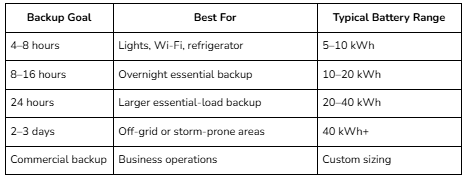
EnergySage notes that many people use one battery for basic backup, two to three batteries to reduce grid use during peak pricing, and far more storage for going fully off-grid.
Step 4: Use Depth of Discharge Sizing
Depth of discharge sizing means adjusting your battery calculation based on how much of the battery can safely be used.
For example:
A 10 kWh battery with 80% DoD provides:
10 × 0.80 = 8 kWh usable
A 20 kWh battery with 90% DoD provides:
20 × 0.90 = 18 kWh usable
Lithium iron phosphate batteries, also known as LiFePO4 batteries, are commonly used for home and business storage because they offer strong cycle life, safety, and stable performance. LINIOTECH’s 10 kWh LiFePO4 rack battery page lists an 80% DoD cycle-life rating, modular expansion, and residential/commercial storage applications.
For accurate sizing, never calculate only by nameplate capacity. Always calculate by usable capacity.
Step 5: Match Battery Size With Hybrid Inverter Sizing
A battery stores energy, but the inverter delivers power to your home or business. This is why a hybrid inverter sizing guide is essential.
Your hybrid inverter should match:
- Your peak simultaneous load
- Your battery voltage and current limits
- Your solar panel array size
- Your grid connection or off-grid requirement
- Your future expansion plan
A common sizing approach is to match the inverter kW with the expected load and battery capacity. Growatt’s inverter sizing guidance notes that a 5 kW hybrid inverter commonly pairs with a 5–10 kWh battery, while oversizing or undersizing can reduce performance.
For example:
- A small essential-load system may use a 3–5 kW inverter.
- A typical home backup system may use a 6–12 kW inverter.
- A whole-home or business system may need 12 kW, 15 kW, or larger.
LINIOTECH offers hybrid inverter options designed to manage solar, battery, and grid power in one system, with residential battery integration and scalable energy-system support.
3 kW to 6 kW Solar System Home Battery Examples
A 3 kW to 6 kW solar system is common for smaller to mid-sized residential energy needs. The right battery depends on whether your goal is savings, backup, or off-grid independence.
Example 1: 3 kW Solar System With Essential Backup
Estimated essential loads:
- Refrigerator: 2 kWh/day
- Wi-Fi and electronics: 0.7 kWh/day
- LED lights: 0.8 kWh/day
- Fans and small devices: 1.5 kWh/day
Total:
5 kWh/day
Battery calculation with 80% DoD and 90% inverter efficiency:
5 ÷ 0.80 ÷ 0.90 = 6.94 kWh
Recommended battery range:
7–10 kWh
This setup is ideal for basic backup, small homes, cabins, and budget-conscious solar users.
Example 2: 6 kW Solar System With Larger Backup
Estimated essential and comfort loads:
- Refrigerator/freezer: 3 kWh/day
- Lighting: 1 kWh/day
- Wi-Fi and electronics: 1 kWh/day
- TV/laptops: 1.5 kWh/day
- Small HVAC zone or pump: 5 kWh/day
Total:
11.5 kWh/day
Battery calculation:
11.5 ÷ 0.80 ÷ 0.90 = 15.97 kWh
Recommended battery range:
16–20 kWh
This system is better for homeowners who want overnight backup, more comfort loads, or reduced grid use during expensive utility periods.
Off-Grid Solar Sizing for Homes, Cabins, and Businesses
Off-grid solar sizing requires more storage than grid-tied backup because there is no utility power available when solar production is low.
For off-grid systems, calculate:
- Daily energy consumption
- Battery autonomy days
- Lowest-sunlight season
- Solar panel recharge capacity
- Generator backup need
- Battery DoD
- Inverter efficiency
- Peak load and surge load
Unbound Solar’s off-grid battery sizing guide recommends using monthly kWh from the electric bill, converting it into daily usage, and considering low-sunlight conditions when sizing battery banks.
Off-grid formula:
Battery capacity = Daily kWh × Days of autonomy ÷ DoD ÷ Inverter efficiency
Example:
- Daily use: 12 kWh
- Autonomy: 2 days
- DoD: 80%
- Inverter efficiency: 90%
12 × 2 ÷ 0.80 ÷ 0.90 = 33.3 kWh
Recommended battery range:
35–40 kWh
For full off-grid systems, it is better to oversize slightly than to run out of power during cloudy weather.
Solar System for Business Energy Costs
A solar system for business energy costs should be sized differently from a home system. Businesses often care about three goals:
- Reducing energy bills
- Reducing peak demand charges
- Keeping operations running during outages
Commercial storage can be especially useful for businesses with refrigeration, pumps, warehouse lighting, servers, manufacturing equipment, or high afternoon electricity demand. EIA’s February 2026 electricity update reported year-over-year increases in average revenue per kWh across residential, commercial, and industrial sectors, with commercial average revenue up 10.7% compared with the prior February.
Business battery sizing should include:
- 15-minute or hourly demand data
- Peak kW load
- Daily kWh use
- Critical operating loads
- Utility rate structure
- Demand charges
- Solar production profile
- Backup duration requirement
- Expansion plans
LINIOTECH commercial energy storage systems are positioned for operational continuity, energy-cost planning, peak-load requirements, and scalable commercial applications.
Common Solar Battery Sizing Mistakes
Mistake 1: Sizing Only by Solar Panel Size
A 6 kW solar system does not automatically require a 6 kWh battery. Battery size should be based on load, backup hours, DoD, and inverter efficiency.
Mistake 2: Ignoring Peak Load
Your battery may have enough kWh, but still fail to run your appliances if the inverter output is too low. Always calculate peak simultaneous load.
Mistake 3: Forgetting Inverter Losses
Most systems lose some power during DC-to-AC conversion. A 90% efficiency assumption is common for planning.
Mistake 4: Backing Up Too Many Loads
HVAC, electric dryers, water heaters, ovens, and EV chargers can drain batteries quickly. Start with essential loads, then expand if budget allows.
Mistake 5: Not Planning for Growth
Future EV charging, business expansion, new appliances, or longer backup goals can change your required capacity. Modular battery systems make expansion easier.
Why Choose LINIOTECH for Solar Battery Storage?
LINIOTECH provides solar energy solutions, hybrid inverters, lithium battery storage, and commercial energy storage systems for homeowners and businesses. For buyers comparing storage options, the advantage is scalability: you can start with the battery size you need today and expand as your energy requirements grow.
For homes, LINIOTECH battery systems can support backup power, solar self-consumption, and energy independence. For businesses, LINIOTECH commercial storage can help support continuity, reduce peak-load exposure, and improve long-term energy planning.
The best system is not always the largest system. The best system is the one sized correctly for your real load, your backup goals, and your budget.
Final Solar Battery Sizing Checklist
Before choosing your battery, confirm:
- Your average daily energy consumption kWh
- Your essential loads
- Your peak load solar battery requirement
- Your desired backup hours
- Your required depth of discharge sizing
- Your inverter efficiency
- Your hybrid inverter size
- Your solar panel capacity
- Your grid-tied or off-grid goal
- Your future expansion needs
Once these numbers are clear, choosing the right solar energy storage system becomes much easier.
Conclusion
Sizing a solar energy storage system for your home or business starts with a simple question: what do you need to power, and for how long?
Use this solar battery sizing guide to calculate your daily energy consumption, estimate backup hours, adjust for depth of discharge, and match your battery with the right hybrid inverter. A small home may only need 7–10 kWh for essential backup, while larger homes may need 16–40 kWh or more. Businesses may require custom commercial storage based on peak demand, operating hours, and cost-saving goals.
For reliable solar energy storage, LINIOTECH offers scalable battery and inverter solutions designed for homes, businesses, and off-grid energy systems.
FAQs
1. How do I calculate solar battery size for my home?
Use this formula: Battery size = Load kW × Backup hours ÷ Depth of Discharge ÷ Inverter efficiency. For daily use, calculate your total daily energy consumption in kWh, then adjust for DoD and inverter losses.
2. What size battery do I need for a 3 kW solar system?
For a small 3 kW solar system, many homes use around 7–10 kWh of battery storage for essential backup. The exact size depends on your daily energy consumption, backup hours, and appliance load.
3. What size battery do I need for a 6 kW solar system?
A 6 kW solar system may pair well with 10–20 kWh for essential or overnight backup. Larger homes, HVAC loads, or off-grid goals may require more capacity.
4. How many backup hours can a solar battery provide?
Backup hours depend on battery capacity and load. A 10 kWh battery running a 1 kW load may last about 8–9 hours after inverter losses and DoD are considered. Higher loads reduce runtime.
5. What is the best battery type for solar energy storage?
LiFePO4 batteries are a strong choice for solar storage because they offer long cycle life, stable chemistry, and good usable capacity. They are commonly used in residential, commercial, and off-grid solar battery systems.