
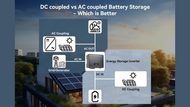
AC-Coupled vs DC-Coupled Battery Storage: Which Is Better?
Posted by LINIOTECH on Jul 27th 2026
Choosing between AC-coupled and DC-coupled battery storage is one of the most important decisions in a solar-plus-storage system. The choice affects system design, efficiency, installation cost, backup power behavior, future expansion, and inverter compatibility.
In simple terms, AC coupling connects battery storage on the AC side of the system, usually with a separate battery inverter. DC coupling connects solar panels and batteries on the DC side, usually through a hybrid inverter or charge controller before power is converted to AC for home use.
Neither option is automatically better for every project. AC-coupled storage is often a practical choice for adding batteries to an existing solar system. DC-coupled storage is often cleaner and more efficient for new solar-plus-battery installations. The right answer depends on your current equipment, backup goals, budget, utility setup, and long-term energy plan.
Quick Answer
AC-coupled battery storage is usually better for retrofit projects where solar panels and a grid-tied inverter are already installed. DC-coupled battery storage is usually better for new solar-plus-storage systems where the solar array, battery bank, and inverter can be designed together from the start.
What Does Coupled Mean in Solar Battery Storage?
In solar energy storage, “coupled” describes where the battery connects in relation to the solar array and inverter system.
Solar panels produce DC electricity. Batteries also store electricity as DC energy. Most homes and businesses use AC electricity. That means a solar-plus-storage system must manage conversion between DC and AC power at the right time.
- AC-coupled storage connects the battery system to the AC side of the electrical system.
- DC-coupled storage connects the battery to the DC side, usually before one shared hybrid inverter converts power to AC.
This sounds technical, but the practical question is simple: should the battery work beside the existing solar inverter, or should the battery and solar panels be managed together through one integrated inverter design?
How an AC-Coupled Battery System Works
An AC-coupled battery system uses a separate battery inverter or battery-based inverter to charge and discharge the battery from the AC side of the system.
A typical AC-coupled solar battery setup works like this:
- Solar panels produce DC electricity.
- The existing solar inverter converts DC power into AC power.
- The home uses that AC power first.
- Excess AC power is converted back into DC power by the battery inverter to charge the battery.
- When backup power is needed, the battery inverter converts stored DC power back into AC power.
Because AC-coupled systems use the AC side of the home electrical system, they are especially useful when solar has already been installed. The original solar inverter may stay in place, and the battery system can be added as a separate storage layer.
Benefits of AC-Coupled Battery Storage
- Good for adding batteries to an existing solar system.
- Can work well with homes that already use microinverters or a traditional grid-tied inverter.
- Often avoids major rewiring of the solar array.
- May allow battery storage to be installed without replacing the original PV inverter.
- Can support staged upgrades when the homeowner is not ready to redesign the entire solar system.
Limitations of AC-Coupled Battery Storage
- Usually requires more conversion steps when storing solar energy.
- May involve more equipment than a simple hybrid inverter design.
- Can be less efficient for direct solar-to-battery charging.
- Backup behavior depends on inverter controls, transfer equipment, and how the system is wired.
- May require careful coordination between the solar inverter and battery inverter during an outage.
How a DC-Coupled Battery System Works
A DC-coupled battery system connects solar panels and battery storage on the DC side of the power system. In many modern residential systems, this is handled by a hybrid inverter.
A typical DC-coupled solar battery setup works like this:
- Solar panels produce DC electricity.
- DC power is routed through a hybrid inverter or charge-control stage.
- The system sends energy to the home, battery, or grid depending on demand.
- Excess solar energy can charge the battery before being converted to AC.
When the home needs power, the inverter converts stored DC energy into AC power.
Because the battery and solar array are managed together on the DC side, DC-coupled systems can reduce unnecessary conversion steps. This is why DC coupling is often preferred for new solar-plus-storage installations.
Benefits of DC-Coupled Battery Storage
- Efficient path from solar panels to battery storage.
- Cleaner design for new solar-plus-storage installations.
- Often uses one hybrid inverter instead of separate solar and battery inverters.
- Can reduce equipment complexity when designed from the beginning.
- Works well for off-grid and hybrid solar systems where battery storage is central to the design.
Limitations of DC-Coupled Battery Storage
- May require replacing or redesigning an existing solar inverter setup.
- Less convenient when a home already has solar panels and microinverters.
- Requires careful compatibility between panels, battery voltage, inverter voltage range, and BMS communication.
- String sizing, MPPT limits, battery voltage, and charge/discharge current must be planned together.
- Not every battery can be paired with every hybrid inverter.
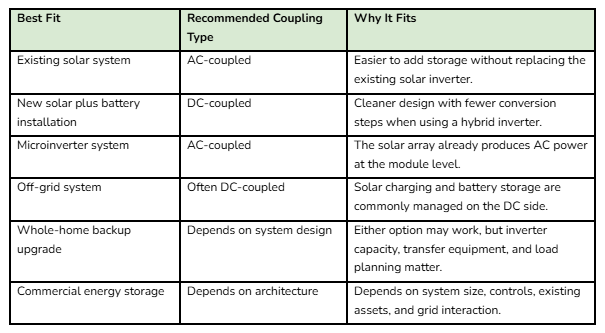
AC-Coupled vs DC-Coupled Battery Storage Comparison
Which System Is More Efficient?
DC-coupled battery storage is often more efficient when charging the battery directly from solar because the energy can stay on the DC side before it is stored. With AC coupling, solar power is commonly converted from DC to AC, then back to DC for battery charging, and then back to AC again when used by the home.
That does not mean AC-coupled systems are bad. In a retrofit project, the installation savings and flexibility of AC coupling may be more important than the small efficiency difference. In a new installation, however, it often makes sense to avoid unnecessary conversion steps if the system can be designed around a compatible hybrid inverter from day one.
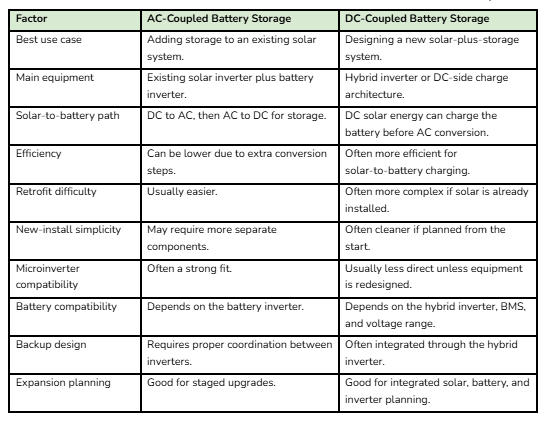
Which Is Better for Existing Solar Systems?
AC-coupled storage is usually the stronger option when a home already has solar panels and a working grid-tied inverter. This is especially true if the system uses microinverters, because the solar array is already producing AC power at the roof or module level.
A retrofit battery project should answer these questions first:
- Does the existing solar inverter still work well?
- Is the existing inverter still under warranty?
- Does the homeowner want to avoid rewiring the solar array?
- Is the current system built around microinverters?
- Does the battery system need to support backup power during outages?
- Can the battery inverter coordinate correctly with the existing PV inverter?
When the goal is to add storage without rebuilding the solar system, AC coupling can be the more practical path.
Which Is Better for New Solar Plus Storage?
DC-coupled storage is often the better choice for a new solar-plus-battery installation because the solar array, battery bank, inverter, controls, and backup loads can be designed as one system.
This is where hybrid inverters become important. A hybrid inverter can manage solar production, battery charging, grid interaction, and backup output through one central control point. For homeowners comparing integrated system options, LINIOTECH offers hybrid solar inverter solutions designed for battery and energy storage integration.
A DC-coupled design may be especially attractive when the project includes:
- A new solar array
- A new LiFePO4 battery bank
- Whole-home or partial-home backup
- A hybrid inverter installation
- Off-grid or grid-tied backup operation
- Future solar and battery expansion
AC Coupling and Backup Power
Backup power is one of the most important parts of the AC vs DC coupling decision. A battery can be installed and still not support the loads a homeowner expects during an outage if the system is not wired correctly.
In an AC-coupled setup, the battery inverter must form or support the backup power environment, and the solar inverter must behave properly when the grid is down. Some systems can keep solar production active during an outage, while others may limit solar charging or shut down depending on inverter controls, code requirements, and transfer equipment.
The key point is simple: do not assume any battery automatically creates whole-home backup. Backup capability depends on inverter output, transfer equipment, load panel design, battery power output, and installation configuration.
DC Coupling and Hybrid Inverter Backup
In a DC-coupled system with a hybrid inverter, solar charging, battery storage, and backup output can be managed through one main inverter platform. This can make backup behavior simpler to design when the project starts from scratch.
For example, a hybrid inverter can prioritize solar use, charge the battery when excess production is available, discharge the battery when the home needs power, and support selected backup loads during an outage. That integrated control is one reason DC-coupled systems are common in modern solar-plus-storage designs.
For broader storage options, explore LINIOTECH home energy storage systems that combine LiFePO4 battery technology with inverter-based energy management.
AC Coupling vs DC Coupling for Off-Grid Systems
Off-grid systems usually need battery storage as a core design element rather than an add-on. Because there is no utility grid to rely on, the inverter and battery system must manage daily energy demand, solar charging, surge loads, and reserve capacity.
For many off-grid projects, DC coupling is a natural fit because solar energy can be used to charge the battery bank directly through a compatible inverter or charge-control architecture. However, larger or more complex off-grid systems may use both AC and DC coupling depending on equipment layout, distance, redundancy, and expansion goals.
The best off-grid design should be based on actual loads, solar production, battery capacity, generator backup needs, and inverter surge requirements.
AC Coupling vs DC Coupling for Commercial Storage
Commercial battery storage is more complex than a simple home backup project. Businesses may be trying to reduce peak demand, support critical loads, shift energy use, manage solar exports, or improve resilience during outages.
In commercial projects, the best coupling method depends on:
- Existing solar infrastructure
- Electrical service type
- Peak-load profile
- Battery power rating
- Storage capacity in kWh
- PCS or inverter architecture
- Energy management system controls
- Backup-load requirements
- Utility interconnection rules
A business with an existing PV system may consider AC-coupled storage to avoid major solar-side redesign. A new commercial solar-plus-storage installation may consider DC coupling or a more integrated BESS architecture if it improves control, efficiency, and equipment layout.
How Solar Clipping Affects the Decision
Solar clipping happens when panels are capable of producing more power than the inverter can convert at that moment. In some system designs, a battery can help capture energy that might otherwise be clipped, but this depends heavily on inverter design and how the battery connects.
A DC-coupled system may offer an advantage when excess DC solar energy can be routed into the battery before inverter clipping occurs. In an AC-coupled system, the solar inverter has already converted and limited solar output on the AC side, so battery charging is managed differently.
This does not mean every DC-coupled system automatically eliminates clipping. It simply means the solar-to-battery pathway should be considered when designing panel capacity, inverter capacity, and battery charging behavior.
Inverter Compatibility Matters More Than the Label
The phrase AC-coupled or DC-coupled is not enough to confirm that a system will work correctly. Battery and inverter compatibility still matters.
Before choosing equipment, review LINIOTECH guide on battery and inverter compatibility and confirm the technical details with the manufacturer or installer.
Important compatibility checks include:
- Battery voltage range
- Maximum charge current
- Maximum discharge current
- Inverter continuous output
- Inverter surge output
- BMS communication protocol
- CAN or RS485 support
- Battery chemistry settings
- Backup-load panel design
- Parallel battery expansion rules
AC-Coupled vs DC-Coupled Cost Considerations
Cost depends on the existing system, labor, equipment, wiring, permits, and backup requirements. AC coupling may be more affordable for a retrofit because it can preserve the existing solar inverter. DC coupling may be more cost-effective in a new installation because one hybrid inverter can sometimes reduce equipment duplication.
Think about cost in two layers:
- Upfront installation cost: equipment, labor, wiring, permitting, and possible inverter replacement.
- Long-term operating value: efficiency, battery cycling, backup usefulness, maintenance, and expansion options.
The lowest initial price is not always the best system. A slightly higher upfront design cost may be worthwhile if it improves performance, reduces energy losses, or avoids expensive redesign later.
When AC-Coupled Battery Storage Makes Sense
AC-coupled battery storage may be the better choice when:
- You already have solar panels installed.
- Your current solar inverter is still in good condition.
- Your solar array uses microinverters.
- You want a battery retrofit with less solar-side rewiring.
- You want to add storage in stages rather than rebuild the full system.
- Your installer recommends a battery inverter that is compatible with the existing PV setup.
LINIOTECH 15kVA hybrid all-in-one inverter product page also highlights AC coupling capability for integrating storage into an existing solar array without rebuilding the entire system.
When DC-Coupled Battery Storage Makes Sense
DC-coupled battery storage may be the better choice when:
- You are installing solar and batteries together for the first time.
- You want a cleaner hybrid inverter design.
- You want fewer solar-to-battery conversion steps.
- You are building an off-grid or hybrid backup system.
- You want the inverter to manage solar charging, battery charging, and backup output together.
- Your battery bank and inverter are confirmed to be compatible.
For example, the LINIOTECH 10kWh LiFePO4 Power Reserve system with an 8kW hybrid inverter is positioned as a complete residential storage system for solar energy storage and backup applications.
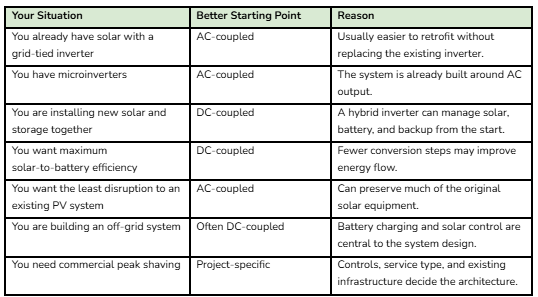
Decision Guide: Which One Should You Choose?
Common Mistakes to Avoid
Mistake 1: Choosing Based Only on Efficiency
Efficiency matters, but system fit matters more. A DC-coupled design may be efficient, but it may not be the easiest or most affordable choice for a home with existing microinverters.
Mistake 2: Assuming Every Battery Provides Backup Power
Battery storage and backup power are not the same thing. Backup requires the right inverter, transfer setup, load panel, battery output, and wiring design.
Mistake 3: Ignoring Battery and Inverter Communication
Modern LiFePO4 systems often rely on BMS communication. If the battery and inverter do not communicate properly, the system may require manual settings or may not operate as expected.
Mistake 4: Not Planning Future Expansion
A system that works today may become limiting later if the homeowner adds more solar panels, larger batteries, an EV charger, or whole-home backup loads.
Mistake 5: Treating AC Coupling and DC Coupling as Brand Features Only
Coupling type is a system architecture decision, not just a product label. The installation design, battery voltage, inverter controls, electrical panel, and load plan all matter.
How LINIOTECH Can Support the Right System Design
A strong solar storage system starts with the right architecture. The inverter, battery bank, solar array, backup loads, and protection equipment should be selected together rather than mixed as separate parts.
LINIOTECH provides hybrid solar inverter solutions, LiFePO4 home energy storage systems, and battery accessories such as DC combiner boxes for residential, off-grid, and commercial solar storage applications.
Before selecting AC-coupled or DC-coupled battery storage, review your current equipment, backup needs, battery capacity, inverter output, and long-term expansion plan. The best system is not the one with the most impressive label. It is the one designed around your actual electrical loads and energy goals.
Final Thoughts
AC-coupled and DC-coupled battery storage both have a place in solar energy systems.
- Choose AC coupling when you already have solar and want a practical battery retrofit.
- Choose DC coupling when you are designing a new solar-plus-storage system around a hybrid inverter.
- Use a project-specific design for off-grid, whole-home backup, and commercial BESS applications.
AC coupling offers flexibility. DC coupling offers an efficient integrated pathway. The right option depends on whether you are upgrading an existing system or building a new one from the ground up.
For homeowners, installers, and businesses comparing solar storage equipment, LINIOTECH can help match battery storage, inverter capacity, and system architecture to the project’s real energy requirements.
FAQs
What is the difference between AC-coupled and DC-coupled battery storage?
AC-coupled storage connects the battery on the AC side of the system, usually through a separate battery inverter. DC-coupled storage connects the battery on the DC side, usually through a hybrid inverter or charge-control architecture.
Is AC-coupled or DC-coupled battery storage better?
AC-coupled storage is often better for existing solar systems. DC-coupled storage is often better for new solar-plus-storage systems. The best choice depends on your equipment, backup needs, and installation goals.
Is DC coupling more efficient than AC coupling?
DC coupling can be more efficient for solar-to-battery charging because it may avoid extra DC-to-AC and AC-to-DC conversion steps. However, efficiency should not be the only factor in the decision.
Can I add a battery to my existing solar system?
Yes, many existing solar systems can add battery storage. AC coupling is often the easier retrofit path, especially if the existing solar inverter is still working well.
Do I need a hybrid inverter for DC-coupled battery storage?
In many modern systems, yes. A hybrid inverter is commonly used to manage solar input, battery charging, AC output, and grid interaction in a DC-coupled solar-plus-storage setup.
Can microinverters work with battery storage?
Yes. Microinverter systems are often paired with AC-coupled battery storage because the solar array already outputs AC power.
Which setup is better for off-grid solar?
Many off-grid systems use DC-coupled designs because the battery is central to daily energy management. However, larger systems may use a mix of AC and DC coupling depending on design requirements.
Which setup is better for whole-home backup?
Either AC-coupled or DC-coupled storage can support backup power when designed correctly. Inverter capacity, transfer equipment, battery output, and load-panel planning matter more than the label alone.
Is AC-coupled storage cheaper?
It can be cheaper for retrofit projects because the existing solar inverter may remain in place. For new installations, DC coupling may reduce equipment duplication and simplify the design.
Can I mix AC-coupled and DC-coupled storage?
Some advanced systems can use both approaches, but this requires professional design. Mixing architectures can create control, protection, and compatibility challenges if not engineered correctly.