
How Many Panels for 6kW Off-Grid Inverter?
Posted by Liniotech Energy on Dec 22nd 2025
Most 6kW off-grid inverter systems need around 11 to 16 solar panels, depending on the wattage of each panel, your daily energy use, your local peak sun hours, and your battery storage capacity.
If you use modern high-watt solar panels, the panel count can be lower:
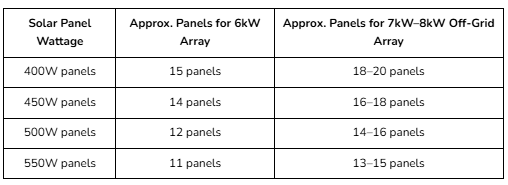
For many homeowners, cabins, RVs, workshops, and small off-grid systems, a 6kW inverter works best with a solar array between 6kW and 8kW, as long as the inverter supports that PV input range.
However, the real answer is not only about the number of panels. The better question is:
How many solar panels do you need to power your daily loads and recharge your batteries properly?
That is where correct off-grid solar sizing matters.
At LINIOTECH, we help homeowners, cabin owners, RV users, and installers choose solar inverters, batteries, and off-grid energy systems that match real power needs.
Why Panel Count Matters for a 6kW Off-Grid Inverter
A 6kW off-grid inverter can deliver up to 6,000 watts of AC power to your appliances at one time. However, the inverter does not create energy by itself. It depends on solar panels, batteries, and proper system design.
If you install too few solar panels, your batteries may not recharge fully during the day. As a result, your system may struggle at night, during cloudy weather, or when your appliances use more power than expected.
On the other hand, if you install too many panels without checking the inverter’s solar input limit, you may overspend or create a system that is not properly matched.
That is why panel count should be based on four important things:
- Your inverter’s solar input capacity
- Your daily energy usage in kWh
- Your local peak sun hours
- Your battery storage size
When these parts work together, your off-grid solar system becomes more reliable, more efficient, and easier to manage.
A 6kW Inverter Is Not the Same as a 6kW Solar Array
This is one of the most common mistakes people make.
A 6kW inverter describes how much power the inverter can supply at one time. A 6kW solar array describes how much solar panel capacity is installed.
For example:
- A 6kW inverter can power up to 6,000W of connected loads.
- A 6kW solar array can produce up to 6,000W under ideal test conditions.
- In real-world conditions, solar panels usually produce less than their rated wattage.
- Batteries are needed to store energy for nighttime use, cloudy days, and backup power.
So, if your goal is full off-grid reliability, you should not size your solar panels only to match the inverter rating. Instead, you should size the solar array to meet your daily energy demand and recharge your battery bank.
For buyers comparing inverter-only options, the 6500W off-grid solar inverter is a relevant match for high-performance off-grid and backup energy applications.
How to Calculate Solar Panels for a 6kW Off-Grid Inverter
Use this simple formula:
Solar Array Size = Daily Energy Use ÷ Peak Sun Hours ÷ System Efficiency
Then calculate the number of panels:
Number of Panels = Solar Array Size ÷ Panel Wattage
For off-grid systems, use a system efficiency factor between 0.75 and 0.85. This accounts for real-world losses from heat, wiring, dust, inverter conversion, charge controller performance, battery charging, and panel angle.
Example Calculation
Let’s say your home uses 24kWh per day.
Your area gets 5 peak sun hours per day.
You use 80% system efficiency.
Solar array size:
24kWh ÷ 5 ÷ 0.80 = 6kW solar array
Now choose your panel wattage.
If you use 500W panels:
6,000W ÷ 500W = 12 panels
So, in this example, you would need about 12 x 500W solar panels for a 6kW off-grid inverter system.
However, if you want stronger winter performance, faster battery charging, or better cloudy-day support, you may choose a larger solar array, such as 7kW to 8kW, if your inverter supports it.
Solar Panel Count by Panel Wattage
Here is a simple sizing table for a 6kW off-grid inverter.
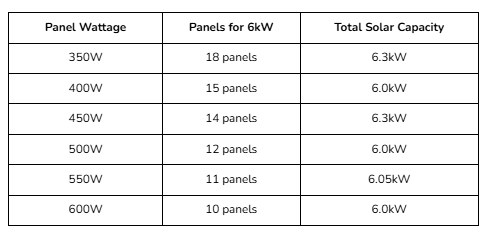
This table gives a clear starting point. Still, many off-grid systems perform better when the solar array is slightly larger than the inverter’s continuous output, as long as the inverter’s PV input limit allows it.
Recommended Solar Array Size for a 6kW Off-Grid Inverter
For most off-grid homes and backup systems, the recommended solar array size is usually:
6kW to 8kW of solar panels
This range gives the inverter enough solar power to handle daytime loads while also charging the battery bank.
Here is a practical guide:
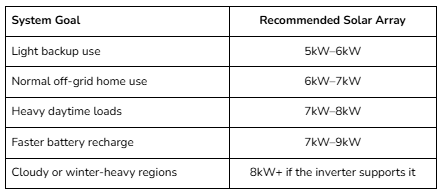
Before installing, always check your inverter’s maximum PV input wattage, maximum VOC, MPPT voltage range, and string current limit.
If you want a ready-to-use system, the 6.5kW off-grid inverter and battery bundle is a strong option because it combines inverter power, MPPT solar charging, and LiFePO₄ battery storage in one setup.
How Many 550W Panels for a 6kW Off-Grid Inverter?
If you use 550W solar panels, you need about 11 panels to build a 6kW solar array.
Calculation:
6,000W ÷ 550W = 10.9 panels
So, the practical answer is:
11 x 550W panels = 6,050W solar array
However, if you want a more robust off-grid setup, you may use 12-14 panels, depending on the inverter’s PV input capacity and system design.
For example:
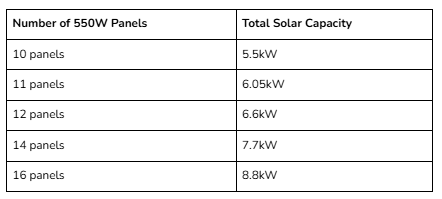
For many modern 6kW to 6.5kW off-grid inverter systems, 12 x 550W panels is a strong practical setup because it gives extra solar production without becoming oversized for many applications.
How Many 400W Panels for a 6kW Off-Grid Inverter?
If you use 400W solar panels, you need about 15 panels to reach 6kW.
Calculation:
6,000W ÷ 400W = 15 panels
A 400W panel setup is still common, but it needs more roof space than a 500W or 550W panel setup. If roof space is limited, higher-watt panels can reduce the total panel count.
How Many 450W Panels for a 6kW Off-Grid Inverter?
If you use 450W solar panels, you need about 14 panels.
Calculation:
6,000W ÷ 450W = 13.3 panels
Since you cannot install part of a panel, you would round up to 14 panels.
That gives you:
14 x 450W = 6,300W solar array
This is a good size for many 6kW off-grid inverter systems because it gives a little extra solar capacity for real-world losses.
How Many 500W Panels for a 6kW Off-Grid Inverter?
If you use 500W solar panels, you need about 12 panels.
Calculation:
6,000W ÷ 500W = 12 panels
This is one of the cleanest panel-count options because it gives you exactly 6,000W of rated solar capacity.
For users who want better battery charging, 14 to 16 panels may be considered if the inverter supports the extra PV input.
Why Off-Grid Systems Often Need More Panels Than Grid-Tied Systems
A grid-tied solar system can use the utility grid as backup. If solar production drops, the home can pull power from the grid.
An off-grid system does not have that same safety net.
That means the solar array must do more work. It has to:
- Power daytime loads
- Recharge the battery bank
- Cover system losses
- Prepare for nighttime use
- Recover after cloudy days
- Support seasonal sunlight changes
Because of this, many off-grid systems need extra solar panel capacity compared with a simple grid-tied setup.
For example, a 6kW grid-tied system may be acceptable with exactly 6kW of panels. But a 6kW off-grid inverter system may perform better with 7kW to 8kW of panels, depending on the battery size and energy usage.
For systems that need solar, battery, and grid control in one unit, LINIOTECH hybrid solar inverter solutions can help manage solar generation, battery charging, and backup power more efficiently.
Match Solar Panels with Battery Capacity
Solar panels produce energy during the day. Batteries store that energy for later. If your solar array is too small, your batteries may not recharge fully. If your battery bank is too small, you may waste solar energy during the day and run out of power at night.
For a 6kW off-grid inverter, common battery sizes include:
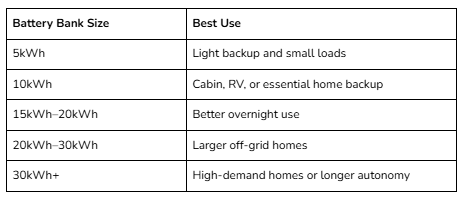
A small 5kWh battery can work for essential loads, but it will not power a full home for long if the energy demand is high. A larger battery bank gives more runtime, but it also needs enough solar panels to recharge properly.
For larger backup goals, explore LINIOTECH home energy storage systems to compare battery storage options for home backup, solar self-consumption, and off-grid power.
That is why a complete system should be sized as one unit: inverter, solar panels, battery bank, and loads.
What Can a 6kW Off-Grid Inverter Run?
A 6kW off-grid inverter can support many common home and backup loads, as long as the total running wattage stays within the inverter’s output rating and the battery bank has enough stored energy.
It can often support:
- LED lighting
- Refrigerator or freezer
- Internet router and modem
- TV and entertainment devices
- Laptops and phone chargers
- Fans
- Small kitchen appliances
- Washing machine
- Water pump
- Power tools
- Small mini-split system
- Essential backup circuits
However, high-startup appliances need special attention. Pumps, compressors, air conditioners, and power tools can require much more power for a few seconds when they start. Therefore, always check both continuous power and surge power before connecting heavy loads.
Example 6kW Off-Grid Solar Setup
Here is a practical example for a small home, cabin, workshop, or backup system.
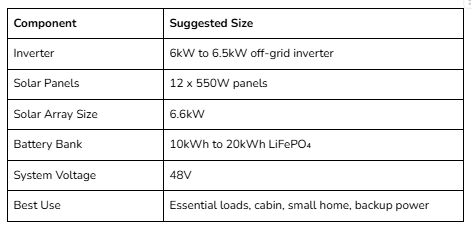
This type of setup gives you enough solar capacity to power daytime loads and recharge batteries in good sunlight. If your home uses more energy, you can increase the solar array and battery capacity if your inverter supports expansion.
Factors That Change the Number of Panels You Need
The exact number of panels depends on your real system conditions. Before choosing a final panel count, review these factors.
1. Daily Energy Usage
Your daily kWh usage is the most important number. A home using 10kWh per day needs a much smaller system than a home using 30kWh per day.
2. Peak Sun Hours
Peak sun hours tell you how much usable sunlight your location receives. A home with 5 peak sun hours needs fewer panels than a home with only 3 peak sun hours.
3. Panel Wattage
Higher-watt panels reduce the number of panels needed. For example, 550W panels need less roof space than 400W panels for the same total array size.
If roof space is limited, bifacial solar panels can be worth comparing because they are designed to capture more energy from the same installation area.
4. Battery Size
A larger battery bank needs more solar energy to recharge. If you want two or three days of backup power, plan for a larger solar array.
5. Roof Direction and Tilt
Panels perform best when they face the right direction and have the right tilt for your location. Poor roof orientation can reduce production.
6. Shading
Even partial shading can reduce output. Trees, vents, chimneys, nearby buildings, and roof obstructions should be checked before installation.
7. Weather and Season
Winter days are shorter, and cloudy weather reduces production. Off-grid systems should be sized for the lowest useful sunlight season, not only the best summer month.
8. Inverter PV Input Limit
Every inverter has a maximum PV input. Do not exceed the inverter’s rated solar input, voltage limit, or current limit.
Common Mistakes When Sizing Panels for a 6kW Inverter
Avoid these mistakes before buying your solar panels.
Mistake 1: Matching Only the Inverter Size
A 6kW inverter does not always need exactly 6kW of panels. It may need more or less, depending on your loads, batteries, and location.
Mistake 2: Ignoring Battery Recharge Time
If the batteries are too large for the solar array, they may not fully recharge during the day.
Mistake 3: Using Summer Sunlight Only
Off-grid systems should be designed for lower-sun months. If the system works only in summer, it may fail when you need it most.
Mistake 4: Forgetting System Losses
Heat, wiring, dust, inverter losses, battery charging losses, and panel angle all reduce real production.
Mistake 5: Exceeding the Inverter’s PV Limits
Always check the maximum PV input wattage, VOC, MPPT voltage range, and input current before connecting panels.
Mistake 6: Ignoring Inverter and Battery Compatibility
Your inverter and batteries must work together properly. If the battery voltage, communication, current rating, or charging limits do not match, the system may not perform safely or efficiently.
If you are not sure whether your battery system needs a hybrid inverter, read Do You Need a Hybrid Inverter If You Have Solar Batteries? before choosing your final setup.
Best Panel Count for a 6kW Off-Grid Inverter
For most users, the best panel count is:
- 12 panels if using 500W panels
- 11 to 12 panels if using 550W panels
- 14 panels if using 450W panels
- 15 panels if using 400W panels
For stronger off-grid performance, many systems use:
- 14 to 16 high-watt panels for better battery charging
- 7kW to 8kW solar array for larger daily loads
- 10kWh to 20kWh battery storage for better nighttime backup
The best setup depends on your energy needs, not only the inverter rating.
Should You Oversize Solar Panels for a 6kW Off-Grid Inverter?
Yes, in many cases, a small amount of solar oversizing can help. Since solar panels rarely produce full rated power all day, extra panel capacity can improve morning, late afternoon, cloudy-day, and winter production.
However, oversizing must stay within the inverter’s limits. You should never exceed the inverter’s maximum PV input voltage, current, or wattage rating.
A safe approach is to work with a qualified installer or energy system designer before adding extra panels.
Final Recommendation
For a 6kW off-grid inverter, start with a solar array between 6kW and 8kW.
If you want the simplest answer:
Use 12 x 500W panels or 11–12 x 550W panels for a basic 6kW off-grid setup.
If you want stronger performance:
Use 14–16 high-watt panels with enough battery storage, as long as your inverter supports the solar input.
The right number depends on your daily energy use, sun hours, battery size, and backup goals. When these parts are matched correctly, your off-grid solar system will charge faster, run more reliably, and give you better energy independence.
To get better long-term battery performance, also review How to Optimize Solar Battery Performance Using Hybrid Inverters, especially if you plan to use LiFePO₄ storage with your off-grid inverter.
Why Choose LINIOTECH for Off-Grid Solar Systems?
Choosing the right solar panels is important, but choosing the right inverter and battery system matters just as much. LINIOTECH provides solar batteries, hybrid inverters, off-grid bundles, and energy storage solutions designed for homeowners, cabins, RVs, workshops, farms, and small businesses.
Whether you are building a new system or upgrading an older setup, LINIOTECH can help you select the right inverter, battery capacity, and solar panel layout for your energy goals.
Ready to build a properly sized off-grid solar system? Start with LINIOTECH’s hybrid inverter options, compare home battery storage, or choose a complete off-grid inverter and battery bundle for a cleaner, easier setup.
Frequently Asked Questions
How many solar panels do I need for a 6kW off-grid inverter?
Most 6kW off-grid inverters need 11 to 16 solar panels, depending on panel wattage. You may need 11 panels if using 550W panels, 12 panels if using 500W panels, 14 panels if using 450W panels, or 15 panels if using 400W panels.
Can I use 12 solar panels with a 6kW inverter?
Yes. If each panel is 500W, then 12 panels create a 6kW solar array. If each panel is 550W, then 12 panels create a 6.6kW array.
Is 6kW enough for an off-grid home?
A 6kW inverter can be enough for a small home, cabin, RV, workshop, or essential-load backup system. Larger homes with HVAC, pumps, and heavy appliances may need a bigger inverter or multiple inverter units.
How many batteries do I need for a 6kW inverter?
Battery size depends on how long you want backup power. A small system may use 5kWh to 10kWh of battery storage. A larger off-grid home may need 20kWh to 30kWh or more.
Can a 6kW inverter run a refrigerator?
Yes. A 6kW inverter can usually run a refrigerator, along with other essential loads, if the total load stays within the inverter rating and the battery bank has enough energy.
Can I connect more than 6kW of panels to a 6kW inverter?
Sometimes, yes. Many inverter systems allow some PV oversizing, but you must follow the inverter’s maximum PV input wattage, voltage, and current limits.
How much power does a 6kW solar system produce per day?
A 6kW solar array can produce around 18kWh to 30kWh per day depending on sun hours, weather, panel direction, temperature, shading, and system losses.
What is the best solar panel size for a 6kW inverter?
Modern 500W and 550W panels are often a good choice because they reduce total panel count and save space compared with lower-watt panels.
Do off-grid systems need more panels than grid-tied systems?
Often, yes. Off-grid systems must power loads and recharge batteries without relying on the grid, so they usually need a stronger solar array and proper battery storage.
What is the best 6kW off-grid setup?
A strong starting setup is a 6kW to 6.5kW inverter, 6.6kW to 8kW of solar panels, and 10kWh to 20kWh of LiFePO₄ battery storage, depending on your daily energy use.