
How Many Solar Panels for a 10kW Inverter?
Posted by LINIOTECH on Jul 10th 2026
A 10kW inverter does not have a universal solar-panel count. The answer depends on panel wattage, the inverter’s maximum PV input power, MPPT voltage range, maximum DC voltage, input-current limits, local sunlight, temperature, and how the strings are wired.
As a quick starting point, a nominal 10,000W solar array would need about 25 x 400W panels, 23 x 450W panels, 20 x 500W panels, 19 x 550W panels, or 17 x 600W panels. Those are arithmetic estimates, not final electrical designs.
The most important rule is simple: never size a solar array from inverter wattage alone. A 10kW inverter may accept a PV array larger than 10kW, but the exact limit is model-specific. You must verify the inverter datasheet before choosing the final number of panels or the string layout.
|
Quick answer: For a roughly 10kW nominal array, use about 25 x 400W, 23 x 450W, 20 x 500W, 19 x 550W, or 17 x 600W panels. Final sizing still depends on the inverter’s PV input and MPPT specifications. |
If your goal is to build a solar array close to 10,000 watts of rated DC capacity, the basic formula is:
Number of panels = Target solar-array watts ÷ Panel watts
For example, with 500W panels:
10,000W ÷ 500W = 20 panels
That gives a 10,000W nameplate array. But with a 550W module, 10,000 ÷ 550 = 18.18, so you cannot simply install 18.18 panels. You must choose a whole number and then check whether the resulting array fits the inverter’s electrical limits.
Solar Panel Count for a 10kW Nominal Array
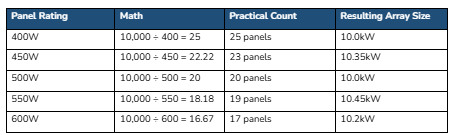
Important: The table shows panel counts for a nominal array near 10kW. It does not confirm that every 10kW inverter can accept each configuration. Check the inverter’s maximum PV power, voltage, current, and MPPT limits.
How Many 400W Panels for a 10kW Inverter?
You need 25 x 400W panels to create a 10,000W nominal solar array.
25 × 400W = 10,000W
This is a straightforward match in nameplate watts. The tradeoff is physical space: lower-watt modules usually require more panels, more mounting points, more connectors, and potentially more string planning than higher-watt modules.
How Many 450W Panels for a 10kW Inverter?
You need about 23 x 450W panels to reach or slightly exceed 10kW.
23 × 450W = 10,350W
Twenty-two panels would equal 9,900W, which is also close to 10kW. Whether 22 or 23 is better depends on the inverter’s PV limits, string voltage, roof layout, shading, and the installer’s design objective.
How Many 500W Panels for a 10kW Inverter?
You need 20 x 500W panels for an exact 10,000W nominal array.
20 × 500W = 10,000W
This clean arithmetic makes 500W modules easy to understand, but the final string configuration still matters. For example, two strings of ten modules may or may not fit the inverter’s MPPT voltage window depending on each panel’s Vmp and Voc.
How Many 550W Panels for a 10kW Inverter?
You need about 19 x 550W panels to build an array slightly above 10kW.
19 × 550W = 10,450W
Eighteen panels would produce 9,900W of nameplate capacity. Both 18 and 19 can be reasonable planning numbers, but only the inverter datasheet and string calculation can confirm the better option.
How Many 600W Panels for a 10kW Inverter?
You need about 17 x 600W panels for a 10.2kW nominal array.
17 × 600W = 10,200W
High-watt modules reduce total panel count, but they often have higher current and different physical dimensions. That makes MPPT input-current compatibility especially important.
Does a 10kW Inverter Need Exactly 10kW of Solar Panels?
No. A 10kW inverter does not automatically require exactly 10kW of panels. Inverter AC output rating and solar-array DC nameplate capacity are related, but they are not the same specification.
Some inverter models permit a PV array above the inverter’s rated AC output. This is often called DC oversizing or a DC-to-AC ratio above 1.0. The purpose is to improve energy harvest during mornings, afternoons, winter conditions, or other periods when panels operate below nameplate power.
However, oversizing is not a universal rule. The acceptable ratio depends on the exact inverter. A model may have hard limits for maximum recommended PV power, MPPT current, short-circuit current, and maximum DC voltage. Exceeding those limits can create performance, warranty, or safety problems.
Can You Connect 12kW or 14kW of Panels to a 10kW Inverter?
Possibly, but only if the inverter manufacturer allows it. LINIOTECH’s existing 6kW vs 10kW comparison notes that a 10kW system may be paired with a larger panel array, depending on panel wattage and available sunlight. That idea should still be applied model by model, not as a universal sizing rule.
For context, read LINIOTECH 6kW vs 10kW off-grid inverter comparison for a broader discussion of inverter capacity, loads, batteries, and array size.
Why MPPT Voltage Matters More Than Simple Panel Count
A panel-count calculation can look perfect in watts and still be electrically wrong. The inverter must receive each PV string within its MPPT operating window.
MPPT stands for maximum power point tracking. The inverter uses its MPPT inputs to operate solar strings near their best power-producing voltage as sunlight and temperature change.
Before choosing a string length, compare these panel and inverter specifications:
Panel Vmp: voltage at maximum power
- Panel Voc: open-circuit voltage
- Panel Imp: current at maximum power
- Panel Isc: short-circuit current
- Inverter MPPT voltage range
- Inverter maximum DC input voltage
- Maximum current per MPPT
- Maximum short-circuit current per MPPT
- Number of MPPT trackers and string inputs
A common mistake is to divide 10,000W by panel wattage, buy that number of modules, and only later discover that the strings do not fit the inverter’s voltage or current limits.
Example: Why 20 Panels Can Still Need Careful String Design
Suppose you select 20 x 500W panels. The array is exactly 10kW by nameplate rating. You might consider two strings of ten panels, but whether that works depends on the electrical specifications of both the panel and the inverter.
A proper design checks the string’s operating voltage against the MPPT window and the cold-weather open-circuit voltage against the inverter’s maximum DC voltage. It also checks the parallel-string current against the MPPT input-current limit.
That is why a 20-panel answer is useful for budgeting and roof planning, but it is not a complete electrical design.
How Temperature Changes Solar String Voltage
Solar-module voltage changes with temperature. In colder conditions, open-circuit voltage generally rises. In hotter conditions, operating voltage generally falls.
This matters because a string that appears acceptable at standard test conditions can exceed the inverter’s maximum DC voltage on a very cold morning, or fall outside the preferred MPPT range in hot operating conditions.
For final design, installers use the module temperature coefficients, local design temperatures, and inverter limits rather than relying only on the panel’s headline wattage.
Does Sunlight Change How Many Panels You Need?
Sunlight does not change the inverter’s electrical input limits, but it can change the array size needed to meet your energy goal.
Two homes can both use a 10kW inverter, yet need different solar-array strategies because of:
- Peak sun hours
- Seasonal weather
- Roof orientation
- Tilt angle
- Shading
- Dust or soiling
- Temperature
- Desired battery charging speed
- Daily energy consumption
A property with strong solar access may meet its daily energy target with less installed DC capacity than a property with limited winter sun or partial shading. In off-grid systems, the array also has to support battery recharge, not just daytime loads.
How Many Panels for a 10kW Off-Grid Inverter?
For an off-grid 10kW inverter, panel count should be based on daily energy demand and battery recharge requirements, not just the inverter’s power rating.
A 10kW inverter might power a large load for a short period, but that does not mean a 10kW solar array will always replace the energy used each day. The system could need more or less PV capacity depending on runtime, battery size, solar resource, and seasonal autonomy targets.
For example, a home using 30kWh per day and a workshop using 60kWh per day may both have a 10kW inverter. Their appropriate solar arrays could be very different because their energy consumption is different.
For a smaller-system comparison, see How Many Panels for a 6kW Off-Grid Inverter? to understand how panel wattage changes the count at another inverter size.
How Battery Storage Changes 10kW Solar Array Sizing
Battery storage changes the design objective. A solar array may need to power daytime loads and also restore energy removed from the battery overnight or during an outage.
That means a battery-backed 10kW inverter system should evaluate:
- Daily load energy in kWh
- Overnight battery use
- Desired state-of-charge recovery time
- Maximum inverter charging power
- Battery charge-current limits
- Expected solar production by season
- Backup reserve target
A larger array is not automatically better if the inverter cannot accept the PV input or the battery cannot absorb the available charging power. Good system design balances generation, conversion, storage, and load demand.
Explore LINIOTECH hybrid solar inverter solutions for systems designed to coordinate solar generation with battery charging and backup power.
Which Panel Wattage Is Best for a 10kW Inverter?
There is no single best panel wattage. The right choice depends on roof or ground space, electrical compatibility, module availability, price per watt, installation labor, and system architecture.
400W Panels
Useful when module dimensions and current characteristics fit the project, but they require more panels for a 10kW array.
450W Panels
A common middle ground that can work well for residential and light-commercial layouts.
500W Panels
Convenient arithmetic for a 10kW nominal array because 20 modules equal exactly 10,000W.
550W Panels
Reduce total module count and may suit larger rooftops or ground-mount systems, subject to MPPT current compatibility.
600W Panels
Further reduce panel count, but module size and current can become more demanding for residential roof layouts and inverter inputs.
LINIOTECH also offers bifacial solar panel options for projects where rear-side energy capture and site conditions make bifacial technology a good fit.
Do Bifacial Panels Change the Panel Count?
The front-side nameplate rating is still the starting point for electrical sizing. Bifacial modules can gain additional energy from rear-side irradiance when the installation has favorable ground reflectivity, spacing, tilt, and mounting conditions.
That extra energy yield can improve annual production, but it should not be used as an excuse to ignore inverter voltage, current, or maximum PV input limits.
How Much Roof Space Do 10kW of Solar Panels Need?
Roof-space requirements depend on the physical dimensions of the chosen module, not just its wattage. Higher-watt panels can reduce the number of modules, but they may also be physically larger.
A proper layout should account for:
- Module length and width
- Required setbacks
- Fire-access pathways where applicable
- Roof obstructions
- Shading zones
- Orientation and tilt
- Maintenance access
- Structural loading
Do not estimate roof fit from panel count alone. Use the exact module dimensions and a site-specific layout.
Do You Need a DC Combiner Box for a 10kW Solar Array?
Not every 10kW array needs the same combiner architecture. A combiner box may be used when multiple PV strings are brought together before the inverter, depending on the inverter inputs, system topology, protection requirements, and installation design.
The correct solution should be selected by a qualified designer or installer because PV-side combining is different from battery-side parallel combining.
Review LINIOTECH DC combiner box solutions to understand available system-integration options and confirm the intended application of each product.
Common Mistakes When Pairing Panels With a 10kW Inverter
Mistake 1: Matching only by watts
A 10kW array can still be incompatible if string voltage or input current is outside the inverter limits.
Mistake 2: Ignoring cold-weather Voc
String open-circuit voltage can rise in cold conditions and must remain below the inverter maximum.
Mistake 3: Ignoring the MPPT current
Modern high-watt modules can have substantial current. Parallel strings may exceed an MPPT input limit even when array watts look acceptable.
Mistake 4: Assuming more panels always means more usable power
Once inverter limits are reached, extra DC capacity may be clipped or may not be allowed at all, depending on the design.
Mistake 5: Sizing an off-grid array from inverter kW alone
Off-grid PV capacity should be tied to daily kWh consumption, battery recovery, and seasonal sunlight.
Mistake 6: Copying another installation
Two systems with the same 10kW inverter rating may use different panels, strings, batteries, climate assumptions, and energy targets.
How to Size Solar Panels for a 10kW Inverter
Check the exact inverter model: Record maximum PV input power, MPPT range, maximum DC voltage, current per MPPT, short-circuit current limit, and number of trackers.
Choose the exact solar module: Use the real datasheet values for wattage, Voc, Vmp, Isc, Imp, and temperature coefficients.
Set an energy-production target: Estimate daily and seasonal kWh needs rather than assuming the inverter rating defines the array size.
Calculate an initial panel count: Divide the target array watts by panel watts and round to a whole number.
Design the strings: Check series voltage, parallel current, MPPT distribution, orientation, and shading.
Correct for temperature: Verify cold-weather maximum Voc and hot-weather operating voltage using site conditions.
Check roof or ground layout: Confirm the selected panels physically fit with safe access and minimal shading.
Coordinate with batteries and loads: For hybrid and off-grid systems, make sure charging power, battery capacity, and daily consumption are balanced.
Have the final design reviewed: A qualified solar professional should verify electrical protection, conductor sizing, equipment ratings, and local requirements before installation.
Three Example 10kW Array Planning Scenarios
Scenario 1: 20 x 500W Panels
Nominal array: 10.0kW
This is the cleanest arithmetic match. The designer still needs to determine whether the panels should be split across one, two, or more MPPT inputs based on voltage and current.
Scenario 2: 18 x 550W Panels
Nominal array: 9.9kW
This configuration is slightly below 10kW by nameplate rating. It may still be entirely reasonable if it meets the project’s energy target and electrical constraints.
Scenario 3: 24 x 550W Panels
Nominal array: 13.2kW
This is a substantially oversized DC array relative to a 10kW inverter output rating. It should only be considered if the exact inverter explicitly supports that PV input and the string design remains within every voltage and current limit.
Build the Whole System, Not Just the Panel Count
A reliable 10kW solar system is a coordinated energy system, not a collection of independently sized components.
Solar panels → MPPT inputs → inverter → battery storage → electrical loads
The panel count has to support the energy goal. The string configuration has to fit the inverter. The battery system has to accept charging power and supply the required loads. Protection and wiring have to match the system architecture.
At LINIOTECH, homeowners, installers, and businesses can explore solar inverters, battery storage, solar panels, and related system components as part of a complete energy solution.
Final Thoughts
So, how many solar panels do you need for a 10kW inverter?
For a nominal array near 10kW, the quick estimates are:
- 25 x 400W panels
- 23 x 450W panels
- 20 x 500W panels
- 19 x 550W panels
- 17 x 600W panels
But the correct system cannot be chosen from panel wattage alone. The final answer depends on the exact inverter’s PV input rating, MPPT voltage range, maximum DC voltage, current limits, string configuration, climate, site conditions, battery needs, and daily energy target.
Use the arithmetic panel count as a starting point. Use the inverter and module datasheets to create the actual design.
FAQs
How many 550W solar panels do I need for a 10kW inverter?
About 19 x 550W panels produce a 10.45kW nominal array. Eighteen panels produce 9.9kW. The correct choice depends on the inverter’s PV input, MPPT voltage, current limits, and string design.
How many 500W panels are needed for a 10kW inverter?
Twenty 500W panels equal exactly 10,000W of nominal DC capacity. You still need to verify voltage and current compatibility.
Can I connect 12kW of solar panels to a 10kW inverter?
Possibly. Some inverter models allow DC oversizing, but the acceptable PV power and DC-to-AC ratio are model-specific. Check the manufacturer's datasheet.
Can I connect 15kW of panels to a 10kW inverter?
Only if the exact inverter explicitly supports that PV input and the string design remains within all voltage and current limits. Do not assume a 1.5 DC-to-AC ratio is universally acceptable.
Is 10kW of solar panels enough for a 10kW inverter?
It can be, but “enough” depends on the project goal. Off-grid and battery-backed systems should be sized around daily energy use and battery recovery, as well as inverter power.
How many 400W panels make 10kW?
Twenty-five 400W panels equal 10,000W.
How many 450W panels make 10kW?
Twenty-two panels equal 9.9kW, and 23 panels equal 10.35kW. Either may be considered during planning, subject to inverter limits.
Do higher-watt solar panels work better with a 10kW inverter?
Not automatically. Higher-watt panels reduce the module count but can have different current, voltage, dimensions, and cost. Compatibility matters more than wattage alone.
What is the best string size for a 10kW inverter?
There is no universal best string size. It depends on panel Voc and Vmp, temperature coefficients, inverter MPPT range, maximum DC voltage, and current per MPPT.