
How Much Battery Storage Does a 10kW Inverter Need?
Posted by LINIOTECH on Jul 8th 2026
A 10kW inverter does not automatically need a 10kWh battery. That is the first thing to get right.
The inverter rating tells you how much power the system can deliver at one time. Battery capacity tells you how long the system can keep supplying energy. Because those are different jobs, the correct battery size depends on your average load, required backup time, usable battery capacity, inverter losses, and the battery bank's discharge capability.
For many homes and off-grid systems, a practical battery bank paired with a 10kW inverter may fall somewhere around 20kWh to 40kWh. Light essential-load backup can use less, while heavy whole-home loads or long overnight autonomy can require 50kWh or more. The right answer comes from a load calculation, not from matching 10kW with 10kWh.
Quick answer: A 10kW inverter often pairs well with roughly 20-40kWh of battery storage for residential or off-grid use, but the actual requirement can be lower or much higher. Size the battery from load in kW multiplied by runtime in hours, then adjust for usable depth of discharge, conversion losses, reserve margin, and battery discharge limits.
Why a 10kW Inverter Does Not Automatically Need a 10kWh Battery
A 10kW inverter and a 10kWh battery use similar-looking units, but they measure different things.
- 10kW is the power: the rate at which electricity can be delivered.
- 10kWh is energy: the amount of electricity stored or consumed over time.
A 10kW inverter can theoretically supply a 10kW load at a given moment if the inverter, battery bank, wiring, protection devices, and operating conditions all support it. But a 10kWh battery would not necessarily sustain that load for one full hour after real-world limits and losses are considered.
This is why battery power rating and battery energy capacity should be checked separately. A large battery with insufficient discharge capability may not support the inverter's peak demand, while a high-power battery with too little energy may run the loads only briefly.
The Two Numbers You Must Size: kW and kWh
A reliable 10kW inverter system needs both adequate power capability and adequate energy capacity.
1. Power Capability in kW
Power capability answers: Can the battery bank supply the inverter and loads at this moment?
For example, a system may need to handle a 7kW running load plus a temporary motor startup surge. Battery modules, the battery management system, DC bus, cabling, fuses or breakers, and the inverter must all be designed for the required current.
2. Energy Capacity in kWh
Energy capacity answers: How long can the battery support the load?
A home averaging 2kW for eight hours needs 16kWh of delivered energy before accounting for usable capacity limits, conversion losses, and reserve margin. A home averaging 5kW for the same eight hours needs 40kWh of delivered energy before those adjustments.
Quick Battery Sizing Table for a 10kW Inverter
The examples below are planning estimates, not universal system specifications. They assume 90% usable battery energy, 95% inverter efficiency, and an additional 15% design reserve. Actual manufacturer limits and site conditions can change the result.
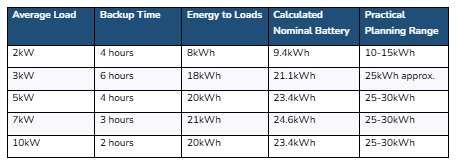
Notice something important: two different load profiles can require similar energy storage. A 5kW load for four hours and a 10kW load for two hours both deliver 20kWh to the loads. The difference is that the 10kW case places much greater instantaneous power demand on the battery bank.
How to Calculate Battery Storage for a 10kW Inverter
A practical starting formula is:
Nominal battery capacity (kWh) = Average load (kW) x Backup time (hours) / (Usable battery fraction x Inverter efficiency)
Then add an appropriate design reserve for uncertainty, future growth, battery aging, temperature, or days with lower solar production.
Step 1: Find Your Average Load
Do not use the 10kW inverter rating as your average load unless you genuinely expect to operate near full output continuously. Most properties have changing loads throughout the day.
Create a realistic load profile using appliance nameplates, monitoring data, utility interval data, or measured consumption. Separate essential loads from optional loads.
- Essential loads: refrigerator, freezer, lights, Wi-Fi, communications, selected outlets.
- Medium loads: washing machine, microwave, dishwasher, office equipment.
- Heavy loads: central air conditioning, electric heating, well pumps, water heaters, ranges, compressors, and large tools.
Step 2: Choose the Required Runtime
Decide whether the battery is intended for a short outage, overnight off-grid use, whole-home backup, or multi-day autonomy. Runtime has a direct effect on the required kWh.
- 2-4 hours: short backup or peak-period support.
- 6-10 hours: evening and overnight coverage for moderate loads.
- 12-24 hours: longer resilience, depending on average demand and solar recharge.
Multiple days: requires much more storage or a reliable recharge source such as solar or a generator.
Step 3: Adjust for Usable Battery Capacity
A battery's nameplate capacity is not always the same as the energy you plan to deliver to loads. System settings may preserve a minimum state of charge, and the allowable operating window depends on the battery chemistry, manufacturer, warranty terms, and control strategy.
For an illustrative LiFePO4 planning calculation, you might use a 90% usable fraction. Do not apply that assumption blindly; use the actual battery documentation and programmed limits for the selected system.
Step 4: Account for Conversion Losses
Energy is lost in conversion and system operation. A simplified planning calculation can include inverter efficiency. For example, using 95% as an illustrative value means the battery must supply more energy than the AC loads ultimately receive.
Step 5: Add a Reserve Margin
A design reserve helps prevent a system from being sized exactly to an optimistic estimate. A margin may account for future loads, aging, weather, unplanned runtime, and uncertainty in the load profile.
Worked Example: 4kW Average Load for 6 Hours
Suppose a home with a 10kW inverter averages 4kW during an outage and needs six hours of backup.
- Calculate delivered energy: 4kW x 6 hours = 24kWh.
- Assume 90% usable battery energy and 95% inverter efficiency.
- Calculate nominal storage: 24 / (0.90 x 0.95) = approximately 28.1kWh.
- Add a 15% reserve: approximately 32.3kWh.
A practical design target may therefore land around 30-35kWh, subject to the exact battery, inverter, discharge power, installation rules, and the homeowner's acceptable reserve level.
Battery Size Scenarios for a 10kW Inverter
Scenario A: Essential Loads Only
A household runs refrigeration, lights, internet, a few electronics, and selected outlets at an average of roughly 1.5-2kW.
- 4 hours of backup: roughly 10-15kWh may be a reasonable planning range.
- 8 hours of backup: roughly 20kWh or more may be appropriate after losses and reserve.
- Long overnight backup: often moves toward 20-30kWh depending on actual consumption.
In this use case, the 10kW inverter provides headroom for occasional larger loads, while the battery is sized around average energy demand.
Scenario B: Mixed Whole-Home Loads
A home runs refrigeration, lighting, electronics, a well pump, kitchen equipment, and managed HVAC, averaging around 3-5kW during the backup window.
- 4 hours: approximately 20-30kWh may be a realistic planning range.
- 6 hours: approximately 25-40kWh depending on average load.
- 8 hours: approximately 35-55kWh depending on HVAC and other heavy loads.
Scenario C: Heavy Loads Near the Inverter Limit
A property operates large HVAC equipment, pumps, workshop tools, or other high-demand loads and averages 7-10kW for significant periods.
- 2 hours: roughly 20-30kWh may be needed based on the actual average load and reserve.
- 4 hours: roughly 35-55kWh or more may be needed.
- 8 hours: storage can quickly rise toward 70-100kWh or beyond.
At this point, battery discharge power, thermal limits, DC, recharge time, and system architecture become just as important as total kWh.
Is a 10kWh Battery Enough for a 10kW Inverter?
Sometimes, yes - but only for the right load profile.
A 10kWh battery can make sense when the goal is short-duration backup, essential loads, peak shaving, or a system that expects frequent solar or grid recharge. It may be too small for long, whole-home backup, heavy HVAC operation, or sustained high-power loads.
The second issue is discharge capability. Even if a battery stores around 10kWh, it must also be able to supply the power the inverter demands. A battery with adequate energy but insufficient continuous discharge current can become the bottleneck.
For a scalable example, review LINIOTECH 10kWh 51.2V LiFePO4 power wall battery. Always confirm the selected battery's current limits, supported parallel configuration, and inverter compatibility before final sizing.
Is 20kWh a Better Match for a 10kW Inverter?
For many residential systems, 20kWh is a more flexible starting point than 10kWh because it provides more usable energy for evening loads and outages. But it is still not a universal answer.
A 20kWh bank may work well for:
- Essential-load backup for an extended period.
- Moderate overnight consumption.
- A home with managed HVAC and controlled heavy loads.
- Solar self-consumption, where the battery recharges regularly.
A household averaging 5kW would consume 20kWh in only four hours before accounting for losses. That same storage could last much longer if the average demand is 1-2kW.
When 30kWh to 40kWh Makes More Sense
A 30-40kWh battery bank is often worth considering when the 10kW inverter is intended for broader whole-home loads, overnight off-grid operation, well pumps, HVAC, or longer outage resilience.
This range can provide more room for:
- Higher evening consumption.
- Longer backup windows.
- Reduced dependence on immediate solar recharge.
- Managed air-conditioning loads.
- Future load growth.
For modular storage planning, see LINIOTECH rack LiFePO4 battery modules, which support battery-bank architectures where capacity can be scaled to the project requirements.
Battery Discharge Power Matters as Much as Battery Capacity
This is the most common technical mistake in 10kW inverter battery sizing: focusing only on kWh.
At high inverter output, a low-voltage battery bank must deliver substantial DC. Using a simplified current calculation:
DC current approximately equals inverter power / (battery voltage x inverter efficiency)
At 10kW AC output and 95% inverter efficiency:
- At 51.2V nominal: about 206A DC.
- At 48V nominal: about 219A DC.
These are simplified estimates. Actual current changes with battery voltage under load, inverter efficiency, transient demand, and system design. The point is that a 10kW inverter can impose very high DC-side current on a 48V or 51.2V battery bank.
The design must therefore verify:
- Battery continuous and peak discharge current.
- BMS current limits.
- Number of parallel battery modules permitted.
- DC cable ampacity and voltage drop.
- Busbar ratings.
- Overcurrent protection and disconnects.
- Inverter battery-voltage range.
How Many 5.12kWh Batteries for a 10kW Inverter?
Many low-voltage LiFePO4 systems use modular batteries around 5.12kWh. From an energy-capacity perspective, the math is straightforward:
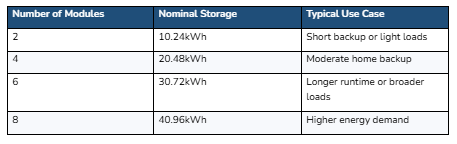
But energy capacity alone is not enough. The exact number of modules must also satisfy the required discharge current. Check each battery's continuous current rating, BMS limits, communication compatibility, and the manufacturer's permitted parallel count.
LINIOTECH 5.12kWh 51.2V LiFePO4 rack and wall-mount battery is an example of the modular form factor used in scalable storage systems.
How Many 10kWh Batteries for a 10kW Inverter?
If the system uses nominal 10kWh battery modules, the storage capacity scales more simply:
- 1 battery = about 10kWh nominal storage.
- 2 batteries = about 20kWh nominal storage.
- 3 batteries = about 30kWh nominal storage.
- 4 batteries = about 40kWh nominal storage.
Again, module count must be checked against power output and communication requirements, not just energy capacity. A 40kWh bank can still be poorly designed if its discharge path, BMS limits, or inverter settings do not support the required load.
48V or High-Voltage Battery for a 10kW Inverter?
Both low-voltage and high-voltage architectures can be used in energy storage, but the inverter must be designed for the selected battery voltage range.
48V or 51.2V Battery Systems
- Common in residential and off-grid systems.
- Often use modular LiFePO4 batteries in parallel.
- Require high DC at 10kW power levels.
- Need careful cable, busbar, BMS, and protection design.
High-Voltage Battery Systems
- Can reduce current for the same power level.
- Often used with compatible high-voltage hybrid or commercial inverters.
- Require matched battery, inverter, controls, and safety architecture.
- Should never be substituted into a low-voltage inverter system without explicit compatibility.
For projects that require a different system architecture, explore LINIOTECH high-voltage LiFePO4 battery solutions.
How Solar Panels Change the Battery Size You Need
Solar recharge can reduce the amount of battery storage required for a given resilience goal, but only when production is available at the right time and at sufficient power.
Consider two off-grid homes with identical evening loads:
- Home A has strong daytime solar production and can recharge the battery daily.
- Home B experiences poor winter production and needs longer autonomy between charging opportunities.
Home B may require a larger battery bank even though both homes use the same 10kW inverter.
Battery sizing should therefore consider solar resource, array size, seasonal production, charge power, and the time required to restore the battery after an outage or overnight discharge.
Battery Size by System Goal
Short Outage Backup
For a few hours of essential-load backup, 10-20kWh may be enough for many load profiles. The actual requirement depends on average demand and whether large loads are excluded.
Overnight Off-Grid Use
For moderate evening and overnight consumption, 20-40kWh is a common planning territory. Homes with electric HVAC, pumps, or high nighttime usage may need more.
Whole-Home Backup
Whole-home backup often requires 30-60kWh or more when the goal is to maintain broad appliance use for many hours. Energy-intensive homes can exceed this range quickly.
Multi-Day Off-Grid Autonomy
Multi-day autonomy can push storage far beyond 40kWh, especially in poor solar conditions. A resilient design may combine battery storage with load management, oversized solar, or another backup charging source.
Do Not Size the Battery From Inverter Rating Alone
A 10kW inverter should be selected based on peak power demand, while the battery bank should be selected based on energy demand and discharge capability. Those decisions are related, but they are not identical.
For a broader load-analysis process that applies beyond 10kW inverters, read LINIOTECH's solar energy storage system sizing guide.
For the inverter itself, verify continuous AC output, surge rating, battery voltage window, maximum charge and discharge current, transfer capability, PV input limits, phase configuration, and approved battery communication protocols.
You can also explore LINIOTECH hybrid solar inverter solutions when planning a complete solar-plus-storage system.
Common Mistakes When Pairing Batteries With a 10kW Inverter
Mistake 1: Matching 10kW to 10kWh
This ignores runtime and the difference between power and energy.
Mistake 2: Ignoring Battery Discharge Current
A battery bank can have enough kWh on paper, but still be unable to supply the inverter at high output.
Mistake 3: Sizing From Daily kWh Only
Daily energy use does not show peak power demand or when loads occur. A home can use modest daily energy and still have large simultaneous loads.
Mistake 4: Using Generic Depth-of-Discharge Assumptions
Use the actual operating limits, warranty requirements, and programmed reserve for the selected battery.
Mistake 5: Ignoring Recharge Time
A large battery bank is only useful if the solar array, grid charger, or generator can restore enough energy within the available charging window.
Mistake 6: Forgetting Future Loads
New HVAC equipment, an EV charger, workshop tools, pumps, or home expansion can change both peak power and daily energy demand.
A Better 10kW Inverter Battery Sizing Workflow
- List the loads that must run during backup or off-grid operation.
- Measure or estimate the realistic average load in kW for the target period.
- Identify peak simultaneous demand and motor startup loads.
- Choose the required backup duration in hours.
- Calculate delivered energy: average kW x hours.
- Adjust for usable battery fraction and conversion losses.
- Add a justified reserve margin.
- Verify battery continuous and peak discharge capability.
- Verify inverter voltage and communication compatibility.
- Check recharge power and solar availability.
- Confirm wiring, protection, installation, and code requirements with a qualified professional.
Build a Balanced 10kW Solar and Battery System
The best battery bank is not the biggest one. It is the one that matches the property's actual load profile, desired runtime, inverter power, recharge strategy, and plans.
A well-designed 10kW system should balance:
- Peak AC load.
- Battery energy capacity.
- Battery discharge power.
- Solar recharge capability.
- Inverter and battery communication.
- Expansion requirements.
LINIOTECH provides residential and commercial solar storage equipment for scalable energy systems. Explore LINIOTECH energy solutions to compare battery, inverter, and solar options as part of one integrated design.
Final Thoughts
So, how much battery storage does a 10kW inverter need?
There is no fixed answer, but 20-40kWh is a useful planning range for many residential and off-grid applications. Light essential-load backup may need only 10-20kWh, while heavy whole-home loads, long overnight runtime, or multi-day autonomy can require 50kWh, 80kWh, or more.
The key is to size from the load profile:
- Use kW to understand power demand.
- Use kWh to understand runtime.
- Account for usable battery capacity and losses.
- Verify discharge current at the battery voltage.
- Check the exact inverter and battery specifications.
A 10kW inverter can be the center of a capable whole-home or off-grid system, but only when the battery bank can provide both the power and the energy the property actually needs.
FAQs
Can I use a 10kWh battery with a 10kW inverter?
Yes, if the battery is electrically compatible and can supply the required discharge power. However, 10kWh may provide limited runtime for heavy loads, and the battery's current limits must be checked carefully.
Is 20kWh enough for a 10kW inverter?
It can be enough for many moderate backup and solar self-consumption applications. Runtime depends on the average load. A 5kW average load would use 20kWh in about four hours before accounting for conversion losses and reserve.
How long will a 30kWh battery last with a 10kW inverter?
The inverter rating does not determine runtime. At a 3kW average AC load, 30kWh lasts much longer than at an 8kW average load. Usable capacity, inverter efficiency, reserve settings, and changing loads also affect the result.
How many 5.12kWh batteries do I need for a 10kW inverter?
From an energy perspective, four modules provide about 20.48kWh, six provide about 30.72kWh, and eight provide about 40.96kWh. The final module count must also meet the inverter's discharge-current and compatibility requirements.
How many 10kWh batteries do I need?
Two modules provide roughly 20kWh nominal storage, three provide 30kWh, and four provide 40kWh. Choose the count from runtime and power calculations rather than inverter size alone.
Does a 10kW inverter need a 48V battery?
Not necessarily. Some 10kW inverters use 48V or 51.2V battery banks, while others are designed for high-voltage batteries. Use only the voltage range and battery architecture specified by the inverter manufacturer.
Can a 48V battery bank supply a 10kW inverter?
Potentially, yes, but DC is high. A simplified calculation at 10kW output and 95% inverter efficiency is roughly 219A at 48V nominal. The battery bank, BMS, cables, busbars, and protection devices must all be designed accordingly.
Should I size the battery for peak load or average load?
Use average load and runtime to estimate energy capacity in kWh, but use peak simultaneous load and surge demand to verify power capability in kW and current. Both checks are necessary.
Does adding more solar panels reduce the battery size I need?
It can, if solar production is available when needed and can recharge the battery reliably. Seasonal weather, array size, charge power, and overnight load still matter.
What is the best battery size for a 10kW off-grid inverter?
For many projects, 20-40kWh is a useful starting range, but there is no universal best size. Calculate actual loads, target runtime, usable capacity, losses, discharge power, and recharge conditions before choosing the battery bank.