

Series vs Parallel Solar Batteries: Which Is Better?
Posted by LINIOTECH on Jul 23rd 2026
When building a solar battery bank, one of the most important wiring decisions is whether batteries should be connected in series, in parallel, or in a manufacturer-approved combination of both. This choice affects system voltage, usable capacity, current flow, inverter compatibility, safety, and future expansion.
The simple answer is this: series connections increase voltage, while parallel connections increase amp-hour capacity at the same voltage. Both approaches can increase total stored energy when more batteries are added, but they do it in different ways. That difference matters a lot when you are working with LiFePO4 solar batteries, hybrid inverters, off-grid systems, and home backup storage.
For most modern 48V-class residential solar storage systems, parallel battery expansion is more common because it lets homeowners add more kWh while staying within the inverter’s supported battery-voltage range. Series connections are used when a system is specifically designed for a higher battery voltage, such as engineered high-voltage battery stacks for larger residential, commercial, or industrial storage.
Quick Answer: Series vs Parallel Solar Batteries
In a series battery connection, the battery voltage adds together while the amp-hour rating stays the same. In a parallel battery connection, the voltage stays the same while the amp-hour rating adds together.
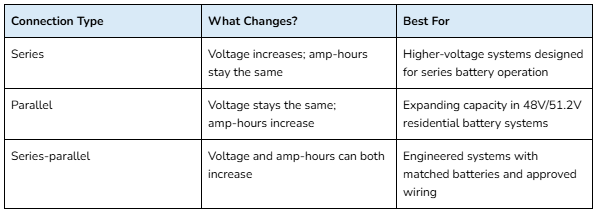
The safer rule is not to ask only which connection is better. Ask which connections your battery manufacturer, inverter manufacturer, BMS architecture, cable design, and protection equipment actually support.
For homeowners comparing low-voltage home battery options, LINIOTECH Power Storage Wall Battery solutions are designed around practical solar backup and residential storage use cases.
What Does Connecting Batteries in Series Mean?
Connecting batteries in series means the positive terminal of one battery connects to the negative terminal of the next battery. This adds voltage together while the amp-hour capacity remains the same.
For example, if two 51.2V 100Ah LiFePO4 batteries were connected in series in a system that is designed and approved for that configuration, the result would be approximately 102.4V at 100Ah. The total energy would be:
102.4V x 100Ah = 10,240Wh, or 10.24kWh
That is the same total energy as two 5.12kWh batteries, but the system reaches that energy at a higher voltage and lower current. This is one reason high-voltage battery systems can be more efficient in larger applications.
Series Battery Example
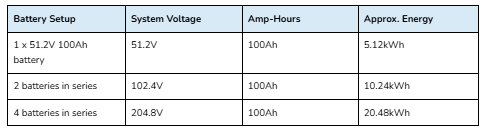
This looks clean mathematically, but it should not be treated as a DIY wiring invitation. Many 48V LiFePO4 batteries are not designed to be externally connected in series. Their BMS, insulation, communication, and inverter settings may only support parallel expansion.
What Does Connecting Batteries in Parallel Mean?
Connecting batteries in parallel means positive connects to positive and negative connects to negative. This keeps the system voltage the same while increasing amp-hour capacity.
For example, if two 51.2V 100Ah LiFePO4 batteries are connected in parallel in an approved system, the battery bank remains 51.2V, but the capacity becomes 200Ah. The energy calculation is:
51.2V x 200Ah = 10,240Wh, or 10.24kWh
Parallel Battery Example
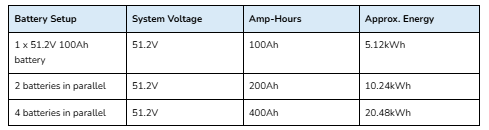
This is the common expansion path for many 48V-class solar battery systems. The inverter still sees a battery bank within its expected voltage range, while the homeowner gains more stored energy and more potential discharge capacity, depending on BMS limits and system design.
For modular storage layouts, the LINIOTECH Rack LiFePO4 Battery Module category is relevant for solar backup, off-grid systems, and scalable battery-bank planning.
Series vs Parallel: The Key Technical Difference
The biggest difference is how the system handles voltage and current. Higher voltage allows the same power to move with lower current. Lower current can reduce stress on cables, terminals, protection devices, and system components when everything is designed correctly.
Use a 10kW load as an example. Current can be estimated with this formula:
Current = Power ÷ Voltage
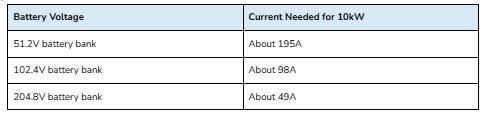
This explains why high-voltage battery systems are popular in larger storage applications. The current is lower for the same power output. However, higher voltage also requires properly rated equipment, trained installation, compatible inverters, and stronger safety discipline.
For larger-scale storage architecture, LINIOTECH also offers High Voltage LiFePO4 Battery solutions for applications where system scalability and voltage architecture are central design factors.
Which Is Better for Solar Batteries?
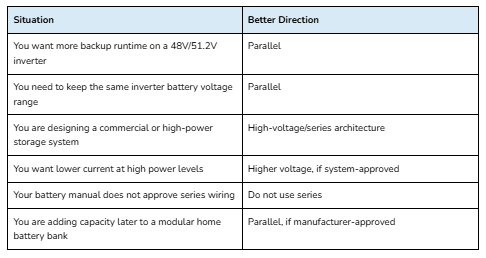
Parallel is usually the better fit for a typical 48V/51.2V residential solar battery expansion. The series is better only when the inverter, BMS, battery modules, protection devices, and installation design are built for a higher-voltage battery system.
Choose Parallel When You Need More Capacity at the Same Voltage
Parallel battery wiring is often used when the goal is to increase backup runtime. For example, a homeowner may start with one 5.12kWh battery and later add more matched batteries to reach 10.24kWh, 15.36kWh, or 20.48kWh while keeping the same 48V-class inverter architecture.
Parallel expansion can help with:
- Longer backup runtime during outages
- More stored solar energy for evening use
- Higher total battery capacity without changing the inverter voltage class
- Modular system growth over time, when supported by the manufacturer
- Better fit for many wall-mounted and rack-mounted LiFePO4 systems
Choose Series Only When the System Is Designed for Higher Voltage
Series battery wiring is not something to assume. It is appropriate only when the entire system is designed around a higher battery voltage. That includes the inverter, battery modules, BMS, fuses, disconnects, cables, labels, and installation procedures.
Series architecture can help with:
- Lower current at higher power levels
- Reduced conductor size requirements in certain designs
- Better efficiency in larger systems
- High-voltage hybrid inverters and commercial storage systems
- Engineered battery cabinets or stackable HV modules
Do Solar Batteries Store More Energy in Series or Parallel?
If the number of batteries is the same, total energy can be the same in either series or parallel. The difference is how that energy is arranged electrically.
Two 51.2V 100Ah batteries equal about 10.24 kWh, whether they are placed in a 102.4V 100Ah series configuration or a 51.2V 200Ah parallel configuration. The total stored energy is similar, but the voltage and current behavior are different.
That is why kWh alone does not tell the full story. A battery bank also needs the right voltage range, discharge current, communication protocol, cable design, and inverter compatibility.
For more context on voltage labels in LiFePO4 batteries, read the LINIOTECH guide to 48V vs 51.2V LiFePO4 batteries.
Why Parallel Battery Banks Are Common in 48V Solar Systems
Many residential off-grid and hybrid solar systems use a 48V-class battery architecture because it is widely supported, practical for home backup, and compatible with many low-voltage hybrid inverters. In these systems, adding batteries in parallel can be a straightforward way to increase stored energy while keeping the voltage class unchanged.
However, parallel does not mean careless. A properly designed parallel battery bank still needs:
- Matched battery models and capacities
- Manufacturer-approved parallel limits
- Equal-length cables were required
- Correct overcurrent protection
- Proper busbar or combiner architecture
- BMS communication setup
- Compatible charge and discharge settings
Uneven wiring can cause one battery to work harder than another. Over time, that may create imbalance, reduced performance, nuisance shutdowns, or premature wear.
Why Series Battery Banks Need Extra Caution
Series wiring increases voltage. That can be useful, but it also increases the importance of correct design. A battery BMS that is safe at one voltage level may not be intended to handle an externally stacked higher voltage. Communication and protection logic may also be different.
Before wiring batteries in series, confirm:
- The battery manufacturer explicitly allows series connection
- The inverter battery input supports the resulting voltage range
- The BMS supports the series configuration
- All batteries are the same model, age, capacity, and firmware, where required
- All disconnects, fuses, breakers, and cables are rated for the higher DC voltage
- Installation follows local electrical code and manufacturer documentation
If these items are not confirmed, do not build a series battery bank. A professionally engineered high-voltage battery system is usually the safer path when higher voltage is needed.
Battery BMS Communication Matters
Modern LiFePO4 solar batteries are not just boxes of cells. They include a Battery Management System, or BMS, that monitors voltage, current, temperature, state of charge, protection limits, and sometimes communication with the inverter.
In a parallel battery bank, many systems use one master battery or a coordinated communication setup so the inverter can understand the whole bank. In a series or high-voltage system, communication and pack-level control are even more critical because the system must manage a wider voltage range and multiple battery modules safely.
This is why battery wiring should never be separated from inverter communication. CAN, RS485, dip switch settings, battery addresses, firmware versions, and inverter battery profiles can all affect whether the system performs correctly.
Series vs Parallel Solar Panels Are Not the Same as Batteries
A common source of confusion is that solar panels are often wired in series strings, then sometimes paralleled into an inverter or combiner box. Battery wiring follows a different set of risks because batteries can deliver large currents continuously and include active BMS protection.
On the PV side, series wiring raises string voltage and helps the array reach the inverter’s MPPT operating range. On the battery side, series wiring changes the battery bank voltage feeding the inverter. That is a much more restrictive compatibility requirement.
In short: do not copy PV string logic directly onto battery-bank design.
Do You Need a DC Combiner Box for Parallel Batteries?
A DC combiner box can be useful when multiple battery modules are connected in parallel and the installation needs organized wiring, protection, and distribution. It can help simplify battery-bank layout compared with loose or inconsistent cable routing.
LINIOTECH provides DC Combiner Box Solar Solutions for solar energy systems and battery-storage applications where cleaner DC-side wiring and safer distribution are important. LINIOTECH also offers a dedicated 8-in-6-out battery parallel DC combiner box for battery parallel configurations.
The right combiner or busbar solution depends on system current, number of batteries, cable size, overcurrent protection, enclosure rating, and local code requirements. Always follow the installation manual and use qualified professionals for the final design.
Can You Mix Different Solar Batteries in Series or Parallel?
In general, avoid mixing different solar batteries unless the manufacturer clearly approves the exact combination. This includes differences in voltage, capacity, chemistry, BMS type, age, firmware, and communication protocol.
Mixing batteries can create several problems:
- Uneven charge and discharge behavior
- BMS communication errors
- Reduced usable capacity
- Unexpected shutdowns
- Overloaded cables or terminals
- Warranty and safety issues
For the most reliable result, use matched batteries from the same series and follow the approved maximum number of parallel or series units.
Series vs Parallel Battery Decision Guide
Common Mistakes to Avoid
Mistake 1: Thinking Series Always Adds Runtime
The series raises the voltage. Runtime depends on total stored energy, load, inverter efficiency, usable depth of discharge, and system limits. Adding batteries can increase energy, but the wiring method changes how voltage and current behave.
Mistake 2: Paralleling Batteries Without Matching Cables
Poor cable layout can lead to uneven current sharing. Follow the approved wiring method, use correct cable sizes, and protect each battery path as required.
Mistake 3: Ignoring BMS Limits
A battery may store enough kWh but still fail to support the required discharge current. Always check continuous current, peak current, communication setup, and supported battery count.
Mistake 4: Mixing Old and New Batteries
Even batteries with the same voltage label may behave differently if they have different ages, capacities, internal resistances, firmware, or states of health.
Mistake 5: Building a High-Voltage Bank Without an HV System
High-voltage storage should be treated as a system-level design, not a casual series wiring project. Use equipment intended for high-voltage battery operation.
Final Thoughts
So, which is better: series or parallel solar batteries?
For most 48V-class residential solar storage systems, parallel is the more practical path because it expands capacity while keeping the same battery voltage class. This is useful for homeowners who want more backup runtime, more stored solar energy, or a modular battery bank that can grow over time.
A series connection is useful when the system is designed for higher voltage, but it requires compatible batteries, a suitable inverter, correct BMS architecture, rated protection devices, and professional installation. It is not something to improvise with standard 48V battery modules unless the manufacturer specifically permits it.
A strong solar battery system is not only about adding more batteries. It is about matching voltage, capacity, current, BMS communication, inverter settings, and protection equipment. To build a safer and more scalable setup, explore LINIOTECH solar energy storage solutions and choose battery architecture as part of a complete system, not as a standalone wiring decision.
FAQs
Is it better to connect solar batteries in series or parallel?
For most 48V residential solar battery systems, parallel is usually better for adding capacity while staying within the inverter’s supported voltage range. The series is better only for systems designed around a higher battery voltage.
What happens when batteries are connected in series?
Voltage adds together while amp-hour capacity stays the same. Two 51.2V 100Ah batteries in series would become about 102.4V 100Ah, if the batteries and inverter are approved for that setup.
What happens when batteries are connected in parallel?
Voltage stays the same while amp-hour capacity increases. Two 51.2V 100Ah batteries in parallel become about 51.2V 200Ah.
Does parallel wiring increase battery runtime?
Yes, when additional matched batteries are added, parallel wiring increases total Ah and kWh at the same voltage, which can increase runtime depending on the load.
Does series wiring increase battery runtime?
Series wiring increases voltage. Runtime depends on total stored energy and load. Adding batteries in series can increase total kWh, but the main electrical change is a higher voltage.
Can I connect LiFePO4 batteries in series?
Only if the battery manufacturer explicitly allows series connection and the inverter supports the resulting voltage range. Many 48V LiFePO4 batteries are intended for parallel expansion only.
Can I connect LiFePO4 batteries in parallel?
Often yes, but only within the manufacturer’s approved limits. Use matched batteries, correct cables, proper protection, and the required BMS communication setup.
Can I mix different battery brands in parallel?
Avoid it unless both manufacturers clearly approve the exact combination. Different BMS systems, charge profiles, internal resistance, and communication protocols can create performance and safety problems.
Why do high-voltage battery systems use series architecture?
Higher voltage allows the same power to move with lower current. This can improve efficiency and reduce current-related stress in larger systems when the design is properly engineered.
Do I need a combiner box for parallel batteries?
A combiner box can help organize and protect multiple parallel battery connections, but the correct design depends on current, battery count, cable size, protection equipment, and code requirements.