
Texas Energy Fund Backup Power Package Guide | LINIOTECH
Posted by LINIOTECH on Nov 11th 2026
Texas has set aside $1.8 billion to keep hospitals, nursing homes, fire stations and water plants running when the grid fails. The money sits inside the Texas Energy Fund, and it pays for something very specific: a backup power package that combines solar, battery storage and a natural gas or propane generator, built to run a critical facility for at least 48 hours on its own.
The Public Utility Commission of Texas (PUCT) adopted the rule for the Texas Backup Power Package (TBPP) Program on May 7, 2026. Eligible facilities can receive grants of up to $500 per kilowatt plus low-cost loans for systems up to 2.5 MW. That is real money for a county EMS station or an assisted living center that has never been able to justify a resilient commercial energy storage system on its own budget.
Most coverage of the program so far lives in PUCT dockets and policy memos. This guide translates the rule into plain language and then does what those documents do not: it walks facility managers, engineers and installers through the equipment side, including how to size the battery, inverter and solar portions of a package that actually meets the 48-hour standard.
How TBPP Fits Into the Texas Energy Fund
The Texas Legislature created the Texas Energy Fund in 2023 through Senate Bill 2627, a direct response to Winter Storm Uri. Uri knocked out power to more than 4.5 million people for up to a week in February 2021, and Hurricane Beryl caused widespread outages again in 2024. The fund was designed to make sure that kind of failure does not repeat.
The Texas Energy Fund runs four programs. The best-known one offers low-interest loans for large gas-fired power plants. TBPP takes a different approach. Instead of adding more central generation, it puts resilient backup power directly at the buildings communities cannot afford to lose.
The Legislature carved $1.8 billion out of the fund for TBPP in 2023 but did not release the money until the 2025 session. The PUCT then adopted the implementing rule, 16 TAC §25.513, on May 7, 2026. That rule sets eligibility, application requirements, evaluation criteria, grant and loan terms and compliance obligations. The program itself runs until September 1, 2050, which makes it a long-term funding source rather than a one-time grant window.
The scale of the opportunity is large. Texas has more than 30,000 critical facilities, according to the Texas Solar Energy Society, and roughly 90% of the state's distribution feeders serve at least one of them.
Who Qualifies for TBPP Funding?
TBPP funds backup power for critical facilities, meaning sites essential to community health, safety and well-being. According to the PUCT, eligible facilities include:
- Hospitals
- Nursing homes and assisted living facilities
- Police and fire stations
- Emergency communication centers, including 9-1-1 centers
- Community heating and cooling centers
- Storm shelters
- Water and wastewater facilities
- Other sites essential to community health, safety and well-being
The law also draws clear lines on what does not qualify. Charter schools and commercial oil and gas facilities are excluded, and for-profit businesses that do not directly serve health and safety needs are not eligible critical facilities.
The 2.5 MW limit. Each backup power package can be up to 2.5 MW. A larger facility, such as a regional hospital, can still apply, but the TBPP-funded system must be sized to carry only its essential loads during an outage. Any extra backup capacity would need non-TEF funding.
Why this matters for planning. Most eligible sites fall well below the 2.5 MW cap. A rural fire station, a small water plant or a 100-bed nursing home typically needs tens to a few hundred kilowatts of critical load. That puts them squarely in the range of modular cabinet-style storage systems rather than utility-scale projects.
What a Texas Backup Power Package Must Include
A TBPP is not a standby generator with a new name. Under the rule, a backup power package must combine natural gas or propane generation, battery storage and solar generation, and it must be able to power the facility for at least 48 continuous hours without refueling or recharging from the grid. The PUCT describes it as a stand-alone, multiday backup power source that serves the facility directly, without passing through a utility meter.
Each component has a distinct job:
| Component | Role in the package | Why it matters during an outage |
|---|---|---|
| Natural gas or propane generator | Carries the base load over multiple days | Provides the energy depth needed to reach 48 hours and beyond |
| Battery energy storage | Instant switchover, peak support, quiet operation | Bridges the seconds before the generator starts and handles load spikes |
| Solar PV | Daytime generation and battery recharge | Cuts fuel burn during an outage and lowers utility bills year-round |
| Hybrid inverter and controls | Islanding, transfer and energy management | Coordinates all three sources so the facility never sees the switch |
Three rules shape how these pieces come together.
Diesel-only systems do not qualify. A facility that already has a diesel standby generator cannot simply relabel it. The package must include gas or propane generation alongside batteries and solar.
The mix is flexible. The statute does not dictate the proportions. A site focused on daily bill savings might lean on more solar, while a site worried about multi-day winter outages might size the generator larger and the solar smaller.
Grid market participation is limited. Funded systems face restrictions on selling power or grid services into ERCOT markets. Behind-the-meter value is still on the table, such as using solar to offset utility purchases and using batteries for peak shaving to cut demand charges, subject to the final program terms.
How Much Funding Can a Facility Receive?
TBPP offers two forms of support: grants of up to $500 per kilowatt of backup capacity, and low-cost loans that may be forgivable if the facility meets program conditions. Grants are capped by the 2.5 MW system size limit, so the largest possible grant for a single site is $1.25 million.
| Example facility | Backup capacity | Maximum grant at $500/kW |
|---|---|---|
| Rural fire station | 50 kW | $25,000 |
| Water well pump station | 150 kW | $75,000 |
| 100-bed nursing home | 250 kW | $125,000 |
| Regional water treatment plant | 1 MW | $500,000 |
| Largest eligible package | 2.5 MW | $1,250,000 |
These figures are illustrative. The final award for any site depends on the PUCT's evaluation criteria and the capacity definitions in the rule.
The grant will not cover every dollar of a solar, battery and generator system, so the remaining cost matters. Battery storage is usually the largest single line item, and prices vary widely with project size and system type. Our breakdown of commercial battery storage cost per kWh shows where the money goes and how cabinet and container systems compare.
During rulemaking, the PUCT also signaled it intends to recognize qualified TBPP vendors who can market to facilities and help submit funding applications. Draft materials discussed several ways vendors could structure the remaining cost, including direct sale, leasing and resilience-as-a-service. Facilities should confirm which structures the final program allows before signing a contract.
Equipment Guide: Sizing a TBPP System That Meets the 48-Hour Standard
The 48-hour requirement changes how you size each component. A battery alone cannot carry most critical facilities for two full days, and a generator alone does not qualify. The design goal is to let each part do what it does best.
Step 1: Define the critical load
Start with 12 months of utility interval data and a list of circuits that must stay on: life safety, medical equipment, communications, refrigeration, pumps and HVAC for occupied areas. Record both the peak kW and the average kW of those loads. Multiply the average by 48 to get the minimum energy the package must supply.
Step 2: Size the generator for energy depth
The natural gas or propane generator does the heavy lifting across two days. Size it to carry the critical load's peak, or slightly below it if the battery will cover short spikes. Confirm fuel supply for at least 48 hours: a reliable gas line or enough on-site propane storage.
Step 3: Size the battery for speed and flexibility
The battery covers the moments a generator handles poorly. It picks up the load the instant the grid drops, rides through generator start-up, absorbs motor and compressor surges, and lets the generator shut off during low-load overnight hours. A practical starting point is 3 to 4 hours of average critical load.
For three-phase commercial sites, high-voltage battery systems are the efficient choice because they pair directly with large hybrid inverters. Our high voltage LiFePO4 battery collection includes the 61.44 kWh commercial high voltage battery, built for Sol-Ark 60K 480V and 30K 208V inverters, which suits fire stations, clinics and small pump stations. Larger sites can step up to the LTN-CESS-215K outdoor cabinet ESS or a 60 kW / 100 kWh 480V three-phase ESS with integrated off-grid backup.
Step 4: Size solar to cut fuel and bills
Solar reduces generator fuel burn during an outage and lowers utility bills every other day of the year. In Texas, a commercial array typically produces about 4 to 5 kWh per installed kilowatt on a clear day. High-output bifacial solar panels work well on carports and ground mounts, where they capture reflected light from below.
Step 5: Choose the inverter and controls
The hybrid inverter ties everything together. It must match the building's service voltage (208V or 480V three-phase for most critical facilities), form a stable island when the grid fails, and accept a generator input. Commercial units from our Sol-Ark hybrid inverter are designed for exactly this role, and Sol-Ark has filed material in the PUCT's TBPP docket on how its hybrid inverters align with the program.
Example packages
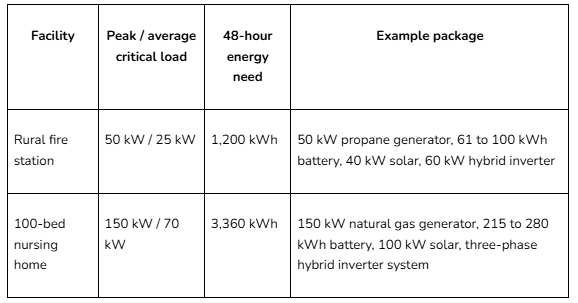
These examples are illustrative starting points, not engineered designs. A licensed engineer must size each package from the site's actual load data.
Do not skip the details
Outdoor batteries in Texas see summer heat and the occasional hard freeze. Check operating temperature ranges and heating options, and review our guide to LiFePO4 batteries in cold weather for winter charging limits. Confirm that every battery system carries the safety listings your local fire marshal requires, and plan for monitoring that proves the system is ready before the next storm arrives.
How to Prepare Your Facility Now
The rule is final, but the application process is still rolling out. Facilities that do the groundwork now will be ready to apply the day the window opens.
| Milestone | Date |
|---|---|
| Texas Energy Fund created by SB 2627 | 2023 |
| Legislature releases $1.8 billion for TBPP | 2025 session |
| PUCT publishes proposed rule | December 2025 |
| Public comment period closes | January 30, 2026 |
| PUCT adopts final rule (16 TAC §25.513) | May 7, 2026 |
| PUCT workshop on vendor procurement | July 20, 2026 |
| Application process opens, first awards | Expected late 2026 to 2027 |
| Program expires | September 1, 2050 |
Use this time to work through six steps:
- Confirm eligibility. Make sure your facility type appears on the PUCT's list of critical facilities and that your backup need fits within 2.5 MW.
- Pull your load data. Request 12 to 24 months of utility bills and 15-minute interval data from your utility or retail electric provider.
- List critical circuits. Decide which loads must run for 48 hours and which can drop during an outage.
- Get a site assessment. An engineer should check panel capacity, space for batteries and inverters, roof or carport area for solar, and gas line or propane storage options.
- Choose an experienced vendor. Look for a team that can supply solar, battery storage and inverters as one coordinated package and prepare proposals in the format the PUCT requests.
- Watch the official TBPP page. Check the Texas Energy Fund website regularly for the application window, vendor requirements and deadlines.
If you are still weighing whether storage makes sense for your site beyond TBPP, the industrial and commercial energy storage shows the full range of cabinet and container systems, from 61 kWh to multi-megawatt-hour scale.
Get Your Facility Ready Before the Window Opens
The Texas Energy Fund has turned backup power for critical facilities from a budget wish into a funded program. Up to $500 per kilowatt is on the table, but only for packages that combine gas or propane generation, battery storage and solar and can run a facility for 48 hours on their own. The facilities that win funding will be the ones with clean load data, a realistic design and a supply partner ready to deliver all three components.
LINIOTECH supplies the battery storage, hybrid inverters and solar equipment at the heart of a Texas Backup Power Package, from our headquarters in Cypress, Texas. Our team works with facility managers, engineers and installers to size commercial and high voltage battery systems around real critical loads, pair them with Sol-Ark inverters and bifacial solar, and document the package for your application. Call 800-978-0161 or email sales@liniotech.com to start your TBPP equipment plan today, so your facility is ready when the next storm hits.
Frequently Asked Questions
What is the Texas Energy Fund Backup Power Package program?
It is a $1.8 billion program inside the Texas Energy Fund that provides grants and low-cost loans to critical facilities for backup power. Each funded package combines natural gas or propane generation, battery storage and solar, and must power the facility for at least 48 continuous hours.
How much TBPP funding can a facility get?
Facilities can receive grants of up to $500 per kilowatt of backup capacity, plus low-cost loans that may be forgivable. Packages can be up to 2.5 MW, so the maximum grant for one site is $1.25 million.
Does a diesel generator qualify for TBPP?
No. A diesel-only system does not meet the program definition. The package must include natural gas or propane generation together with battery storage and solar generation.
Can a battery and solar system alone qualify?
No. Batteries and solar are required components, but the package must also include natural gas or propane generation so it can reach the 48-hour runtime without grid recharging.
When can facilities apply for TBPP funding?
The PUCT adopted the program rule on May 7, 2026, and is still rolling out the application process. Observers expected applications to open between late 2026 and 2027. Check the official Texas Energy Fund TBPP page for the current window.
Can private or for-profit facilities apply?
Eligibility depends on the facility's function, not just its ownership. Facility types such as assisted living centers and hospitals are on the eligible list, while for-profit businesses that do not directly serve health and safety, charter schools and commercial oil and gas facilities are excluded.