
LiFePO4 Batteries in Cold Weather, Charging & Winter Tips
Posted by LINIOTECH on Oct 13th 2026
A LiFePO4 battery can power your home on a freezing night. What it cannot safely do is accept a charge while its cells sit below 32°F (0°C). That one rule sits at the center of LiFePO4 cold weather charging, and it often decides whether a home solar battery lasts 15 years or starts losing capacity after one hard winter.
For homeowners with storage in a garage, utility room, or on an exterior wall, winter brings a specific risk. The sun comes up, the panels start producing, and the inverter tries to push current into cells that are still cold from the night. Below, the LINIOTECH team breaks down the real temperature limits, what happens inside the cell, and the setup choices that keep a residential storage system safe until spring.
The Short Answer on LiFePO4 Cold Weather Charging
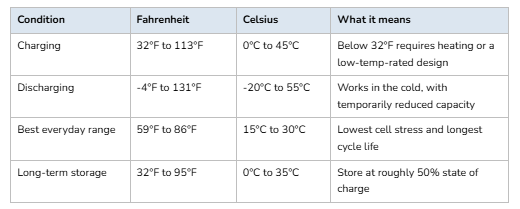
Standard LiFePO4 batteries can discharge down to about -4°F (-20°C), but charging below 32°F (0°C) should be avoided unless the battery has a built-in heater or a manufacturer-approved low-temperature charging profile. A quality BMS blocks charging when the cells are too cold. Self-heating models warm the cells first and allow charging once they reach a safe temperature, usually around 41°F (5°C).
Two details trip people up. The limit applies to cell temperature, not the air in your garage, and cells lag behind air temperature by hours. And because the discharge window is much wider than the charge window, a battery that runs your house fine at 25°F can still be damaged if it is charged at that same temperature.
LiFePO4 Temperature Limits at a Glance
These are typical ranges for residential LiFePO4 batteries. Your model’s datasheet is the final word, and some cells are rated narrower.
Why Charging LiFePO4 Below Freezing Damages the Cells
During charging, lithium ions leave the cathode and slot into the graphite anode. Cold slows that process sharply. The electrolyte thickens, internal resistance climbs, and the anode cannot absorb ions as fast as the charger delivers them.
Instead of moving into the graphite, some of the lithium deposits as metal on the anode surface. This is called lithium plating, and it causes two separate problems:
- Permanent capacity loss. Plated lithium no longer takes part in cycling, so every cold charge removes a small amount of usable kWh that never comes back.
- Long-term safety risk. Repeated plating can grow needle-like dendrites that may pierce the separator and cause an internal short circuit.
Charging below freezing at a very low current reduces plating but does not eliminate it, and most manufacturers will not warranty damage from it. Treat 32°F as a hard line unless your battery is specifically engineered to cross it.
How Cold Affects Solar Battery Performance Through Winter
Cold weather changes more than the charging rules. It shifts how the whole storage system behaves from November to March.
Lower Available Capacity
As cells cool, internal resistance rises and less energy is available on discharge. Field tests in the 26°F to 30°F range have shown LiFePO4 banks still delivering roughly 85 to 90 percent of rated capacity, and the drop is temporary. Once the battery warms up, full capacity returns.
Voltage Sag Under Heavy Loads
A cold battery shows a deeper voltage dip when a well pump, furnace blower, or space heater starts. On a tightly sized system, that dip can trip the inverter’s low-voltage cutoff earlier than expected. If your outage plan depends on heavy winter loads, build in headroom. Our guide on what size solar battery you need for your home walks through that math.
Shorter Days and Less Solar
Winter brings a lower sun angle, shorter days, and snow cover on panels, so daily solar production falls well below summer levels across most of the US. Pair that with a battery that cannot charge until mid-morning, and the usable charging window shrinks to a few hours. This is why placement pays off: a battery that stays above freezing starts charging the moment the panels wake up.
Can Lithium Batteries Freeze?
Not in the way most people mean. A flooded lead-acid battery at a low state of charge holds mostly water in its electrolyte, so it can freeze, swell, and crack its case. LiFePO4 uses an organic electrolyte that stays liquid at temperatures far colder than most US homes ever see.
The cold-weather risks for lithium are different: blocked or damaging charging, reduced capacity, and in extreme cold, brittle plastic housings. Some manufacturers advise against storing batteries in sustained temperatures around -15°F or lower for that reason. So the short answer is that LiFePO4 does not freeze solid like lead-acid, but it still needs protection, mainly at the moment it starts charging.
How the BMS and Hybrid Inverter Handle LiFePO4 Low Temperature Charging
Protection against cold charging happens at two levels. Both need to be set up correctly.
Low-Temperature Charge Cutoff in the BMS
The battery management system reads cell temperature through internal sensors. When the cells reach the charge cutoff point, typically around 32°F (some designs set it a few degrees lower), the BMS stops accepting charge current. Discharge usually continues down to a much lower threshold near -4°F. LINIOTECH batteries in our rack LiFePO4 battery module and power storage wall battery ranges use an internal BMS with thermal protection, but always confirm the exact low-temperature cutoff on your model’s spec sheet.
Closed-Loop Communication With the Inverter
A BMS cutoff is the last line of defense. A better setup tells the inverter about the cold before the BMS has to step in. With closed-loop communication over CAN or RS485, the battery reports its temperature and a live charge current limit. As the cells cool, the BMS lowers that limit, and at the cutoff it drops to zero. The inverter follows it, so the solar charger never fights the battery.
In open-loop, voltage-only setups, the inverter has no idea how cold the cells are unless you add a battery temperature sensor. This is where most cold-charging damage comes from. If you are pairing a battery with a Sol-Ark hybrid inverter or another brand, check that both sides support the same protocol. Our explainers on BMS communication: CAN vs RS485 and battery and inverter compatibility cover exactly what to verify.
What Happens on a Cold Morning
Picture a battery in an unheated garage after a 20°F night. The cells sit at 30°F, and at 8 a.m. the panels start producing.
With closed-loop communication and a healthy BMS, the inverter sees a zero charge limit and sends solar power to house loads or the grid instead. As the home draws from the battery, the cells warm slightly from internal resistance, and charging resumes once they clear the threshold.
With no communication and no temperature sensor, the charge controller only sees a partially charged battery and pushes current. If the BMS cutoff is set too low or has failed, the cells take a cold charge. Repeat that across a winter and the lost capacity adds up.
Self-Heating LiFePO4 Batteries: When They Are Worth It
A self-heating LiFePO4 battery has heating film or pads built around the cells and controlled by the BMS. When a charge source is connected and the cells are below freezing, the BMS routes power to the heater first. Once the cells reach roughly 41°F (5°C), charging begins and the heater shuts off.
A self-heating battery is the right call when:
- The battery is installed outdoors or in a detached shed with no heat.
- Garage temperatures in your area drop below freezing for days at a stretch.
- The system is off-grid and you cannot afford to lose solar charging on cold mornings.
For outdoor wall installs, the Pytes V16 heated LiFePO4 battery combines built-in heating with an IP66 corrosion-resistant enclosure, so it handles both cold and weather exposure. For batteries inside a conditioned space, a standard unit from the LINIOTECH residential energy storage system lineup usually does the job without paying for a heater you will rarely use.
There is a trade-off. Heating takes energy and time, and some designs need around 40 minutes of charge input to warm cells from deep cold before real charging starts. Factor that into winter energy budgets for off-grid systems.
LiFePO4 Battery in a Garage in Winter: Placement Rules
The garage is the most common home location for solar storage in the US, and it is where most cold-weather problems start. Texas homeowners learned during the February 2021 winter storm that a mild climate does not guarantee a mild garage. A few placement choices make a large difference:
- Mount on an interior wall. A wall shared with the house stays warmer than an exterior wall or one beside the garage door.
- Keep it off bare concrete. A slab pulls heat out of anything resting on it. Wall-mount the battery or use a raised, insulated base.
- Stay clear of the garage door. Every opening dumps cold air across the floor and lower walls.
- Insulate the space, not the battery. Insulating the garage door and walls helps. Wrapping the battery tightly can trap heat during summer charging and block ventilation, so follow the manufacturer’s clearance specs.
- Avoid unattended space heaters. A portable heater near an energy storage system is a fire risk. If the space needs heat, use a thermostatically controlled, hardwired unit installed by an electrician.
- Plan for code and vehicle impact. Many US jurisdictions follow residential ESS rules based on IRC R328 and NFPA 855, which limit garage installs and may require impact protection. Confirm with your installer and local inspector.
- Monitor cell temperature. Watch the battery app or inverter dashboard during the first cold snap to see how low the cells actually go.
Several of these overlap with errors we see year-round, which we cover in common solar battery installation mistakes homeowners should avoid.
Winter Protection Checklist for Home Solar Storage
- Check the datasheet for charge and discharge temperature limits, and note the BMS low-temperature cutoff.
- Confirm closed-loop communication is active between the battery and inverter, or install a battery temperature sensor.
- Raise your backup reserve before winter storms so you still have stored energy if charging is blocked for a day or two.
- Schedule grid or generator charging for the warmest part of the day instead of early morning.
- Clear snow from ground-mounted or reachable panels with a soft roof rake, working from the ground only.
- Keep battery and inverter firmware updated, since manufacturers often refine temperature handling.
- For seasonal properties, charge to around 50%, power the battery off, disconnect PV input, and check it every one to two months.
Choosing the Right Battery for Your Climate and Install Location
Install location matters more than climate when you pick a battery type for winter. A standard LiFePO4 wall or rack battery works well in a basement, utility room, or any conditioned space. In an attached garage in a mild-winter region like most of Texas or the Southeast, a standard battery on an interior wall with closed-loop communication is usually enough.
For attached garages in colder regions, outdoor wall mounts, and detached sheds, choose a self-heating battery with an enclosure rating that suits the location. Off-grid cabins and rural homes that rely on solar all winter benefit most from heating, since a blocked charge on a short day can mean an empty battery by nightfall.
Keep Your Home Solar Storage Running All Winter With LINIOTECH
LiFePO4 cold weather charging comes down to one rule and a few smart decisions. Never charge cold cells, let the BMS and inverter talk to each other, place the battery where it stays warm, and choose a self-heating model when the install location calls for it. Get those right and winter becomes a non-event for your storage system.
Planning a new system or worried about a battery sitting in a cold garage? LINIOTECH supplies UL-certified LiFePO4 wall, rack, and heated batteries with matched hybrid inverters, and our team will help you choose the right setup for your climate and install location. Contact LINIOTECH today for a free quote and keep your home powered through the coldest nights of the year.
FAQs
Can you charge a LiFePO4 battery below freezing?
Not a standard one. Charging below 32°F (0°C) causes lithium plating on the anode, which permanently reduces capacity. You can charge below freezing only with a self-heating battery that warms the cells first, or a model the manufacturer specifically rates for low-temperature charging.
What happens if a LiFePO4 battery is charged in freezing temperatures?
Some lithium deposits as metal on the anode instead of storing inside it. That lithium stops cycling, so capacity drops for good. Repeated cold charging can also form dendrites that raise the risk of an internal short. A working BMS should block this, which is why low-temperature charge protection matters.
Is it safe to keep a LiFePO4 battery in the garage during winter?
Yes, if the battery has low-temperature charge protection and the install meets local code. Mount it on an interior wall, off the slab and away from the garage door, and make sure the battery and inverter communicate so charging stops when the cells are too cold.
Do self-heating LiFePO4 batteries drain themselves?
Most designs power the heater from the incoming charge source, so it runs only when solar, the grid, or a generator is supplying power. Some models can also draw from the battery itself. Check the manual, since this affects winter energy budgets on off-grid systems.
How much capacity does a LiFePO4 battery lose in cold weather?
Near freezing, expect roughly 10 to 15 percent less usable capacity, with larger drops as temperatures fall further below 32°F. The loss is temporary. Once the cells warm back up, full rated capacity returns.
Should I disconnect my home solar battery for winter?
Not if you use the system every day. Leave it connected so the BMS and inverter can manage temperature and charging. For a seasonal home or cabin left unused, charge to about 50%, switch the battery off, disconnect the solar input, and check it every month or two.