
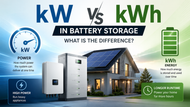
kW vs kWh in Battery Storage: What Is the Difference?
Posted by LINIOTECH on Jul 17th 2026
Battery storage specifications can look simple at first. A product page may mention 5kW, 10kW, 10kWh, 20kWh, 48V, 51.2V, 200Ah, peak output, usable capacity, and backup runtime. But for many homeowners and business buyers, the most confusing part is the difference between kW and kWh.
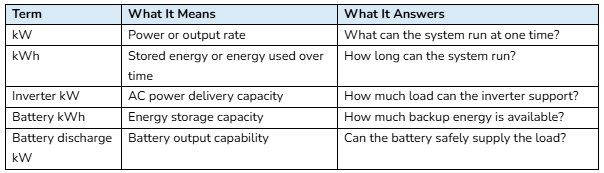
That confusion matters because kW and kWh answer two completely different questions. kW tells you how much power a battery or inverter can deliver at one time. kWh tells you how much energy is stored and how long your loads can keep running.
In simple terms, kW is the strength of the system at a moment in time. kWh is the size of the energy tank. If you mix them up, you may buy a battery that has enough stored energy but cannot power your larger appliances, or you may choose a powerful inverter with too little battery capacity to run through an outage.
This guide explains kW vs kWh in battery storage, how both affect solar backup performance, and what to check before choosing a home or commercial energy storage system.
Quick Answer: kW vs kWh in Battery Storage
kW, or kilowatt, measures power. It tells you how much electricity a battery, inverter, or appliance can deliver or use at one time.
kWh, or kilowatt-hour, measures energy. It tells you how much electricity is stored or consumed over time.
For example, a 2kW load running for 5 hours uses 10kWh of energy:
2kW x 5 hours = 10kWh
That simple formula is the foundation of battery sizing. Once you know the power of your loads and how long they need to run, you can estimate the required storage capacity.
What is kW?
kW stands for kilowatt. One kilowatt equals 1,000 watts. In a solar battery system, kW usually describes power - the rate at which electricity is delivered, consumed, charged, or discharged.
For battery storage, kW may appear in several places:
- Inverter output rating, such as 6kW, 8kW, 10kW, or 15kW.
- Battery continuous discharge rating.
- Battery peak discharge rating.
- Appliance running load.
- Solar inverter charging power.
- Commercial BESS output capacity.
A 10kW inverter, for example, can theoretically deliver up to 10,000 watts of AC power at one time, depending on its manufacturer's specifications, voltage configuration, surge capacity, and operating conditions. That does not mean the system has 10kWh of stored electricity. It only describes the output level that the inverter is built to support.
What is kWh?
kWh stands for kilowatt-hour. It measures energy over time. In battery storage, kWh is the metric used to estimate backup runtime.
A 10kWh battery can store about 10 kilowatt-hours of nominal energy. A 20kWh battery stores about twice as much nominal energy. But usable energy may be lower than nominal energy after accounting for system limits, reserve settings, depth of discharge, inverter losses, and battery management protections.
This is why two batteries with similar names may not provide the same real-world runtime. Always check whether the specification is nominal capacity, usable capacity, or recommended usable capacity.
The Simple Formula: Power x Time = Energy
Most battery sizing begins with one basic formula:
kWh needed = kW load x hours of runtime
Here are simple examples:
- A 1kW load for 10 hours uses 10kWh.
- A 2kW load for 5 hours uses 10kWh.
- A 5kW load for 2 hours uses 10kWh.
- A 10kW load for 1 hour uses 10kWh.
All four examples use the same amount of stored energy, but the power demand is very different. This is why battery capacity alone does not tell the full story. A 10kWh battery may store enough energy for a task, but the battery and inverter must also be able to deliver the required kW at that moment.
Why kW and kWh Both Matter in Solar Battery Systems
A reliable solar battery system must be sized for both power and energy. If either side is wrong, the system may disappoint the user even if the product looks strong on paper.
kW Determines What You Can Run at the Same Time
The kW rating affects simultaneous load support. If a home is running a refrigerator, lights, Wi-Fi, a well pump, a microwave, and an HVAC load at the same time, the combined running load may become several kilowatts.
Motor-driven appliances can also create startup surges. Pumps, compressors, air conditioners, and power tools may briefly demand more than their normal running wattage. The inverter and battery must handle those temporary peaks safely.
kWh Determines How Long the Loads Can Run
The kWh rating affects runtime. A larger battery bank gives the system more stored energy for nighttime use, outages, cloudy periods, and solar self-consumption. A 20kWh bank generally gives more flexibility than a 10kWh bank, assuming the system is designed correctly.
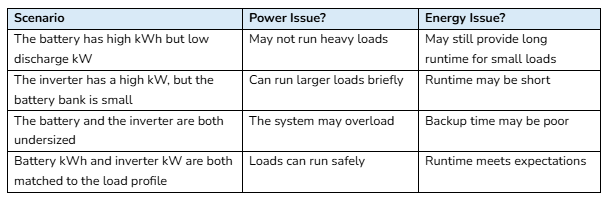
However, more kWh does not automatically mean more power output. A large battery with limited discharge power may still struggle to run high-demand loads.
Common Misconception: A 10kW Inverter Needs a 10kWh Battery
This is one of the most common mistakes in solar storage planning. A 10kW inverter does not automatically need a 10kWh battery. The correct battery size depends on the load profile, desired backup time, battery discharge limits, and solar recharging schedule.
A 10kWh battery paired with a 10kW inverter could theoretically be drained quickly under heavy load. A 20kWh or 30kWh battery bank may be more practical for homes that need longer backup or regular overnight energy use.
For a deeper inverter-specific sizing guide, read LINIOTECH’s article on how much battery storage a 10kW inverter needs.
Battery Power Rating vs Battery Capacity
A battery can have two major performance numbers: power rating and energy capacity. Both matter.
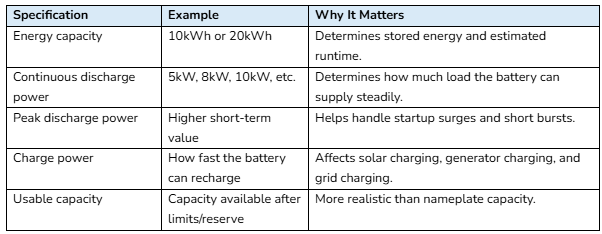
For example, a battery system may store 20kWh of energy but only allow 5kW of continuous output. That system could provide useful backup time, but it may not support every heavy load at once. Another system may deliver higher power output but have less stored energy, giving strong short-term performance but shorter runtime.
How kW and kWh Affect Home Battery Backup
For home backup, the first step is deciding whether the system will protect only essential loads or support larger whole-home comfort loads.
Essential-Load Backup
Essential-load backup usually includes refrigerators, freezers, lights, Wi-Fi, security systems, outlets, medical devices, and selected pumps. This type of setup often requires less power and can stretch battery runtime longer.
Whole-Home Backup
Whole-home backup may include HVAC, electric cooking, laundry, water heating, well pumps, and more outlets. It requires more inverter power, more battery output capability, and usually more stored energy.
Solar Self-Consumption
For solar self-consumption, the goal is often to store daytime solar energy and use it later in the evening or overnight. In that case, kWh is especially important because the battery must cover the home’s normal evening load. kW still matters when several appliances run at the same time.
Example: Estimating Battery Runtime with kW and kWh
Imagine a home with these selected backup loads:

The simplified total is about 10.75kWh before accounting for inverter losses, reserve capacity, weather, battery limits, and real-world usage variation. In this case, a battery system above 10kWh may be more comfortable than a battery that is exactly 10kWh on paper.
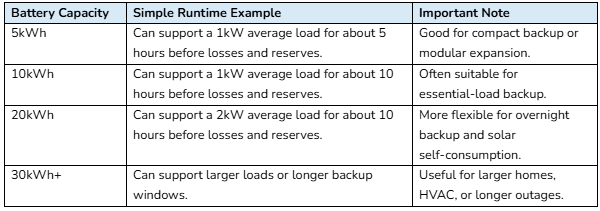
10kWh vs 20kWh: How the Difference Feels in Real Life
A 10kWh battery and a 20kWh battery are not just two product sizes. They create different user experiences.
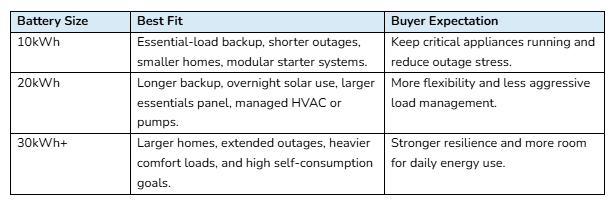
For homeowners comparing battery options, LINIOTECH offers wall-mounted and modular storage products that can support different backup goals. Explore the power storage wall battery collection for residential solar backup options.
How LiFePO4 Batteries Use kW and kWh Ratings
LiFePO4 batteries are widely used in solar energy storage because they are designed for long cycle life, stable chemistry, and solar backup applications. But even within LiFePO4 storage, the same kW vs kWh rule still applies.
A LiFePO4 battery module may be described by voltage and amp-hours, such as 51.2V and 100Ah. To estimate nominal energy, multiply voltage by amp-hours:
51.2V x 100Ah = 5,120Wh = 5.12kWh
That tells you the energy capacity of the module. It does not automatically tell you the maximum power output. For that, check the BMS, discharge current, inverter compatibility, and manufacturer instructions.
For modular battery expansion, review LINIOTECH rack LiFePO4 battery module options and confirm the final configuration with the required inverter and load profile.
Why Battery Voltage Also Matters
Voltage affects current. For the same power output, a lower-voltage system generally requires higher current than a higher-voltage system. Higher current can influence cable sizing, heat, protection equipment, and overall system design.
The power relationship is:
Power = Voltage x Current
For example, delivering 10kW from a 51.2V battery bank may require roughly 195A before losses:
10,000W ÷ 51.2V = about 195A
This is one reason inverter and battery compatibility should never be guessed. The battery bank must safely support the required current, and the inverter must be approved for the battery voltage and communication setup. For related voltage terminology, LINIOTECH’s guide on 48V vs 51.2V LiFePO4 batteries explains why many 48V-class systems list 51.2V nominal battery voltage.
What to Check on a Battery Spec Sheet
When reviewing a solar battery, do not look only at the biggest number on the page. Check these specifications together:
- Nominal energy capacity in kWh.
- Usable energy capacity in kWh.
- Maximum continuous charge and discharge power.
- Peak discharge rating and duration.
- Battery voltage and supported inverter voltage range.
- BMS communication, such as CAN or RS485, when required.
- Depth of discharge recommendations.
- Scalability limits for parallel or series configurations.
- Indoor or outdoor installation rating.
- Compatible inverter list or manufacturer guidance.
kW vs kWh for Commercial Battery Storage
For commercial and industrial battery energy storage systems, kW and kWh become even more important because the business goal may be different from home backup.
A commercial system may be designed for:
- Peak shaving, where high-demand spikes are reduced.
- Load shifting, where energy is stored and used during higher-cost periods.
- Backup power for critical operations.
- Demand charge management.
- Solar self-consumption for larger facilities.
- Microgrid or three-phase energy resilience.
In these cases, kW affects how much demand the battery can offset at one time. kWh affects how long the system can sustain that support. A business that wants to reduce brief demand spikes may need a different power-to-energy ratio than a business that needs several hours of backup power.
For larger applications, visit LINIOTECH industrial and commercial energy storage solutions to review commercial storage categories and system approaches.
How to Choose the Right Battery Using kW and kWh
The best way to choose battery storage is to build the system around the load profile, not around a random battery size.
- List the appliances, circuits, or equipment that must run during backup.
- Record the running power of each load in watts or kilowatts.
- Identify surge loads such as pumps, compressors, HVAC, refrigerators, and tools.
- Estimate how long each load needs to run during an outage or overnight period.
- Calculate energy required using kW x hours = kWh.
- Add a design margin for losses, reserve capacity, weather, and future expansion.
- Match the battery bank to a compatible inverter and confirm discharge limits.
Common Mistakes to Avoid
Mistake 1: Buying kWh Without Checking kW
A battery with enough stored energy may still fail to support heavy simultaneous loads if its discharge power is too low.
Mistake 2: Buying kW Without Enough kWh
A powerful inverter may run larger loads, but a small battery bank can drain quickly under heavy demand.
Mistake 3: Ignoring Usable Capacity
Nominal capacity and usable capacity are not always the same. Real backup planning should account for battery management limits, reserved energy, and conversion losses.
Mistake 4: Forgetting Startup Surge
Motor loads can briefly require more power at startup. Always check surge requirements for pumps, refrigerators, freezers, HVAC systems, and compressors.
Mistake 5: Mixing Incompatible Batteries or Inverters
Battery storage systems should be designed using approved battery models, the correct voltage class, proper communication, and manufacturer-supported configurations.
Where LINIOTECH Fits Into the kW vs kWh Decision
LINIOTECH provides battery storage and solar energy equipment for residential, commercial, and industrial applications. The right solution depends on whether the user needs essential backup, whole-home resilience, solar self-consumption, off-grid power, or business energy storage.
For residential systems, start with the load profile and backup-duration goal. Then match battery kWh, inverter kW, voltage class, and expansion capability. For larger systems, include demand profile, three-phase loads, peak shaving strategy, and commercial operating requirements.
You can explore LINIOTECH residential energy storage systems, hybrid solar inverter solutions, and broader solar energy storage products to compare system components as one complete energy setup.
Final Thoughts
kW and kWh are easy to confuse, but they are not interchangeable.
- kW tells you how much power the system can deliver or use at one time.
- kWh tells you how much energy is stored or consumed over time.
- Inverter kW affects what you can run simultaneously.
- Battery kWh affects how long your loads can keep running.
- Battery discharge kW affects whether the battery can safely support the inverter and loads.
A strong battery storage system is not built by choosing the largest number in isolation. It is built by matching power, energy, voltage, battery chemistry, inverter compatibility, load profile, and backup expectations.
Once you understand kW vs kWh, it becomes much easier to choose a battery system that performs the way you actually need it to perform.
FAQs
What is the difference between kW and kWh in battery storage?
kW measures power, while kWh measures stored energy. kW shows what a system can run at one time. kWh helps estimate how long the system can run.
Is a 10kW battery the same as a 10kWh battery?
No. A 10kW rating describes power output, while 10kWh describes energy capacity. They are related but not the same.
Does a higher kWh battery always provide more power?
Not always. A higher kWh battery stores more energy, but its output power depends on discharge rating, BMS limits, inverter compatibility, and system design.
How do I calculate battery runtime?
Use the basic formula kWh needed = kW load x hours of runtime. Then add design margin for losses, reserve capacity, and real-world load variation.
What does a 20kWh battery mean?
A 20kWh battery stores about 20 kilowatt-hours of nominal energy. Actual usable energy may be lower depending on system settings and battery limits.
Can a 10kWh battery run a whole house?
It depends on the home’s loads. A 10kWh battery may support essential loads, but whole-home backup with HVAC and heavy appliances usually requires careful sizing and often more storage.
Why does inverter kW matter?
Inverter kW affects how much AC power can be delivered at one time. It determines whether the system can run simultaneous loads such as pumps, appliances, HVAC, and electronics.
Why does battery discharge power matter?
Battery discharge power determines whether the battery can safely supply the inverter and loads. A battery may have enough energy but still be limited by output power.
Is kWh the same as Ah?
No. Ah measures amp-hours, while kWh measures energy. To estimate kWh, multiply voltage by amp-hours and divide by 1,000.
What battery size is best for solar backup?
The best size depends on your critical loads, average consumption, desired runtime, inverter size, and solar recharging ability. There is no single battery size that fits every home.