
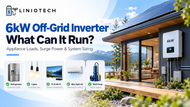
6kW Off-Grid Inverter, What Can It Run?
Posted by LINIOTECH on Oct 20th 2026
A 6kW off-grid inverter can run the core of a typical home at the same time: refrigerator, freezer, lights, internet, TV, a washing machine, a mini-split or window AC, and a well pump, as long as the large motor loads do not all start together. What a 6kW inverter can run comes down to three numbers: its continuous output, its surge capacity, and how the load is split across the two 120V legs.
Most sizing mistakes happen because buyers only look at the 6,000W headline. A well pump that draws 1,200W while running can demand four times that for a split second at startup, and a central air conditioner can demand even more. Below, the LINIOTECH team breaks down real appliance loads, what fits and what does not, and how to size the batteries and solar that keep a 6kW off-grid solar system running day after day.
What a 6kW Inverter Can Run: The Short Answer
A 6kW inverter delivers up to 6,000W of continuous AC power. In practice, you should plan to use about 80 percent of that, or roughly 4,800W, for loads that run for long periods. That leaves headroom for motor startups, heat, and loads that overlap without warning.
Within that budget, a 6kW inverter for home use comfortably handles:
- Refrigeration, freezers, lighting, internet, and electronics running all day
- One mini-split or window air conditioner
- A 1/2 to 1 HP well pump, provided the inverter’s surge rating covers its startup current
- Laundry, a microwave, or a coffee maker, used one at a time alongside the base loads
Where it struggles is with large resistive loads such as an electric water heater, electric dryer, or electric range, and with central air conditioners that have high startup current. Those loads either need a larger inverter, a second inverter in parallel, or careful scheduling so they never run at the same time as other heavy appliances.
6000W Inverter: What Can It Run? Appliance Watt Chart
Running watts are what an appliance draws once it is operating. Starting watts are the short spike when a motor or compressor kicks on. These are typical ranges, so check the nameplate on your own equipment for exact figures.
| Appliance | Running Watts | Starting Watts | On a 6kW Inverter |
|---|---|---|---|
| Refrigerator | 150 to 250W | 600 to 1,200W | Yes |
| Chest freezer | 80 to 150W | 500 to 800W | Yes |
| LED lighting (whole home) | 100 to 300W | None | Yes |
| Wi-Fi, TV, laptops | 150 to 400W | None | Yes |
| Furnace blower (gas furnace) | 400 to 800W | 1,000 to 2,000W | Yes |
| Washing machine | 500 to 1,000W | 1,200 to 2,000W | Yes, one load at a time |
| Microwave | 1,000 to 1,500W | None | Yes, short use |
| Window AC (10,000 BTU) | 900 to 1,200W | 2,000 to 3,000W | Yes |
| Mini-split (12,000 BTU) | 700 to 1,200W | Low (soft start) | Yes, best AC option |
| Well pump (1 HP, 240V) | 1,000 to 1,500W | 3,000 to 6,000W | Yes, if surge rating covers it |
| Central AC (3 ton, 240V) | 3,000 to 4,000W | 8,000W or more | Only with soft starter, little else running |
| Electric water heater (240V) | 4,500W | None | Not practical with other loads |
| Electric dryer (240V) | 5,000 to 5,500W | None | No, nearly the full output |
The pattern is clear. Electronics, refrigeration, lighting, and modest motor loads fit easily. High-wattage heating appliances eat almost the entire capacity, so most off-grid homes switch them to propane or gas, or run them only when solar production is strong and nothing else heavy is on.
Continuous vs Surge Power: Why 6kW Is Not Always 6kW
Every inverter has two ratings that matter. The continuous rating is what it can deliver indefinitely. The surge rating is the brief peak it can supply when a motor starts, often for less than a second up to a few seconds depending on the design.
High-frequency, transformerless all-in-one inverters, which make up most of today’s 6kW off-grid market, are compact and efficient but tend to have shorter surge windows. Low-frequency inverters with a heavy transformer usually hold a higher surge for longer, which helps with stubborn motor loads like older well pumps and air compressors. Neither type is wrong, but if your load list includes big motors, compare the surge spec and its duration, not just the continuous wattage.
Startup current is also cumulative. If the refrigerator compressor kicks on in the same moment as the well pump, both surges land on the inverter together. Staggering heavy loads, or adding a soft starter to the largest motor, is often the difference between a system that runs smoothly and one that trips several times a week.
6kW Split-Phase Inverter: 120V and 240V Loads
Most US homes use 120/240V split-phase power. A 6kW split-phase inverter supplies two 120V legs plus 240V across them, which lets it run 240V equipment like well pumps, mini-splits, and some shop tools without a separate transformer.
There is a catch many buyers miss. On many 6kW split-phase units, each 120V leg can only deliver about half the inverter’s total output. If you put every 120V load on one leg, that leg can overload while the inverter is nowhere near 6,000W overall. During installation, balance 120V circuits across both legs, and check the per-leg rating in the datasheet before you finalize the panel layout.
When one inverter is not enough, many 6kW models can run in parallel. Two units give you 12kW of continuous output and double the surge capacity, which opens the door to central air and heavier shop loads. LINIOTECH hybrid inverters and the LuxPower hybrid inverter range we stock both support stacking for growing off-grid and backup systems.
Can a 6kW Inverter Run AC?
Yes, with the right type of air conditioner. A 6kW inverter runs a window unit or a ductless mini-split easily. Inverter-driven mini-splits are the best match for off-grid solar because they ramp up slowly instead of hitting the inverter with a single large startup spike, and they run efficiently at partial speed most of the day.
Central air is harder. A 3-ton central AC can draw 3,000 to 4,000W while running and much more during the first fraction of a second at startup. Look for the locked rotor amps (LRA) on the condenser nameplate and compare that against the inverter’s surge rating. A soft starter fitted to the compressor often cuts the startup spike by more than half, which can bring a 2 or 3-ton unit within reach of a single 6kW inverter, though very little else should be running when it starts.
Power is only half the story. Running a 3,500W air conditioner for eight hours uses 28kWh of energy, which demands a large battery bank and solar array. Our guide to solar battery backup for air conditioning shows how to size storage for cooling loads.
Can a 6kW Inverter Run a Well Pump?
In most cases, yes. A 1/2 to 1 HP submersible pump running on 240V typically draws 1,000 to 1,500W once running, which is well within a 6kW inverter’s continuous rating. The challenge is startup. Some pumps briefly pull several times their running current, so a pump that looks small on paper can still trip an inverter with a short surge window.
Practical fixes include a soft-start or variable-speed pump controller, a pressure tank sized to reduce how often the pump cycles, and keeping other big motors off while the pump starts. Our article on battery backup for well pumps covers pump sizing and storage in more depth.
Battery Sizing for a 6kW Off-Grid Solar System
The inverter sets how much power you can draw at once. The battery bank sets how long you can keep drawing it. If those two terms still blur together, our explainer on kW vs kWh in battery storage clears it up.
Match the Battery to the Inverter’s Current
At full output, a 6kW inverter on a 48V battery pulls roughly 125 to 135 amps of DC current. Many 48V 100Ah rack modules are rated around 100A of continuous discharge, so one module alone cannot support the inverter at full power, even if its kWh looks adequate. Plan at least two modules to cover current, and more to cover runtime. Stackable units like the LINIOTECH LifePower4 5.12kWh 51.2V battery let you build the bank in 5kWh steps and share the load across modules.
Size the Bank for Daily Energy
Here is a realistic daily load for a small off-grid home on a 6kW inverter:
- Refrigerator and chest freezer: about 2.5kWh
- Lighting, internet, TV, and laptops: about 2kWh
- Well pump: about 1.5kWh
- Laundry, microwave, and coffee maker: about 1.5kWh
- 12,000 BTU mini-split for 8 hours: about 7kWh
- Inverter self-consumption over 24 hours: about 1 to 1.5kWh
That adds up to roughly 16kWh per day. To cover one night and a cloudy morning while keeping the battery above 20 percent, a bank of around 20kWh, such as four 5.12kWh modules, is a solid starting point. Add more storage if you want two or three days of autonomy without a generator.
How Much Solar Does a 6kW Off-Grid Inverter Need?
To replace 16kWh per day in a location with 5 peak sun hours, you need roughly 4 to 5kW of solar after real-world losses. Winter brings shorter days and lower output, so many off-grid designs push toward 6kW of panels or more for margin. Most 6kW all-in-one off-grid inverters accept between about 6.5 and 9kW of PV input through one or two MPPTs, so check the maximum PV power and voltage limits before you buy panels.
Off-grid systems also benefit from a backup generator input. On long cloudy stretches, a generator can recharge the batteries in a few hours and protect them from deep discharge. LINIOTECH carries Honda generators and portable power stations for this role, and our comparison of solar battery vs generator backup explains how the two work together.
Is a 6kW Inverter Enough for Your Home?
A 6kW inverter is the right size for cabins, tiny homes, small off-grid houses, and essential-load backup in larger homes. It struggles as a whole-home solution for houses with electric heating, electric cooking, central air, and an EV charger all on the same system. If you are deciding between backing up everything or only critical circuits, our guide to whole-home vs essential-load battery backup walks through the trade-offs.
For a ready-to-install starting point, the LINIOTECH 6.5kW inverter with 5kWh battery off-grid bundle pairs the inverter with LiFePO4 storage and leaves room to add battery modules as your loads grow.
Build a 6kW Off-Grid System That Runs What You Need With LINIOTECH
What a 6kW inverter can run depends less on the headline number and more on surge capacity, how the 120V legs are balanced, and whether the battery bank can deliver the current and energy your home actually uses. Get those right and a 6kW system will run refrigeration, cooling, water, and everyday appliances reliably off the grid.
LINIOTECH supplies split-phase hybrid inverters, UL-certified LiFePO4 batteries, and complete off-grid bundles, along with technical support to match your system to your real loads. Contact the LINIOTECH team today for a free quote and build a 6kW off-grid system that keeps your home running, sun or storm.
FAQs About What a 6kW Inverter Can Run
What can a 6kW inverter run at the same time?
A 6kW inverter can run a refrigerator, freezer, lights, internet, TV, a washing machine, and a mini-split or window AC at the same time, with room left for short loads like a microwave. Keep continuous use around 4,800W and avoid starting several large motors together.
Can a 6kW inverter run central air conditioning?
Sometimes. A 2 to 3-ton central AC may run on a 6kW inverter if the inverter’s surge rating covers the compressor’s locked rotor amps, usually with a soft starter fitted. Very little else should be running when the compressor starts. A mini-split is a far easier match.
Can a 6000W inverter run a well pump?
Yes, most 1/2 to 1 HP well pumps run on a 6000W inverter. The pump must be 240V-compatible with a split-phase inverter, and the inverter’s surge rating needs to cover the pump’s startup current. A soft-start controller makes the startup much easier on the system.
How many batteries do I need for a 6kW off-grid inverter?
At least two 48V 100Ah modules to supply the 125A or more the inverter draws at full output. For daily runtime, most small off-grid homes need around 15 to 20kWh of storage, which is three to four 5kWh modules.
Is a 6kW inverter enough to power a house?
It is enough for a small or energy-efficient home, or for essential circuits in a larger house. Homes with electric water heating, electric dryers, central air, and EV charging usually need 12kW or more, either from a larger inverter or two 6kW units in parallel.
How many solar panels do I need for a 6kW off-grid inverter?
For about 16kWh per day of use, plan on 4 to 6kW of solar, which is roughly 10 to 15 panels rated at 400W. Stay within the inverter’s maximum PV input and voltage limits, and add margin if you rely on solar through the winter.