
Solar Battery Backup for Air Conditioning: How Much Power Do You Need?
Posted by LINIOTECH on Aug 11th 2026
Air conditioning is one of the biggest reasons homeowners start looking seriously at solar battery backup. Keeping the refrigerator, lights, internet, and a few outlets running is one thing. Keeping the house cool during a summer outage is a very different energy challenge.
A solar battery can run air conditioning, but the system must be sized correctly. The battery bank needs enough energy capacity in kWh, the inverter needs enough output power in kW, and the system needs enough surge capability to start the AC compressor without shutting down.
The right setup depends on the type of air conditioner, the size of the unit, how long you want it to run, whether solar panels can recharge the battery during the day, and whether you want whole-home backup or only essential-load backup.
For homeowners planning AC backup as part of a full solar-plus-storage setup, LINIOTECH residential energy storage solutions can help connect the battery, inverter, solar array, and backup-load plan into one system instead of treating each component separately.
Quick Answer: Can a Solar Battery Run an Air Conditioner?
Yes, a solar battery can run an air conditioner if the battery and inverter are sized for the AC load. A small window unit or efficient mini-split may need only 500W to 1,500W while running. A larger central AC system may require several kilowatts while running and much more power for startup surge.
For many homes, light AC backup may be possible with about 10kWh to 20kWh of usable storage. Longer overnight cooling, central AC, or whole-home backup may require 30kWh to 50kWh or more, depending on the home and the equipment.
The safest answer always comes from the AC nameplate, the inverter specifications, and a real backup-load calculation.
Why Air Conditioning Is Harder to Back Up Than Basic Loads
Most essential loads are relatively predictable. A Wi-Fi router, LED lights, laptop, TV, or phone charger uses modest power. Air conditioning is different because it combines three challenges:
- High running power
- Compressor startup surge
- Long runtime during hot weather
A refrigerator may cycle on and off. An AC system can run for hours, especially during August heat. That means the battery has to cover both the momentary startup demand and the total energy consumed over time.
This is the same reason inverter sizing and battery sizing should be separated. For a deeper explanation, read 10kW Off-Grid Inverter: What Can It Run? and How Much Battery Storage Does a 10kW Inverter Need?.
kW vs kWh: The First Thing to Understand
Before sizing battery backup for AC, separate these two terms:
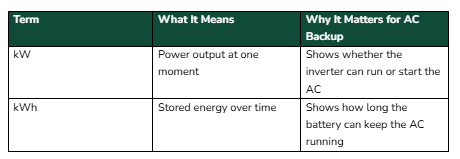
Example: If an air conditioner draws 3kW while running for 4 hours, it uses about 12kWh before accounting for losses and reserve capacity.
Simple formula:
AC energy needed = AC running power × runtime
Battery size needed = energy needed ÷ usable battery percentage
How Much Power Does an Air Conditioner Use?
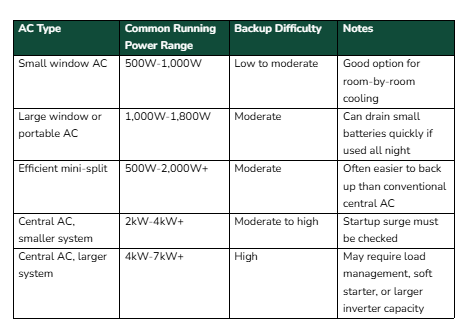
Air conditioner power use varies widely. The size of the space, insulation, outdoor temperature, AC efficiency, compressor type, thermostat setting, duct design, and runtime all affect the result.
Use the table below only as a planning guide. For a real system design, always check the equipment nameplate or manufacturer data.
Startup Surge: The Hidden AC Backup Problem
The running wattage of an AC unit is only part of the story. Many air conditioners need a higher burst of power when the compressor starts. This is called startup surge or inrush current.
If the inverter cannot handle that surge, the system may trip, shut down, or fail to start the AC even if the battery has enough stored energy.
This is why an AC backup plan should check:
- AC running watts or running amps
- Locked rotor amps or starting demand
- Inverter continuous output
- Inverter surge output and surge duration
- Battery discharge current
- BMS protection limits
- Whether the system supports 120V, 240V, or split-phase output as needed
If the battery and inverter cannot communicate or the discharge current is too low, AC performance can suffer. Review Battery and Inverter Compatibility: What to Check Before You Buy before finalizing an AC backup system.
How Much Battery Capacity Do You Need to Run AC?
Battery capacity depends on how much power the AC uses and how long you want it to run. The formula is simple, but the real answer needs a margin for inverter losses, battery reserve, and hot-weather conditions.
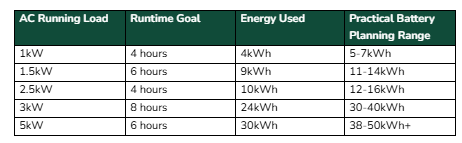
These planning ranges include margin because batteries should not always be drained to zero, and inverter conversion losses reduce usable energy. The hotter the weather and the longer the outage, the more margin matters.
Example 1: Small Room AC Backup
Suppose a homeowner wants to run a small window AC that draws about 900W.
- AC load: 0.9kW
- Runtime goal: 6 hours
- Energy needed: 0.9kW × 6 hours = 5.4kWh
After accounting for reserve and inverter losses, a practical battery target may be around 7-10kWh. This is a realistic backup goal for one cooled room, especially if solar panels recharge the battery during the day.
Example 2: Mini-Split Backup
An efficient mini-split may use much less power than a conventional central AC system, especially once the room reaches the set temperature. If the mini-split averages around 1.2kW over the cooling period:
- Average AC load: 1.2kW
- Runtime goal: 8 hours
- Energy needed: 1.2kW × 8 hours = 9.6kWh
With system margin, this may point toward 12kWh to 16kWh of battery storage. This can be a smart resilience strategy: cool one or two priority spaces instead of trying to cool the entire house during an extended outage.
Example 3: Central AC Backup
Now consider a central AC system that averages 3.5kW while operating.
- Average AC load: 3.5kW
- Runtime goal: 6 hours
- Energy needed: 3.5kW × 6 hours = 21kWh
After margin, a central AC backup plan may require roughly 27kWh to 35kWh or more. If the homeowner also wants to run refrigerators, lights, internet, pumps, and other loads, the battery requirement increases.
Central AC backup is possible, but it is rarely a “small battery” problem. It needs the right inverter, battery bank, wiring, load management, and startup-surge planning.
Whole-Home Backup vs Essential-Load Backup for AC
One of the biggest decisions is whether the battery system should back up the entire home or only selected circuits.
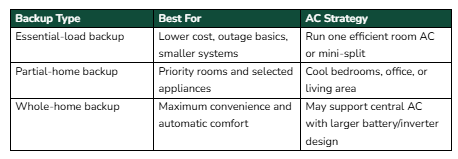
For many homes, the most cost-effective plan is not to run every load. It is to keep one or two spaces cool, protect food storage, maintain internet and lighting, and avoid draining the battery too quickly.
LINIOTECH power storage wall battery options and rack LiFePO4 battery modules can support different capacity layouts depending on whether the goal is essential-load backup, partial-home backup, or more extensive backup coverage.
Do You Need a 10kW Inverter for AC Backup?
Not always. A 10kW inverter may be useful for homes with larger simultaneous loads, central AC, well pumps, kitchen appliances, or workshop equipment. But a smaller system may be enough if the goal is to run a room AC, lights, fridge, Wi-Fi, and basic outlets.
The inverter should be sized around peak simultaneous demand, not just the AC by itself.
For larger systems, compare the load examples in 10kW Off-Grid Inverter: What Can It Run? and then use How Much Battery Storage Does a 10kW Inverter Need? to estimate runtime.
Can Solar Panels Recharge the Battery While Running AC?
Yes, solar panels can help recharge the battery and support AC loads during the day, but only if the solar array, inverter, charge controller, and battery bank are sized correctly.
During sunny hours, solar can reduce how quickly the battery drains. But solar production changes with cloud cover, roof angle, shading, temperature, and time of day. In late afternoon or evening, AC demand may remain high while solar production drops.
That is why a strong AC backup plan should include both:
- Enough battery storage for the expected outage period
- Enough solar charging capacity to recover energy during daylight
For solar-array planning, review LINIOTECH bifacial solar panel solutions and consider whether the system should be AC-coupled or DC-coupled battery storage based on the existing solar setup.
AC Backup Planning Checklist
Before buying a battery system for air conditioning, gather these details:
- AC type: window unit, portable unit, mini-split, or central AC
- AC voltage requirement: 120V, 240V, or split-phase
- Running watts or running amps
- Startup surge or locked rotor amps
- Expected runtime during an outage
- Other loads that must run with the AC
- Battery usable capacity in kWh
- Battery continuous discharge rating
- Inverter continuous and surge output
- Solar charging capacity during the day
- Whether load management or a soft starter is needed
Common Mistakes When Sizing Battery Backup for AC
Mistake 1: Looking Only at Battery kWh
A large battery is not enough if the inverter cannot start the AC compressor or if the battery discharge rating is too low.
Mistake 2: Ignoring Startup Surge
AC startup surge can be much higher than normal running power. This is one of the most common reasons a backup system fails to run air conditioning.
Mistake 3: Trying to Back Up the Whole House With a Small Battery
A 10kWh battery may be excellent for essential loads, but whole-home AC backup can require much more energy, especially overnight.
Mistake 4: Forgetting About Other Loads
The AC is rarely the only load. Refrigerators, lights, internet, well pumps, cooking appliances, and medical devices may also need backup power.
Mistake 5: Assuming Solar Always Keeps Up With AC
Solar production can help, but clouds, shading, temperature, and late-day cooling demand can reduce how much energy is available.
Best Setup for Most Homeowners
For many households, the most practical August outage strategy is not to cool the entire home. A smarter setup is often:
- Back up one efficient mini-split or room AC
- Keep refrigerators, lights, Wi-Fi, and key outlets running
- Use load management to avoid running heavy appliances together
- Add enough solar input to recharge during the day
- Use scalable LiFePO4 batteries so capacity can grow later
This approach can keep the home livable without oversizing the system unnecessarily.
Build AC Backup Around the Complete System
A reliable solar battery backup system for air conditioning is not just one battery. It is a complete energy system built around the load profile.
The key components are:
- Solar panels
- Hybrid inverter or battery inverter
- LiFePO4 battery bank
- Backup-load panel or whole-home transfer setup
- Battery management and inverter communication
- Load management strategy
LINIOTECH provides hybrid inverter solutions, LiFePO4 battery storage, and complete home energy storage systems for homeowners who want backup power, solar self-consumption, and better energy control during outages.
Final Thoughts
A solar battery can run air conditioning, but the system must be designed for the AC load. A small room AC may need a modest battery system. A larger central AC system may require a much larger battery bank, stronger inverter output, startup-surge planning, and load management.
The most important questions are:
- How many watts does the AC use while running?
- How much surge power does it need to start?
- How many hours should it run during an outage?
- What other loads must run at the same time?
- Can solar panels recharge the battery during the day?
For a balanced solar-plus-storage design, explore LINIOTECH energy solutions and match your AC backup goal with the right inverter, battery capacity, solar charging setup, and load-management plan.
FAQs
Can a solar battery run an air conditioner?
Yes. A solar battery can run an air conditioner if the inverter output, battery discharge rating, and battery capacity are sized for the AC load and startup surge.
How many batteries do I need to run AC?
It depends on the AC size and runtime goal. A small room AC may need around 7kWh to 10kWh for several hours. Central AC backup can require 30-50kWh or more for extended cooling.
Can a 10kWh battery run an air conditioner?
A 10kWh battery can run some smaller AC loads for a limited time. It may not be enough for long central AC backup, especially if other home loads are running.
Can a solar battery run central AC?
Yes, but central AC backup usually needs a larger inverter, high surge capability, enough battery capacity, and sometimes a soft starter or load management system.
Is a mini-split better for battery backup than central AC?
Often yes. Efficient mini-splits can be easier to support with battery backup because they may use less power and can cool priority rooms instead of the whole house.
Does AC drain a solar battery fast?
It can. Air conditioning is usually one of the highest loads in a home, especially during hot weather when runtime is long.
Can solar panels run AC during the day without batteries?
Solar panels can support AC during the day when production is strong, but batteries or grid support are usually needed for stable operation, evening cooling, cloud cover, and outage backup.
Do I need a soft starter for AC backup?
Some central AC systems may benefit from a soft starter because it can reduce startup demand. Whether it is needed depends on the AC and inverter specifications.
What is better for outages: whole-home backup or essential-load backup?
Essential-load backup is usually more affordable and efficient. Whole-home backup offers more convenience but needs a larger system, especially if central AC is included.
What should I check before buying an AC battery backup system?
Check AC running watts, startup surge, voltage, required runtime, other backup loads, battery capacity, battery discharge rating, inverter output, solar charging capacity, and installer requirements.