
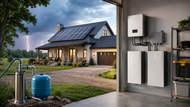
Battery Backup for Well Pumps: Solar Storage Sizing for Rural Homes
Posted by LINIOTECH on Aug 20th 2026
For rural homeowners, losing power does not only mean losing lights, Wi-Fi, refrigeration, or air conditioning. It can also mean losing access to water. If your property uses a private well, the well pump becomes one of the most important loads to protect during a blackout.
A battery backup system can run a well pump, but it must be sized differently from simple household electronics. A pump is a motor load. It needs normal running power after it starts, but it can also demand a short burst of higher startup power when the motor turns on. That startup surge is where many undersized backup systems fail.
This guide explains how to size battery backup for a well pump, how much inverter power is needed, how much battery storage makes sense, and how solar panels can help recharge the system during longer outages.
Quick Answer: How Much Battery Backup Does a Well Pump Need?
Most rural homes should plan for a split-phase inverter that can support the pump voltage, enough surge capacity to start the pump motor, and enough battery capacity to cover the pump run time plus other essential loads. A small well-pump-only backup setup may use only a few kilowatt-hours per day, but a practical whole-home essential backup system often needs 10kWh, 20kWh, or more depending on refrigeration, lighting, electronics, HVAC, and water usage.
A safe planning process looks like this:
- Confirm whether the pump is 120V or 240V.
- Check the pump horsepower, running amps, and starting demand.
- Choose an inverter with enough continuous and surge output.
- Estimate how many minutes the pump runs per day during an outage.
- Add battery storage for the pump plus the other loads you want to protect.
- Add solar recharge if the outage may last longer than one day.
If you are still learning how battery capacity and inverter power work together, read LINIOTECH guide: kW vs kWh in Battery Storage: What Is the Difference? It explains why inverter output and battery runtime must be sized separately.
Why Well Pumps Need Special Backup Sizing
A refrigerator, LED light, router, or phone charger is relatively easy to estimate. A well pump is more demanding because it combines several sizing challenges at once: motor startup surge, voltage requirements, pressure-tank cycling, wiring distance, and water demand during the outage.
The most important point is simple: the inverter must start the pump, not just run it. A pump that uses moderate power after startup may still trip an undersized inverter if the starting surge is too high. This is why a backup system that looks large enough on paper can still fail the moment the pump turns on.
Typical Well Pump Power Ranges
The exact power requirement depends on the specific pump, motor, depth, pressure settings, wiring, and voltage. Use the pump nameplate or installer documentation whenever possible. The table below is only a planning guide for early conversations.
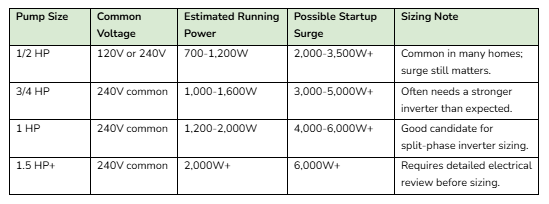
These ranges are intentionally conservative because real-world pump startup behavior can vary. For final design, do not rely on horsepower alone. The pump nameplate, measured amps, locked-rotor data, and inverter surge rating are more useful than a generic wattage estimate.
120V vs 240V Well Pumps
Many private well pumps in North American homes use 240V power, especially deeper wells and larger submersible pumps. That matters because not every portable battery, inverter, or backup unit can deliver native 120/240V split-phase output.
If the well pump requires 240V, the backup system must provide compatible 240V output and enough starting capacity. For rural homes, a split-phase solar inverter is often a better fit than a smaller 120V-only backup device.
LINIOTECH 7.2kW 120/240V split-phase solar inverter charger is one example of an inverter category designed for homes and properties that need both 120V household circuits and compatible 240V loads. For broader inverter options, review LINIOTECH hybrid solar inverter solutions.
How to Size the Inverter for a Well Pump
Inverter sizing starts with power, not battery capacity. The inverter must handle the pump’s running power and short startup surge while also supporting any other loads that may be running at the same time.
Use this basic sizing logic:
- Continuous inverter output should be higher than the combined running wattage of the well pump and essential loads.
- Surge output should be high enough to start the pump motor without tripping the inverter.
- Output voltage must match the pump voltage, especially for 240V pumps.
- The battery bank must be able to deliver the required discharge current safely.
For example, if a rural home may run a well pump, refrigerator, freezer, lights, Wi-Fi, and a few outlets during an outage, the inverter should be sized around the combined peak scenario instead of the pump alone. LINIOTECH article 10kW Off-Grid Inverter: What Can It Run? is a useful supporting guide for understanding how well pumps interact with other home loads.
How to Size Battery Capacity for a Well Pump
Battery sizing is about runtime. The pump may draw high power when it runs, but it usually does not run nonstop all day. A pressure tank stores pressurized water and allows the pump to cycle on and off. That is why daily pump run time is often more important than pump horsepower when estimating battery capacity.
Use this simple formula for a first-pass estimate:
Battery energy needed = pump running watts x pump run hours / 1,000
Then add a safety margin for inverter losses, battery reserve, surge events, and real-world water use. If you also want backup for refrigerators, lights, internet, medical equipment, HVAC, or cooking loads, add those loads separately rather than hiding them inside the pump calculation.
Example 1: Small Well-Pump-Only Backup
Assume a 1/2 HP well pump uses around 1,000W while running and runs for one total hour during a day of outage conditions.
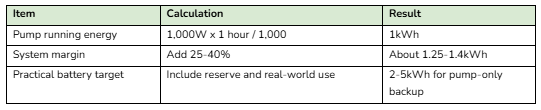
This kind of setup may be enough for very limited emergency water use, but it does not cover a broader home backup plan. Most homeowners want refrigeration, communication, lights, outlets, and sometimes heating or cooling support too.
Example 2: Rural Home Essential Backup
Now assume the home needs the well pump plus basic household essentials during a blackout. The pump runs for one hour total, while the refrigerator, freezer, lights, router, and outlets run for longer periods.
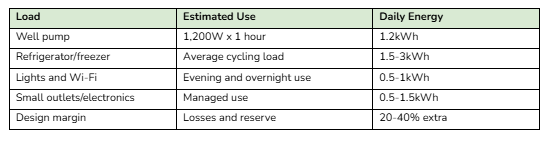
In this scenario, a 10kWh battery may provide a practical starting point for essential backup, while 20kWh or more may be better for longer outages, higher water demand, or additional loads. For a deeper inverter-and-battery sizing example, see LINIOTECH guide: How Much Battery Storage Does a 10kW Inverter Need?.
Is a 10kWh Battery Enough for a Well Pump?
A 10kWh battery can be enough for many well-pump backup scenarios when the pump is not running constantly and the homeowner manages other loads carefully. The key is to treat the well pump as an essential load, not as the only load in the house.
For many rural homes, the better question is not “Can one battery run my well pump?” The better question is “How much water and essential power do I need before solar recharge or grid power returns?”
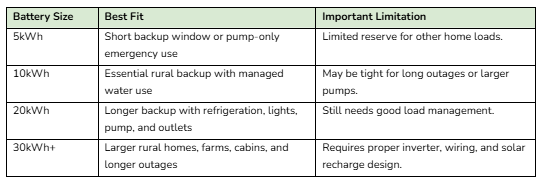
For homeowners comparing battery options, LINIOTECH power storage wall batteries and rack LiFePO4 battery modules can be used to plan different storage capacities for residential and larger backup systems.
How Solar Panels Change the Backup Plan
Battery backup is most useful when it is paired with solar recharge. Without solar, the battery is a stored-energy tank. Once it is empty, the backup window is over. With solar panels, the system can recharge during daylight and support a longer outage if weather and system design allow it.
For well-pump backup, solar recharge is especially valuable because water use can be scheduled during the day. A homeowner can pump water, refill a pressure tank, run essential loads, and recover battery capacity while the solar array is producing.
If the property is planning a new solar-plus-storage system, the design should account for solar array size, MPPT limits, inverter compatibility, battery recharge rate, and backup load priority. LINIOTECH bifacial solar panel solutions and the AC-coupled vs DC-coupled battery storage guide are useful internal resources for planning the solar side of the system.
Battery and Inverter Compatibility Matters
A well pump is not the place to guess on compatibility. The inverter, battery, BMS, wiring, and pump requirements all have to work together. Even if the battery has enough stored energy, the system may still fail if the inverter cannot provide the required split-phase output, surge power, or discharge current.
Before finalizing a system, confirm battery voltage range, maximum discharge current, inverter communication, charge limits, and manufacturer-approved battery settings. LINIOTECH Battery and Inverter Compatibility guide explains these checks in more detail.
Load Management for Rural Homes
A rural backup system becomes more reliable when the homeowner manages heavy loads intentionally. During an outage, the well pump may not be the only high-demand load. Refrigerators, freezers, air conditioning, electric water heating, microwave ovens, dryers, and power tools can quickly stack on top of each other.
The goal is to avoid starting every heavy load at once. If the pump starts while an air conditioner, microwave, electric oven, and freezer compressor are all running, the surge event may be much harder on the inverter. A better backup strategy prioritizes water, refrigeration, communication, lighting, and selected outlets first.
For a broader home backup comparison, see LINIOTECH article Whole-Home vs Essential-Load Battery Backup: Which Setup Is Better? once it is published in the August cluster.
Battery Backup vs Generator for Well Pumps
Generators have long been used for rural well-pump backup, and they can still be useful for extended outages or very large motor loads. But battery storage offers a different set of advantages: automatic operation, quiet backup, no routine fuel handling during an emergency, solar recharge potential, and cleaner operation around the home.
The strongest design may depend on the property. Some homeowners want battery backup for daily reliability and solar self-consumption, while keeping a generator as a secondary emergency source. Others prefer a solar-plus-battery setup for quieter and more automated backup of essential loads.
If your main concern is whether solar batteries can support a home during an outage, LINIOTECH article Can Solar Batteries Power My House During a Blackout? is a good supporting resource.
Well Pump Backup Sizing Checklist
Before choosing battery backup for a well pump, gather these details. They will make the sizing conversation much more accurate and reduce the risk of buying the wrong system.
- Pump voltage: 120V or 240V.
- Pump horsepower and motor type.
- Running amps and starting amps if available.
- Estimated pump run time per day during an outage.
- Pressure tank size and pressure switch settings.
- Other essential loads that will run at the same time.
- Desired backup duration: one day, two days, three days, or longer.
- Solar array size and daily recharge expectation.
- Inverter continuous output, surge rating, and split-phase capability.
- Battery usable capacity and maximum discharge current.
Common Mistakes to Avoid
Mistake 1: Sizing Only by Pump Horsepower
Horsepower is useful, but it is not enough. Voltage, amps, surge, pressure settings, and real run time matter more for battery and inverter sizing.
Mistake 2: Ignoring Startup Surge
A well pump may need far more power for a short moment when it starts. If the inverter cannot handle that surge, the pump may not start reliably.
Mistake 3: Choosing a 120V Backup Unit for a 240V Pump
Many well pumps require 240V. Always verify pump voltage before buying a battery backup or inverter.
Mistake 4: Forgetting Other Essential Loads
Most rural homeowners do not only need water. They also need refrigeration, lights, internet, outlets, and sometimes HVAC or heating support.
Mistake 5: Treating Solar Recharge as Guaranteed
Solar recharge depends on system size, weather, shading, season, and panel orientation. It should be included in the design, but the battery should still be sized for realistic outage conditions.
Build a Rural Backup System Around Water, Power, and Runtime
A well-pump backup system should be designed around real daily life. During an outage, a rural home needs water access, food preservation, communication, safety lighting, and enough stored energy to bridge the backup window.
LINIOTECH provides home energy storage systems, LiFePO4 battery storage, and hybrid inverter solutions that can help homeowners build a more dependable backup plan for rural and off-grid properties. The right system should combine inverter output, surge capacity, battery storage, solar charging, and load management into one balanced design.
For a private-well property, do not start with a battery size alone. Start with the well pump, the essential loads, the backup duration, and the solar recharge plan. From there, the battery and inverter can be matched to the actual use case.
Final Thoughts
Battery backup can run a well pump, but the system must be sized correctly. The most important details are pump voltage, running power, startup surge, battery capacity, inverter output, and daily water use.
A small battery may be enough for short emergency water use, while a larger solar-plus-storage system may be needed for full rural home backup. If your home depends on a private well, battery backup is not just a convenience. It is part of keeping the home livable during an outage.
A properly designed LINIOTECH solar storage system can help protect water access, essential power, and long-term energy independence for rural homes, farms, cabins, and off-grid properties.
FAQs
Can a battery backup run a well pump?
Yes. A battery backup system can run a well pump if the inverter supports the pump voltage, has enough continuous output, and can handle the pump’s startup surge.
How many watts does a well pump use?
Many residential well pumps use roughly 700W to 2,000W while running, but larger pumps can use more. Startup demand can be several times higher than running power, so the pump nameplate should always be checked.
Do I need 240V battery backup for a well pump?
Many well pumps use 240V power, especially deeper or larger submersible pumps. If your pump is 240V, your inverter or backup system must provide compatible 240V output.
Is a 10kWh battery enough for a well pump?
A 10kWh battery can be enough for many well-pump backup scenarios if water use is managed and the pump is not running constantly. Longer outages or additional home loads may require more storage.
How long will a battery run a well pump?
Runtime depends on the pump’s running watts, total pump run time, battery usable capacity, inverter losses, and other loads running from the same battery.
Can solar panels recharge a well pump battery backup?
Yes. Solar panels can recharge the battery during daylight when the system is designed with compatible solar input, inverter settings, battery capacity, and load priorities.
Can a portable power station run a well pump?
Some larger portable systems can run selected pumps, but many portable units cannot support 240V output or high motor surge. Always check the pump requirements before relying on a portable unit.
Should I use a generator or battery backup for a well pump?
A generator can be useful for extended outages, but battery storage provides quiet, automatic backup and can recharge from solar. Some properties may benefit from both.
What size inverter is needed for a well pump?
The inverter must match the pump voltage and support both running watts and startup surge. Small pumps may work with moderate inverter capacity, while larger 240V pumps may require a stronger split-phase inverter.
What is the best backup setup for rural homes with wells?
The best setup usually includes a compatible split-phase inverter, enough LiFePO4 battery storage for the desired runtime, solar recharge, and an essential-load plan that prioritizes water, refrigeration, lights, and communication.