
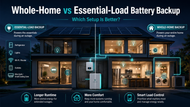
Whole-Home vs Essential-Load Battery Backup: Which Setup Is Better?
Posted by LINIOTECH on Aug 13th 2026
When homeowners start comparing solar battery backup systems, one of the first questions is simple: should the battery power the entire house, or only the most important circuits? This choice affects system cost, battery size, inverter capacity, outage runtime, installation design, and daily comfort.
A whole-home battery backup system is designed to support most or all of the home during an outage. An essential-load battery backup system, sometimes called a critical-load setup, powers only selected circuits such as refrigeration, lights, Wi-Fi, outlets, security equipment, medical devices, and sometimes a well pump or selected HVAC equipment.
Neither option is automatically better for every home. Whole-home backup gives more convenience. Essential-load backup usually gives longer runtime and better cost control. The right setup depends on what you need to keep running, how long outages usually last, whether solar panels can recharge the battery, and how much battery capacity you want to install.
For homeowners still learning the basics of stored energy and power demand, it is helpful to first review LINIOTECH’s guide on kW vs kWh in battery storage, because whole-home versus essential-load backup is really a decision about both power capacity and runtime.
Quick Answer
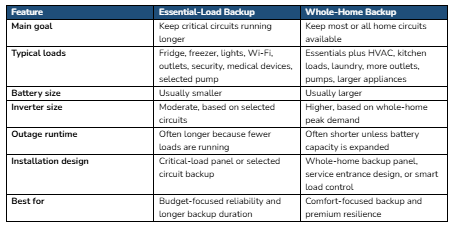
Essential-load battery backup is usually better when the goal is affordable, long-lasting outage protection for refrigerators, lights, internet, outlets, security systems, and a few critical appliances. Whole-home battery backup is usually better when the goal is comfort and convenience, especially if the homeowner wants to run HVAC, kitchen appliances, laundry, pumps, and more circuits during an outage.
In simple terms: choose essential-load backup when runtime matters most, and choose whole-home backup when convenience matters most. For many homes, the best design is a smart middle ground: back up the most important circuits first, then add enough inverter power and battery capacity for selected comfort loads.
Whole-Home vs Essential-Load Backup: Simple Comparison
What Is Essential-Load Battery Backup?
Essential-load backup powers only the circuits that matter most during an outage. Instead of asking the battery to run the entire house, the system is wired to protect a smaller group of loads. This may include the refrigerator, freezer, lights, internet equipment, selected outlets, garage door opener, security system, medical equipment, sump pump, or well pump.
This design is popular because it stretches battery runtime. A battery bank that might only run heavy whole-home loads for a short period can last much longer when it is only supporting essential circuits. That makes essential-load backup a strong choice for homeowners who care more about reliability than running every appliance normally during a blackout.
LINIOTECH article Can Solar Batteries Power My House During a Blackout? also explains this difference from the outage angle: essential circuits use less stored energy, while whole-house backup requires larger batteries and higher output capacity.
What Is Whole-Home Battery Backup?
Whole-home battery backup is designed to keep most or all of the home available when the grid goes down. Instead of selecting a few circuits, the backup system is sized and wired so the homeowner can use the home more normally during an outage.
This can include lighting, refrigeration, outlets, Wi-Fi, well pumps, selected HVAC equipment, kitchen loads, laundry equipment, and other circuits depending on the system design. The benefit is convenience. The tradeoff is that whole-home backup usually needs more battery capacity, more inverter output, better load management, and a more carefully planned electrical design.
For homeowners asking whether batteries can support the entire property, LINIOTECH already has a useful related guide: Can You Run an Entire House on Battery Power?. This new article goes one step deeper by helping readers decide whether full-home backup is actually the best choice for their outage goals.
The Real Difference Is Load Control
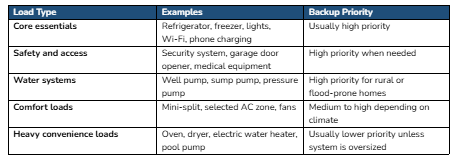
The difference between whole-home backup and essential-load backup is not only about battery size. It is about load control. During an outage, every running appliance pulls energy from the battery. Heavy loads such as central air conditioning, electric water heating, ovens, dryers, pool pumps, and large well pumps can drain storage much faster than lights, Wi-Fi, and refrigeration.
That is why two homes with the same battery capacity can have very different outage performance. One homeowner may run only essentials and get long backup time. Another may run AC, cooking loads, and laundry and drain the same battery much faster.
This is also where inverter size matters. The inverter must be able to support the power demand at the moment the loads are running. Battery capacity determines how long the system can continue. For a deeper explanation, connect this article internally to LINIOTECH’s How Much Battery Storage Does a 10kW Inverter Need? guide.
Which Loads Should Be Essential?
Every home is different, but essential loads are usually the circuits that protect food, communication, safety, health, and basic comfort. For many families, the refrigerator, freezer, lights, Wi-Fi, phone charging, garage door opener, security system, and a few outlets are the priorities.
Homes with wells, sump pumps, medical devices, work-from-home requirements, or elderly family members may need a slightly different essential-load plan. Rural homes may prioritize a well pump. Coastal homes may prioritize refrigeration and communication during storm outages. Homes in hot climates may want a small mini-split or selected cooling zone instead of full central AC.
A good essential-load design should be practical, not minimal for the sake of being minimal. The goal is to keep the home safe and livable while avoiding unnecessary energy drain.
Common Essential and Comfort Loads
When Essential-Load Backup Is the Better Choice
Essential-load backup is often the better choice when the homeowner wants reliable outage protection without oversizing the system. It is also a smart option when outages are usually short, budget is important, or the homeowner wants the battery to last through the night with less risk of draining too quickly.
This setup is especially useful for homes that want a clean alternative to noisy fuel generators but do not need every circuit during an outage. It can also be a practical first step for homeowners who plan to expand later. A system can begin with essential backup, then scale up with additional battery modules and inverter capacity when the budget or energy needs change.
For modular expansion, readers can explore LINIOTECH rack LiFePO4 battery modules and power storage wall batteries as product-level internal links from this section.
When Whole-Home Backup Is the Better Choice
Whole-home backup is usually the better choice when the homeowner wants maximum convenience and is willing to size the system properly. This is common for homes in outage-prone areas, homes with frequent storms, larger rural properties, homes with critical comfort needs, or homeowners who want a premium energy-resilience setup.
Whole-home backup can also make sense when the home has solar panels, enough battery capacity, and a hybrid inverter that can manage backup power safely. With solar recharge, the battery system may recover energy during the day and extend outage runtime. Without solar recharge, whole-home loads depend only on stored battery capacity, so runtime planning becomes more important.
For full-system planning, link to LINIOTECH residential energy storage solutions and hybrid solar inverter solutions from this part of the article.
Battery Capacity: Why Whole-Home Backup Needs More Storage
The biggest reason whole-home backup costs more is simple: larger loads consume more energy. A refrigerator, freezer, Wi-Fi router, lights, and a few outlets may use a manageable amount of electricity over several hours. Add central AC, electric cooking, laundry, water heating, and a well pump, and the battery requirement can increase quickly.
This is where kWh becomes the key number. If a home averages 1.5kW during an outage, 15kWh of delivered energy can last roughly 10 hours before losses and reserve margins. If the same home runs comfort loads and averages 5kW, that same 15kWh is used much faster.
For readers who need a dedicated formula, add an internal link to kW vs kWh in battery storage. That blog explains the difference between power output and stored energy in a way that supports this article without repeating the same explanation in full.
Inverter Size: Why Whole-Home Backup Needs More Power
Battery capacity is only half the story. The inverter also has to deliver enough power at the moment the home needs it. Essential-load backup may only require moderate inverter output because the system is supporting selected loads. Whole-home backup has to handle more simultaneous loads, which can include motor startup surges from compressors, pumps, and power tools.
For example, a home may have enough battery energy to run through the night, but if the inverter cannot handle the startup surge of an AC compressor or well pump, the system may still trip or limit performance. This is why load calculation and inverter compatibility should be part of the same design process.
For this section, the best supporting internal link is LINIOTECH Battery and Inverter Compatibility: What to Check Before You Buy. It gives readers a technical next step after they understand the backup strategy.
What About Air Conditioning?
Air conditioning is often the load that decides whether a home should use essential-load backup, whole-home backup, or a hybrid approach. Many homeowners want AC during summer outages, but central air conditioning can require significant running power and startup power.
A practical design may back up a selected cooling zone instead of the full HVAC system. For example, one efficient mini-split or one managed AC circuit may provide livable comfort while using much less energy than trying to cool the entire home during a blackout.
Since Blog 1 in the August series is dedicated to this topic, add an internal link here after publishing: Solar Battery Backup for Air Conditioning: How Much Power Do You Need? This creates a clean topical path from general backup design to AC-specific sizing.
Electrical Panel Design: Critical Loads Panel vs Whole-Home Backup Panel
The backup strategy also affects how the system is wired. In an essential-load setup, the installer may use a critical-load panel that contains only the circuits selected for backup. When the grid goes down, the battery system powers that panel while nonessential circuits stay off.
In a whole-home setup, the design may use service entrance equipment, a transfer system, smart load control, or a whole-home backup panel depending on local code, utility requirements, inverter specifications, and the home’s electrical service. This design gives more convenience, but it also requires more careful engineering because the system must prevent overloads and isolate safely from the grid during outages.
Homes with existing solar panels also need to decide whether the battery should be AC-coupled or DC-coupled. For that decision, readers should be directed to LINIOTECH AC-Coupled vs DC-Coupled Battery Storage guide.
Cost: Why Essential-Load Backup Usually Costs Less
Essential-load backup usually costs less because the system is smaller and more focused. It may need fewer battery modules, lower inverter output, simpler load planning, and a smaller group of circuits to back up. This does not mean it is basic or weak. A well-designed essential-load system can be the most efficient way to get meaningful backup protection.
Whole-home backup usually costs more because it requires more hardware and more design margin. The system may need additional battery capacity, stronger inverter output, load-management equipment, larger protection devices, and more detailed electrical work.
The better question is not which system is cheaper. The better question is which system gives the best value for the homeowner’s actual outage problem.
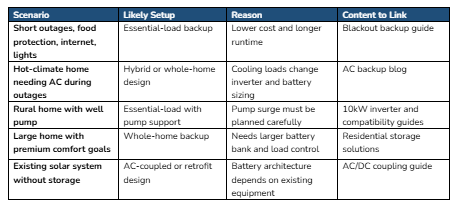
Example Backup Scenarios
A Smart Middle Ground: Essential Backup Plus Managed Comfort Loads
Many homeowners do not need a strict either-or choice. A smart middle-ground design can protect essential circuits while also allowing selected comfort loads when battery capacity is available. This may include a refrigerator, freezer, internet, outlets, lighting, a well pump, and one managed cooling zone.
This approach gives the homeowner better comfort than a bare essential-load setup while avoiding the cost and energy drain of trying to run the entire house normally during every outage. It also makes expansion easier because the system can be designed with future battery modules or smarter load control in mind.
For shoppers comparing system options, the LINIOTECH home energy storage system page is a useful internal link because it presents energy storage as a scalable system rather than a one-size-fits-all backup product.
How to Choose the Right Setup
The right battery backup setup should start with a simple question: what problem are you trying to solve? A homeowner worried about food spoilage and internet access during short outages has a different need than a homeowner trying to run central AC through a multi-day blackout.
Before choosing between whole-home and essential-load backup, review your outage history, critical appliances, HVAC expectations, well pump needs, daily energy usage, solar production, and budget. Then match the inverter, battery capacity, wiring design, and load-control strategy to those goals.
Decision Checklist
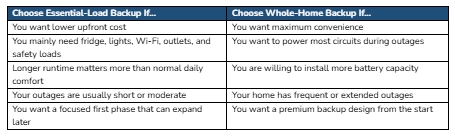
How LINIOTECH Can Help
A reliable backup system is not built by choosing a battery size at random. It is built by matching load priorities, inverter output, battery capacity, battery chemistry, communication settings, solar charging, electrical panel design, and future expansion goals.
LINIOTECH provides LiFePO4 battery storage, hybrid inverter options, residential energy storage systems, and scalable solar storage solutions for homes that need dependable backup power. Whether the best choice is an essential-load setup, whole-home backup, or a managed middle-ground design, the system should be sized around the home’s real power needs.
Explore LINIOTECH residential energy storage systems, compare power storage wall batteries, or review hybrid inverter solutions to start planning a solar battery backup system that fits your home.
Final Thoughts
Whole-home backup and essential-load backup both solve the same problem: keeping your home powered when the grid is not available. The difference is how much of the home the system is expected to support.
Essential-load backup is usually the better fit for homeowners who want longer runtime, lower cost, and protection for the most important circuits. Whole-home backup is better for homeowners who want broader comfort and convenience and are ready to invest in larger battery capacity, stronger inverter output, and smarter load control.
The best setup is the one that matches your actual outage goals. If you want the battery to last longer, protect fewer loads. If you want the home to feel normal during a blackout, plan for more storage, more inverter power, and a more complete backup design.
FAQs
What is the difference between whole-home and essential-load battery backup?
Whole-home backup is designed to support most or all home circuits during an outage. Essential-load backup powers only selected critical circuits such as refrigeration, lights, Wi-Fi, outlets, security equipment, medical devices, and selected pumps.
Is essential-load backup enough for most homes?
For many homes, yes. Essential-load backup can keep the most important appliances running while using less battery energy, which often improves outage runtime and lowers system cost.
Can a battery backup run my entire house?
Yes, but only if the inverter, battery capacity, wiring, solar charging, and load-management design are sized for the home’s actual demand. Larger homes with HVAC and heavy electric appliances need more careful planning.
Does whole-home backup need more batteries?
Usually yes. Whole-home backup supports more circuits and heavier loads, so it commonly requires more usable battery capacity than an essential-load setup.
Can essential-load backup include air conditioning?
It can, but AC must be planned carefully. Many homes use a selected cooling zone, efficient mini-split, or managed HVAC circuit instead of trying to run every cooling load during an outage.
What is a critical-load panel?
A critical-load panel is an electrical subpanel that contains selected circuits for backup power. During an outage, the battery system powers those chosen circuits rather than the entire main panel.
Which backup setup lasts longer during an outage?
Essential-load backup often lasts longer because fewer loads are running. Whole-home backup can also last a long time, but it usually needs a larger battery bank and smart load management.
Can I start with essential-load backup and expand later?
In many system designs, yes. Modular LiFePO4 battery systems and properly planned inverter capacity can allow future expansion, but expansion limits must be confirmed before installation.
Is whole-home backup worth it?
Whole-home backup can be worth it for homeowners who want comfort, convenience, and broader outage protection. It is most valuable when the system is properly sized and the homeowner understands the battery capacity needed for heavy loads.
What should I check before choosing a backup system?
Check your outage history, essential circuits, HVAC expectations, well pump needs, daily energy use, desired runtime, solar production, inverter size, battery capacity, and electrical panel design.