
Commercial Battery Storage for Demand Charges: How Peak Shaving Works
Posted by LINIOTECH on Aug 25th 2026
Demand charges are one of the most expensive and misunderstood parts of many commercial electricity bills. A business may use a reasonable amount of total energy over the month, but one short spike in power demand can still create a large charge on the utility bill.
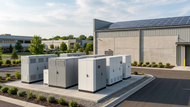
Commercial battery storage helps solve this problem by using stored energy during high-demand moments. Instead of pulling all power from the grid during a short peak, the battery discharges to reduce the facility's grid demand. This strategy is called peak shaving.
For businesses evaluating larger energy storage systems, LINIOTECH Industrial & Commercial Energy Storage Solutions provide a useful starting point for understanding how commercial BESS can support backup power, solar self-consumption, peak shaving, and long-term energy planning.
Quick Answer: How Does Battery Storage Reduce Demand Charges?
Commercial battery storage reduces demand charges by discharging during short periods of high power demand. This lowers the maximum amount of electricity the facility pulls from the grid during the billing interval. If the utility charges based on the highest 15-minute, 30-minute, or hourly demand peak, reducing that peak can lower the demand-charge portion of the bill.
- The business charges the battery when demand is lower, electricity is cheaper, or solar production is available.
- The energy management system monitors the facility load in real time.
- When demand approaches a costly peak, the battery discharges.
- The facility uses less grid power during the peak interval.
- The utility records a lower billed peak demand for that period or month.
In simple terms: peak shaving uses a battery to flatten the most expensive spikes in a commercial load profile.
What Are Demand Charges?
Most people understand energy charges because they are based on total electricity consumption, measured in kilowatt-hours. Demand charges are different. They are based on the highest level of power a facility pulls from the grid during a defined billing interval, measured in kilowatts.

This is why a short operating event can be expensive. A compressor start, HVAC overlap, production-line ramp-up, refrigeration cycle, EV charger cluster, or kitchen equipment rush may last only minutes, but it can still define the peak demand used for billing.
For businesses, the important question is not only how much electricity we use. It is also when do our biggest electrical peaks happen?
Demand Charge Example
Here is a simplified example.
- Monthly energy use: 42,000 kWh
- Monthly peak demand: 500 kW
- Demand charge rate: $18 per kW
- Demand charge cost: 500 kW x $18 = $9,000
If a commercial battery storage system reduces that peak from 500 kW to 400 kW, the demand charge becomes:
- 400 kW x $18 = $7,200
- Estimated demand charge reduction: $1,800 for that month
This example is simplified, but it shows the core idea. The battery does not need to power the entire building all day. For demand-charge reduction, it often requires reducing the facility's peak demand at the right time.
What Is Peak Shaving?
Peak shaving is the process of lowering a facility's maximum grid demand during expensive peak periods. In a commercial battery storage system, peak shaving usually means the battery discharges when the building load approaches a target threshold.

Peak shaving is not the same as simply using less electricity. A business may still use the same machines, HVAC equipment, refrigeration systems, and lighting, but the battery changes how much power is pulled from the grid during critical intervals.
For readers who need a refresher on power versus energy, internally link to LINIOTECH's guide on kW vs kWh in Battery Storage. It supports this article because demand charges are based on kW, while battery runtime depends on kWh.
How Commercial Battery Storage Works for Peak Shaving
A commercial battery energy storage system, often called BESS, typically includes the battery modules, inverter or power conversion system, energy management system, controls, safety equipment, monitoring, and sometimes solar integration.
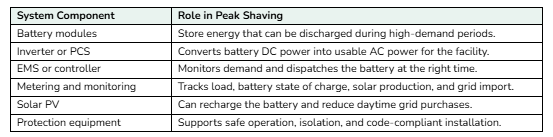
The EMS is especially important. A battery without intelligent control may not discharge when it matters most. A well-designed commercial BESS should account for the facility's load profile, tariff structure, battery limits, and backup power requirements.
For battery and inverter matching, add an internal link to Battery and Inverter Compatibility: What to Check Before You Buy. This helps readers understand why voltage, discharge current, communication, and system architecture matter before choosing equipment.
The Basic Peak-Shaving Sequence
- The facility operates normally, and the EMS monitors real-time power demand.
- The system identifies when grid demand approaches a preset threshold.
- The battery discharges to supply part of the load.
- Grid import stays below the target level when possible.
- The battery recharges later from solar, lower-cost grid power, or another approved charging source.
- The business reduces the peak demand recorded by the utility, depending on tariff rules and system performance.
Which Businesses Benefit Most From Demand Charge Management?
Commercial battery storage is not equally valuable for every business. It usually creates the strongest savings when a facility has high demand charges, predictable peaks, expensive peak periods, or loads that create sharp electrical spikes.
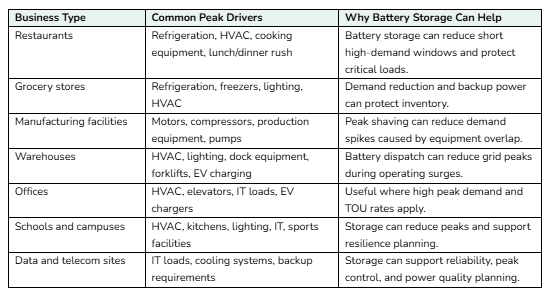
This topic should internally support the upcoming August commercial vertical article on Battery Energy Storage for Restaurants once that page is published, because restaurants are a strong example of peak demand plus outage-risk intent.
How to Size Battery Storage for Demand Charges
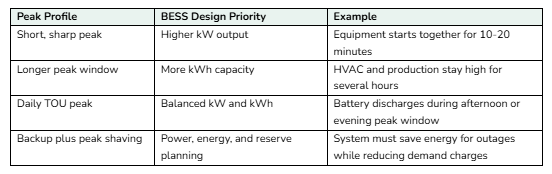
Sizing a commercial BESS for demand-charge management is different from sizing a home battery for nighttime backup. The system must be sized around the facility's load profile, peak duration, tariff rules, and the battery's power output.
The two key values are:
- Power rating in kW: how much peak load the battery can offset at one time.
- Energy capacity in kWh: how long the battery can sustain that offset.
A facility may need a battery with high power output for short peaks, or higher energy capacity for longer demand events. The right design depends on how the peak occurs.
Simple Peak-Shaving Sizing Formula
A simplified planning formula is:
Battery energy needed = peak reduction target x peak duration
Example:
- Target peak reduction: 100 kW
- Peak duration: 2 hours
- Estimated energy required: 100 kW x 2 hours = 200 kWh
In real project design, the final size should also account for inverter efficiency, battery depth of discharge, reserve capacity, temperature, degradation, future load growth, and code requirements.
For larger commercial configurations, the internal link should point to LINIOTECH Commercial High Voltage Battery Storage category and the 60kWh commercial high-voltage battery storage system product page where relevant.
Solar Plus Battery Storage for Demand Charges
Solar panels and commercial battery storage can work together, but they solve different parts of the bill.
- Solar PV reduces energy purchased from the grid when the sun is producing.
- Battery storage can reduce grid demand during expensive peak intervals.
- Together, solar plus storage can improve self-consumption, reduce peak demand, and support backup power planning.
Solar alone may not fully solve demand charges if the facility peak happens when solar output is low, cloudy, or misaligned with operations. Batteries help by storing energy and dispatching it when the building needs demand reduction.
For readers comparing system architecture, link to AC-Coupled vs DC-Coupled Battery Storage. This is useful because retrofit projects and new solar-plus-storage installations may require different coupling approaches.
Demand Charges vs Time-of-Use Rates
Demand charges and time-of-use rates are related but not the same. A time-of-use rate charges different prices for energy consumed at different times of the day. A demand charge is based on the highest power demand recorded during a billing interval or demand window.
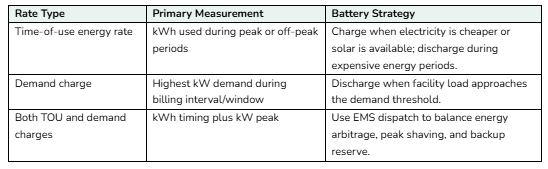
For residential and small-commercial readers researching peak-hour bill reduction, link to the August article Can Solar Batteries Lower Peak-Hour Electricity Bills?. This helps connect TOU savings intent with the commercial demand-charge topic.
Why High-Voltage Battery Systems Are Common in Commercial Storage
Commercial and industrial storage projects often require more power, larger battery capacity, three-phase integration, outdoor equipment, and scalable system design. This is why many larger BESS projects use high-voltage battery architecture instead of small low-voltage battery banks.
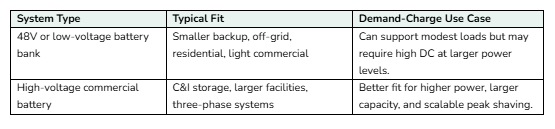
For readers comparing voltage architecture, add internal links to 48V vs High-Voltage Battery: Which Is Better for Solar Storage? and 48V vs 51.2V LiFePO4 Battery: What Changes?.
What Affects Commercial Battery Storage ROI?
Demand-charge savings can be a major driver of commercial BESS ROI, but the result depends on the tariff, facility operations, system cost, and dispatch strategy. A business should model the project before assuming a fixed savings percentage.
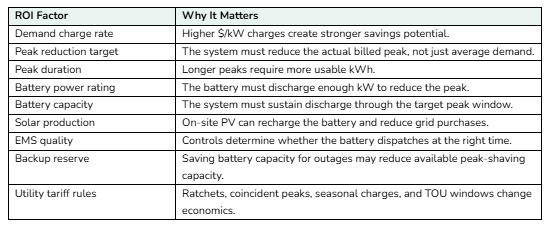
The best ROI candidates usually have a consistent load profile, high demand-charge rates, repeated monthly peaks, and equipment that can be monitored accurately.
Can the Same Battery Provide Backup Power?
Yes, a commercial BESS may support both peak shaving and backup power, but the system has to be designed carefully. If the battery is fully discharged for demand-charge savings, it may not have enough reserve left for an outage.
This is why commercial systems often define operating modes, such as:
- Peak shaving mode: prioritize reducing grid demand.
- Backup reserve mode: hold a minimum state of charge for outages.
- Solar self-consumption mode: store excess solar for later use.
- Hybrid mode: balance demand reduction, rate savings, and resilience.
For businesses that also need resilience, link to LINIOTECH's older commercial storage article Commercial Energy Storage to Protect Business and the Industrial & Commercial Energy Storage Solutions page.
Common Mistakes in Demand-Charge Battery Projects
Mistake 1: Sizing the battery only by kWh
A large energy capacity does not guarantee enough discharge power to shave a high kW peak. Both kW and kWh matter.
Mistake 2: Ignoring the utility tariff
Demand-charge rules vary. A project must be modeled against the exact tariff, billing interval, seasonal structure, and ratchet rules.
Mistake 3: Using the wrong load data
One monthly bill is not enough. Interval data provides a clearer view of when peaks happen and how long they last.
Mistake 4: Forgetting backup reserve
If the business expects backup power, the dispatch strategy must reserve enough energy for critical loads.
Mistake 5: Treating solar alone as a demand-charge solution
Solar can help, but battery dispatch may be needed when the peak does not align with solar production.
Mistake 6: Choosing equipment before system design
Battery voltage, PCS size, EMS controls, site wiring, safety requirements, and expansion plans should be reviewed before purchase.
Commercial BESS Planning Checklist
Before investing in a battery storage system for demand charges, a business should collect the right information and model the project properly.
- At least 12 months of utility bills
- 15-minute or hourly interval load data, if available
- Demand charge rate and billing interval
- Seasonal demand-charge rules and ratchets
- Operating schedule and major equipment loads
- Existing solar PV system details, if installed
- Critical-load requirements for backup power
- Electrical service details and three-phase requirements
- Space, ventilation, outdoor rating, and permitting considerations
- Expansion plans, EV charging plans, or future equipment loads
How LINIOTECH Supports Commercial Battery Storage Projects
Commercial battery storage is not just a product purchase. It is a system-design decision that should match the business load profile, utility tariff, inverter or PCS requirements, battery architecture, safety needs, and long-term energy goals.
LINIOTECH provides commercial energy storage solutions, high-voltage LiFePO4 battery options, hybrid inverter support, rack battery modules, and solar-plus-storage equipment for real-world power needs. Businesses can start with the Industrial & Commercial Energy Storage Solutions page, review Commercial High Voltage Battery Storage, and compare compatible inverter and battery options before final system design.
For facilities dealing with high demand charges, repeated load spikes, grid outages, or solar underutilization, a properly designed commercial BESS can help turn energy storage into a practical cost-control and resilience tool.
Final Thoughts
Commercial battery storage for demand charges works because many businesses are billed not only for how much electricity they use, but also for how much power they demand from the grid at their highest peaks.
Peak shaving uses battery energy strategically. The system charges when demand is lower or solar energy is available, then discharges during high-demand intervals to reduce grid imports. When designed correctly, this can lower demand charges, improve solar value, support backup power planning, and give businesses more control over their energy costs.
The best results come from accurate load data, tariff analysis, correct battery sizing, smart EMS controls, and equipment that matches the facility's electrical requirements.
To plan a commercial battery storage project, explore LINIOTECH Industrial & Commercial Energy Storage Solutions or review high-voltage battery storage options built for scalable C&I applications.
FAQs
What is a demand charge?
A demand charge is a utility fee based on the highest amount of power a commercial facility draws from the grid during a billing interval or demand window. It is measured in kW, not kWh.
How does battery storage reduce demand charges?
Battery storage reduces demand charges by discharging during peak demand periods. This lowers how much power the facility pulls from the grid during the interval that may be used for billing.
What is peak shaving?
Peak shaving is the process of reducing a facility's highest power demand. With battery storage, the battery supplies part of the load during peak periods so grid demand stays lower.
Is peak shaving the same as load shifting?
No. Peak shaving focuses on reducing the highest kW demand. Load shifting moves energy use from expensive periods to cheaper periods. A commercial battery system may do both.
How much battery storage does a business need for peak shaving?
The required battery size depends on the peak reduction target, peak duration, tariff rules, battery output rating, and backup-reserve requirements. Both kW and kWh must be modeled.
Can solar panels reduce demand charges without batteries?
Sometimes, but solar production must align with the facility peak. If the peak occurs when solar output is low or inconsistent, battery storage may provide better demand-charge control.
Which businesses benefit most from commercial battery storage?
Businesses with high demand charges, repeated electrical peaks, refrigeration, HVAC, motors, compressors, production equipment, EV charging, or critical backup loads often have stronger BESS use cases.
Can one battery system provide peak shaving and backup power?
Yes, but the system must reserve enough energy for outages. The EMS should balance peak-shaving dispatch with backup-power requirements.
Are high-voltage batteries better for commercial peak shaving?
High-voltage systems are often better suited for larger commercial and industrial storage because they can support higher power, larger capacity, and scalable system architecture.
What should a business check before buying a commercial BESS?
A business should review utility bills, interval load data, tariff rules, peak duration, electrical service, critical loads, solar production, EMS controls, safety requirements, and future expansion plans.