

Sol-Ark 30K and 60K Batteries, How to Choose a High Voltage Battery Bank
Posted by LINIOTECH on Nov 17th 2026
The Sol-Ark 30K and 60K are two of the most popular three-phase hybrid inverters for commercial solar and storage in the US. They look nearly identical on the wall, but they need very different batteries. The 30K runs on high-voltage battery banks of 300V or more, while the 60K needs 600V or more to deliver its full storage power. Pick a battery outside those windows and the system either will not connect or will never reach its rated output.
Getting the battery right comes down to three decisions: matching the voltage window, sizing the bank in kWh for the hours you need, and confirming closed-loop communication between battery and inverter. This guide walks through each one with real datasheet numbers.
If you are still choosing the inverter itself, browse the full lineup of our Sol-Ark hybrid inverters. If you already own a Sol-Ark 30K or 60K, read on to find the battery bank that fits it.
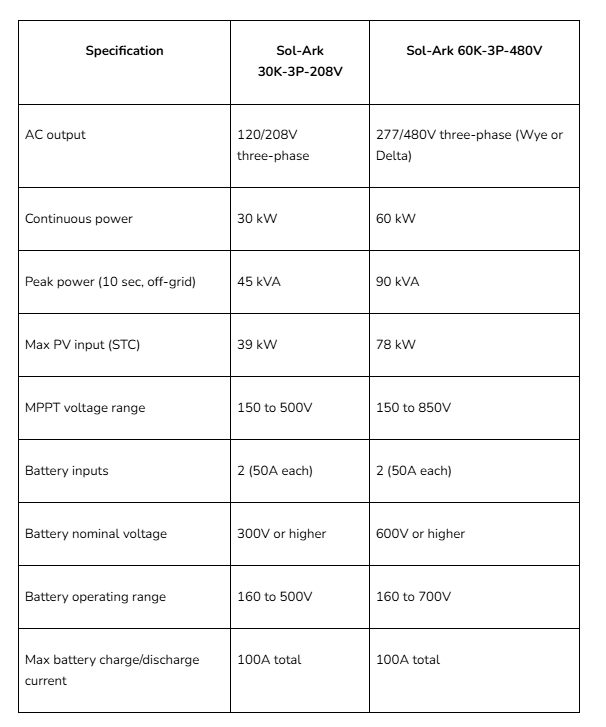
Sol-Ark 30K vs 60K at a Glance
Both inverters share the same chassis, enclosure and battery current limits. The differences are output voltage, power and the battery voltage they expect.
Why Battery Voltage Decides Your Power Output
Both Sol-Ark commercial inverters cap battery current at 100A, split across two 50A inputs. That single limit explains why voltage matters so much. Battery power equals voltage times current, so at a fixed 100A, the battery's voltage sets the maximum power it can deliver.
- 30K with a 300V bank: 300V × 100A = 30 kW, the inverter's full rated output.
- 60K with a 600V bank: 600V × 100A = 60 kW, the full rated output.
- 60K with a 400V bank: 400V × 100A = 40 kW. The inverter still works, but it can never pull more than about 40 kW from the battery during an outage.
That third case is an easy mistake to make. A battery can sit inside the 60K's wide 160 to 700V operating window and still leave a third of the inverter's backup power unused. If you need full 60 kW backup from storage, the bank's nominal voltage must be 600V or higher.
Why not use a 48V battery?
Delivering 60 kW from a 51.2V low-voltage battery would take more than 1,100 amps. That means massive cables, more heat loss and more connection points. High voltage battery banks reach the same power at under 100A, which keeps wiring manageable and round-trip efficiency high. Our guide to kW vs kWh in battery storage covers how power and energy ratings work together.
How high voltage banks are built
Commercial high voltage batteries stack standard modules in series. Sol-Ark's own L3 series uses 5.12 kWh modules rated at 51.2V and 100Ah. String enough of them together and you reach the voltage each inverter needs: about 307V or 410V configurations for the 30K, and 614.4V for the 60K. The bank's full operating range, from empty to full, must stay inside the inverter's battery window. Sol-Ark's 480V L3 bank, for example, runs between 588V and 672V, comfortably inside the 60K's limits.
You can compare module-based options for both inverters in our high voltage LiFePO4 battery.
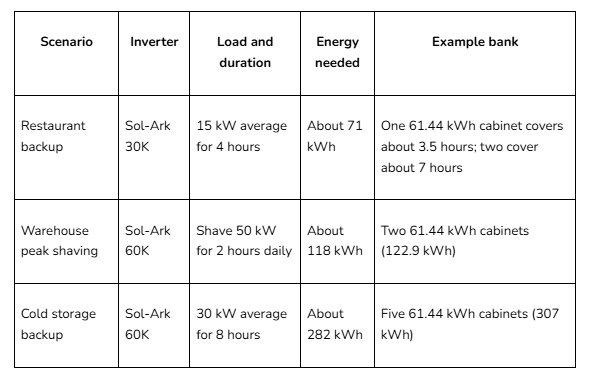
These are planning estimates. A final design should use 12 months of interval data from your utility.
Two sizing rules keep commercial systems efficient:
- Match power and energy. A 60K inverter discharging at full power empties a 61 kWh cabinet in about an hour. If your goal is multi-hour backup, add cabinets rather than inverters.
- Plan cabinets in whole units. High voltage banks expand by adding complete cabinets in parallel, not single modules. Sol-Ark's 208V outdoor L3 cabinet, for example, allows up to six cabinets per 30K inverter.
Budget matters as much as hours. Our breakdown of commercial battery storage cost per kWh shows how cabinet count and system size affect the total.
Compatible High Voltage Battery Options
Sol-Ark designs its commercial inverters to pair natively with its own L3 batteries, but the platform is also high-voltage-battery agnostic. That gives you two main paths.
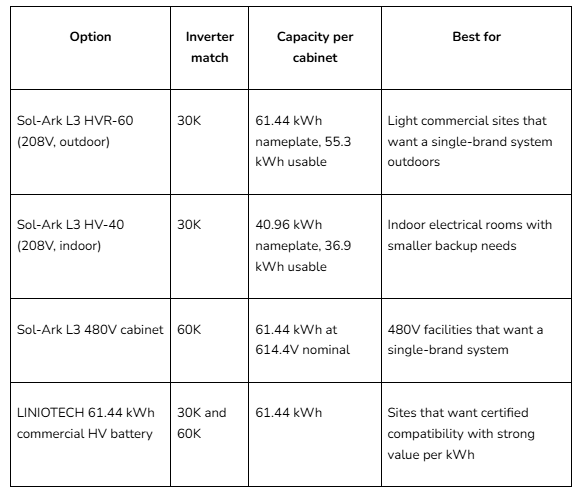
Option 1: A single-brand Sol-Ark system
Sol-Ark's L3 Series batteries are built specifically for these inverters, with one support channel for both. LINIOTECH supplies a ready-matched Sol-Ark 60K-3P-480V system with a 60 kWh outdoor high voltage battery cabinet, which removes the guesswork for 480V sites.
Option 2: A certified partner battery
The LINIOTECH 61.44 kWh commercial high voltage battery is listed for both the Sol-Ark 60K 480V and 30K 208V, carries a UL 9540 listing and uses LiFePO4 chemistry. It gives commercial buyers the same 61 kWh building block with strong value per kWh, and it expands the same way, by adding cabinets.
Larger rack and cabinet systems
Sites that need several hundred kilowatt-hours can look at larger high voltage rack systems. Each one must be checked against the inverter's battery voltage window and approved communication list before you buy. Browse those systems in our industrial and commercial energy storage and ask our team to confirm the match.
Communication, Certifications and Installation Checks
A battery that fits the voltage window still has to pass three more checks before it belongs on a Sol-Ark 30K or 60K.
Closed-loop communication
Both inverters talk to lithium batteries over CAN bus and RS485. In closed loop, the battery's BMS tells the inverter exactly how much current it can accept or deliver at any moment, based on cell temperature and state of charge. That protects the cells, keeps state-of-charge readings accurate and lets the inverter run peak shaving schedules with confidence. Open-loop, voltage-only setups give up most of those benefits. Our explainer on closed loop vs open loop battery communication covers the difference in detail. Always confirm that your battery appears on Sol-Ark's approved communication list.
Certifications your fire marshal will ask for
Commercial battery installations face closer inspection than residential ones. Expect your authority having jurisdiction to ask for:
- UL 9540 listing for the energy storage system
- UL 9540A fire test data for the battery
- UL 1741 SB listing for the inverter's grid interaction
- Spacing, ventilation and signage that meet your local fire code
Collect these documents before you finalize the design. Missing paperwork delays permits more often than equipment problems do.
Site checks before installation
- Location and temperature. LiFePO4 batteries should not charge below freezing. Outdoor cabinets in cold regions need built-in heating or a protected location, as our guide to LiFePO4 batteries in cold weather explains.
- DC wiring and protection. Size conductors and overcurrent protection for the full 100A battery current on each system, with a lockable DC disconnect at the battery.
- Altitude. Sol-Ark notes that L3 batteries derate to 0.8C above 2,000 meters, which matters for high-elevation sites.
- Firmware. Update the inverter and battery firmware to compatible versions during commissioning so communication starts cleanly.
Which Setup Fits Your Business?
Use your service voltage, critical load and goal to find your starting point.
- Light commercial on 120/208V, up to 30 kW of critical load: a Sol-Ark 30K with one or two 61.44 kWh high voltage cabinets. Restaurants, retail stores, small clinics and fire stations usually land here.
- Commercial or industrial on 277/480V, 30 to 60 kW: a Sol-Ark 60K with a bank of 600V or higher. Start with two cabinets if you want more than an hour of full-power backup.
- Loads above 60 kW: parallel multiple 60K units, up to 600 kW, and plan battery cabinets per inverter from the start.
- Peak shaving first: size the kW you want to shave before anything else, keep it at or below the inverter's rating, then add kWh for the length of your peak window.
- Simplest support path: a single-brand Sol-Ark L3 system.
- Best value per kWh with certified compatibility: the LINIOTECH 61.44 kWh high voltage battery.
Single-phase site under 20 kW? You likely do not need a commercial three-phase inverter at all. Residential-class Sol-Ark models paired with 51.2V batteries are simpler and less expensive; see our residential energy storage system.
Build the Right Bank the First Time
The Sol-Ark 30K and 60K reward a careful battery choice. Match the voltage window first: 300V or higher for the 30K, 600V or higher for the 60K if you want full power from storage. Then size the bank in whole cabinets for the hours or peak window you need, and confirm closed-loop communication and the certifications your fire marshal expects. Get those right and a single inverter can grow into a multi-hundred-kilowatt system without replacing anything you already own.
LINIOTECH supplies Sol-Ark commercial inverters, Sol-Ark L3 batteries and our own 61.44 kWh high voltage LiFePO4 battery from our headquarters in Cypress, Texas. As a Sol-Ark certified battery partner, our team can match the inverter, battery voltage, cabinet count and communication setup to your building before anything ships. Call 800-978-0161 or email sales@liniotech.com with your service voltage and load data, and we will design a Sol-Ark 30K or 60K battery bank that delivers every kilowatt you paid for.
Frequently Asked Questions
What batteries work with the Sol-Ark 30K?
The Sol-Ark 30K-3P-208V needs a high voltage lithium battery with a nominal voltage of 300V or higher and an operating range between 160 and 500V. Compatible options include Sol-Ark's L3 HVR-60 and HV-40 batteries and the LINIOTECH 61.44 kWh commercial high voltage battery.
What batteries work with the Sol-Ark 60K?
The Sol-Ark 60K-3P-480V needs a high voltage lithium battery with a nominal voltage of 600V or higher and an operating range between 160V and 700V. Sol-Ark's 480V L3 battery and the LINIOTECH 61.44 kWh commercial high-voltage battery are both listed for it.
Can I use a 48V battery with a Sol-Ark 30K or 60K?
No. Both inverters accept only high-voltage batteries, with a minimum operating voltage of 160V. A 48V or 51.2V battery is far below that range.
How long will a 61 kWh battery run a Sol-Ark 60K?
A 61.44 kWh cabinet provides about 55 kWh of usable energy at 90% depth of discharge. At the full 60 kW, that lasts a little under an hour. At an average critical load of 20 kW, it lasts about 2.7 hours.
Can I add more batteries later?
Yes. High voltage banks expand by adding complete cabinets in parallel. Use the same battery model as your existing bank and stay within Sol-Ark's limit on cabinets per inverter.
Can the Sol-Ark 60K run off-grid?
Yes. Both the 30K and 60K are hybrid inverters that operate grid-tied or off-grid. When the grid fails, they switch to battery backup in milliseconds, so critical equipment keeps running.