
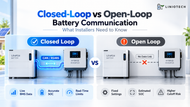
Closed Loop vs Open Loop Battery Communication
Posted by LIMOITECH on Oct 14th 2026
Two identical batteries on two identical inverters can deliver very different results. One reports accurate state of charge, charges at the right rate in every season, and logs clean data for years. The other drifts out of calibration, trips its own BMS at the worst moment, and leaves the homeowner calling about a "dead" battery that is actually half full. The difference is usually how the battery and inverter talk to each other.
The closed-loop vs open loop battery decision shapes system behavior, warranty coverage, and how many callbacks you take after commissioning. This guide from the LINIOTECH technical team covers how each mode works, when open loop still has a place, how to set up closed loop on Sol-Ark, and how to fix the communication faults that show up most often in the field.
Closed Loop vs Open Loop Battery: The Core Difference
In a closed-loop system, the battery’s BMS sends live data to the inverter over a communication cable, usually CAN or RS485. The inverter charges and discharges based on what the battery reports: state of charge, voltage, temperature, and the current limits the BMS will accept right now.
In an open-loop system, there is no data link. The inverter manages the battery using fixed voltage setpoints the installer enters by hand, plus its own estimate of state of charge. The BMS still protects the cells internally, but the inverter has no idea what the BMS is thinking until the BMS disconnects.
Put simply, closed loop lets the battery run the charging strategy. Open loop asks the installer to predict it in advance and hope the settings hold up across seasons, aging, and load changes.
| Factor | Closed Loop | Open Loop |
|---|---|---|
| Data link | CAN or RS485 cable from BMS to inverter | None |
| State of charge | Reported directly by the BMS | Estimated by the inverter from voltage or a shunt |
| Charge control | Follows live charge current and voltage limits from the BMS | Fixed voltage and current setpoints |
| Temperature protection | BMS lowers or blocks charge current in real time | Relies on an inverter temp sensor or the BMS cutting off |
| Warranty | Usually required for listed lithium batteries | Allowed by some battery brands, not all |
| Best for | Modern lithium storage on supported inverters | Lead-acid, legacy inverters, batteries with no comm port |
How Closed-Loop Battery Communication Works
Once the link is up, the BMS sends a steady stream of values to the inverter. The exact list depends on the protocol, but most closed-loop battery communication includes:
- State of charge and state of health
- Pack voltage and the requested charge voltage
- Charge current limit (CCL) and discharge current limit (DCL)
- Cell temperatures and warning or alarm flags
The CCL and DCL values do most of the work. A cold battery, an aging pack, or a cell running high during balancing will all cause the BMS to lower its limits, and the inverter follows immediately. That is why closed-loop systems handle winter mornings, top-of-charge balancing, and heavy surge loads without the BMS ever needing to open its contactor.
Most inverters also treat the link as a heartbeat. If messages stop arriving, the inverter raises a BMS communication fault and either stops charging or falls back to a safe mode, depending on the brand. That behavior protects the battery, but it also means a loose comm cable can look like a battery failure to the homeowner.
The choice between CAN and RS485 is a separate decision from closed vs open loop. Both can carry closed-loop data. If you want the protocol-level detail, our breakdown of BMS communication: CAN vs RS485 covers it.
How Open-Loop Lithium Battery Setups Work
With an open-loop lithium battery, you program the inverter with bulk and float voltages, maximum charge and discharge current, low-voltage shutdown and restart values, and battery capacity. The inverter then manages charging on voltage alone.
That approach works well for lead-acid, which has a sloped voltage curve. LiFePO4 does not. Between roughly 20 and 90 percent state of charge, a LiFePO4 pack’s resting voltage barely moves, so a voltage-based SOC estimate drifts quickly. The inverter might show 40 percent when the battery is at 70, or the reverse. Shunt-based monitoring helps, but it still has to be recalibrated at full charge.
The bigger risk is the BMS hard cutoff. In open loop, the BMS has no way to ask the inverter to slow down. Its only tool is to disconnect. If the cells hit a high-voltage, low-voltage, or temperature limit, the BMS opens and the inverter suddenly loses its battery, which can drop backed-up loads or trip the inverter offline. Repeated hard cutoffs are hard on the BMS and a common source of service calls.
When Open Loop Still Makes Sense
Closed loop is the default for modern lithium storage, but open loop is not obsolete. It is still the right answer in a few situations:
- Lead-acid or AGM banks. There is no BMS to talk to, so open loop with temperature compensation is the only option.
- Older inverters with no lithium protocol support. Some legacy units can only run lithium on voltage settings.
- Batteries without a communication port or with a protocol the inverter does not recognize.
- Temporary troubleshooting. Running open loop briefly can help isolate whether a fault sits in the comm link or the hardware.
Before you commission any lithium battery in open loop, confirm in writing that the battery manufacturer allows it. Some brands void the warranty without closed-loop communication, and some inverter makers tie their own warranty to batteries on their approved closed-loop list. Solis low-voltage hybrids, for example, support closed-loop over CAN only. Our guide on battery and inverter compatibility walks through what to verify before purchase.
Sol-Ark Closed Loop Battery Setup: What to Check
Sol-Ark hybrid inverters use a battery-agnostic 48V architecture, so they will run almost any 48V battery in open loop. Closed loop is a different matter. Sol-Ark certifies specific battery partners after testing communication, performance, and protection behavior, and those certified batteries are the ones you should pair when the customer wants full integration. LINIOTECH is part of Sol-Ark’s Certified Battery Partner Program, and our batteries have been deployed with Sol-Ark 15K inverters over closed-loop communication on projects including a 100 kWh Texas farm installation.
For a Sol-Ark closed-loop battery install, work through these checks:
- Confirm the battery model appears on Sol-Ark’s current certified partner list for that inverter model.
- Update inverter firmware and battery firmware before commissioning, since protocol fixes often ship in updates.
- Use the battery manufacturer’s comm cable into the inverter’s battery communication port, following the pinout in Sol-Ark’s battery integration guide.
- Enable lithium mode and select the protocol number the integration guide lists for that battery.
- Enter the battery bank capacity correctly so related settings scale properly.
- Open the battery screen and confirm live BMS data: SOC, voltage, temperature, and charge and discharge limits should all populate.
For new builds, a pre-matched package removes most of the guesswork. The Sol-Ark 15kW inverter with LINIOTECH 43kWh closed-loop bundle ships as a tested UL 9540 combination, and the full range of Sol-Ark hybrid inverters we stock pairs with LINIOTECH 48V batteries.
Lithium Battery BMS Communication Setup Checklist
The details change by brand, but the commissioning sequence for any lithium battery BMS communication setup follows the same pattern:
- Confirm the battery and inverter support the same protocol, not just the same physical port. CAN on both sides does not guarantee they speak the same CAN protocol.
- Update firmware on both devices.
- Use the manufacturer-supplied cable or build one to the documented pinout. A generic Ethernet patch cable is a common cause of failed links.
- Plug into the correct port on the battery. Many packs have separate ports for the inverter link and for battery-to-battery linking.
- In multi-battery stacks, set the master and slave addresses with the DIP switches or software, and fit a termination resistor if the manual calls for one.
- Follow the manufacturer’s power-up sequence. Many systems expect the batteries to be on before the inverter starts.
- Select the battery protocol in the inverter settings.
- Verify the inverter’s SOC matches the battery’s own display and that current limits are reading.
- Run a short charge and discharge test and confirm the inverter respects the BMS current limits.
Stack layout matters too. How you link modules affects which battery acts as master and what data reaches the inverter. Our guides on series vs parallel solar batteries and 48V vs high-voltage batteries explain those design choices.
Common Battery Inverter Communication Faults and Fixes
Most battery inverter communication problems trace back to a short list of causes:
- No BMS data on the inverter. Usually the wrong port, a wrong pinout, or a protocol mismatch. Check the cable first, then the protocol selection.
- Intermittent comm loss alarms. Look for comm cables routed alongside DC or AC conductors, loose RJ45 connectors, excessive cable length, or missing termination on the bus.
- SOC on the inverter does not match the battery. Often a stack addressing error where the inverter only reads one module, or slave units not linked to the master.
- Charge current lower than expected. The BMS may be limiting CCL due to cold cells, high cell voltage during balancing, or an incorrect battery count on the master. Check what the battery is requesting before adjusting the inverter.
- Battery shuts off while the inverter keeps running. A classic open-loop symptom. Setpoints are too close to the BMS limits. Widen the margin or move to closed loop.
Temperature limits are one of the most overlooked benefits of a working link. In cold garages, the BMS cuts charge current to zero before the cells can be damaged, something an open-loop setup cannot do without a separate temperature sensor.
Which Should Installers Choose?
For any lithium battery on a supported inverter, closed loop should be the default. It gives the customer accurate SOC, smoother charging, built-in temperature protection, cleaner monitoring data, and in most cases the only path to full warranty coverage. LINIOTECH rack LiFePO4 battery modules and high-voltage LiFePO4 batteries are built for closed-loop integration with leading hybrid inverters, including the Solis inverter range.
Reserve open loop for lead-acid, legacy equipment, and batteries with no supported protocol. When you do use it, set conservative voltage margins, document the settings for the customer, and get the battery maker’s written approval.
Build Reliable Battery Systems With LINIOTECH
Closed loop vs open loop comes down to who controls charging. With a working data link, the battery directs the inverter in real time. Without one, you are relying on fixed settings to cover every condition the system will ever see. For lithium storage, closed loop is the stronger build almost every time.
LINIOTECH supports installers with Sol-Ark certified, UL-listed LiFePO4 batteries, matched inverter bundles, and technical help on communication setup. Explore our distribution and installer partnership program, or contact the LINIOTECH team for a free quote on your next closed-loop system.
FAQs About Closed Loop vs Open Loop Battery Communication
What is the difference between closed loop and open loop battery communication?
Closed loop uses a CAN or RS485 cable so the battery’s BMS can send live data and current limits to the inverter. Open loop has no data link, so the inverter manages the battery on fixed voltage settings entered by the installer.
Is closed loop better than open loop for lithium batteries?
Yes, for most lithium systems. Closed loop gives accurate state of charge, real-time charge limits, and temperature protection. LiFePO4’s flat voltage curve makes voltage-based open-loop control less accurate, and the BMS has to rely on hard cutoffs.
Can a Sol-Ark inverter run a lithium battery in open loop?
Yes. Sol-Ark’s 48V inverters are battery agnostic and can run open loop using voltage-based settings. For full integration, accurate SOC, and the best support path, use a battery from Sol-Ark’s certified partner list in closed loop.
Does running open loop void the battery warranty?
It depends on the manufacturer. Some battery brands allow open loop, while others require closed-loop communication with an approved inverter. Some inverter makers also restrict warranty coverage to batteries on their closed-loop compatibility list. Get confirmation before commissioning.
What cable is needed for closed loop battery communication?
Use the battery manufacturer’s communication cable or one built to the pinout in the inverter’s battery integration guide. The cables often use RJ45 connectors, but the pin assignments are specific, so a standard Ethernet patch cable may not work.
What happens if closed loop communication fails?
Most inverters raise a BMS communication fault and either stop charging, limit operation, or switch to a fallback mode. The exact response varies by brand. The battery’s internal BMS still protects the cells, but the system should be checked and the link restored quickly.