
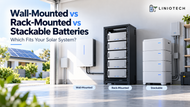
Wall-Mounted vs Rack-Mounted vs Stackable Batteries, Which Fits Your Solar System?
Posted by LINIOTECH on Oct 21st 2026
Wall-mounted batteries suit homeowners who want a clean, single-unit install with large capacity per box. Rack-mounted batteries suit systems that need to grow in small, affordable steps, especially off-grid and DIY builds. Stackable batteries sit in between, offering modular expansion with fewer cables and a tidy footprint. The chemistry inside is often identical. What changes is how the battery installs, scales, and fits the space you have.
The wall mount vs rack mount battery choice affects more than looks. It decides how many units you handle, how much floor or wall space you give up, how easy future expansion will be, and even which code limits apply to your install location. In this guide, the LINIOTECH team compares all three formats side by side so you can match the battery to your home, your inverter, and your plans.
Wall Mount vs Rack Mount Battery: Quick Comparison
Here is how the three formats compare on the factors that matter most during design and installation.
| Factor | Wall-Mounted | Rack-Mounted | Stackable |
|---|---|---|---|
| Typical capacity per unit | 10 to 16kWh | About 5kWh | 5 to 10kWh per module |
| Installation | Bracket on a structural wall or floor stand | Slides into a 19-inch rack or cabinet | Modules stack on a base, often plug-in |
| Expansion | Add whole units in large steps | Add modules in small 5kWh steps | Add modules to the stack |
| Cabling between units | Moderate | Most (busbars, comm links) | Least (built-in connectors on many) |
| Footprint | Off the floor, slim depth | Floor cabinet | Small floor footprint, tall |
| Best for | Grid-tied backup, clean residential installs | Off-grid, DIY, large banks, budget scaling | Installers wanting modular and tidy, HV systems |
Wall-Mounted Solar Battery: Big Capacity, Clean Install
A wall-mounted solar battery is a single, self-contained LiFePO4 unit with its own BMS, breaker, and display, hung on a bracket or set on a floor stand. Tesla’s Powerwall made the format famous, and "powerwall battery" is now common shorthand for any all-in-one wall unit, regardless of brand.
Advantages
- More storage per box. Wall units commonly hold 10kWh or more, so a 20kWh system may need only two batteries instead of four rack modules.
- Cleaner finished install. Fewer units means fewer cables, fewer connections to torque, and a tidier look in a garage or utility room.
- Frees up floor space. Mounting on the wall keeps the battery off the slab and out of the way of vehicles, storage, and foot traffic.
- Outdoor-rated options. Some wall units carry IP65 or IP66 enclosures for exterior walls.
Trade-offs
- Heavy. A 10 to 16kWh wall battery can weigh 200 pounds or more, so it needs solid framing, proper anchors, and usually two people or a lift to hang.
- Larger expansion steps. Growing the system means adding another full unit, which costs more per step than adding a 5kWh module.
The LINIOTECH power storage wall battery range includes the 10kWh 51.2V 200Ah wall-mounted battery with a built-in LCD touch screen. For exterior installs, the Pytes V16 wall mount battery adds heating and an IP66 enclosure for cold and weather exposure.
Rack-Mounted Lithium Battery: Modular and Budget-Friendly
A rack-mounted lithium battery, often called a 48V server rack battery, is a compact module built to the 19-inch rack standard used in data centers. Most are 51.2V 100Ah units storing about 5kWh, designed to slide into a cabinet and connect in parallel with identical modules.
Advantages
- Small, affordable expansion steps. Start with two modules and add 5kWh at a time as budget or loads grow.
- Easy handling. Each module is light enough for one or two people to lift into place.
- High parallel counts. Many 48V rack modules link in large numbers, making very large off-grid banks possible.
- Simple replacement. If one module develops a fault, it can be isolated and swapped while the rest of the bank keeps working, depending on how the system is configured.
Trade-offs
- More cabling. Every module needs DC connections to a busbar or cabinet, plus communication links back to the master battery.
- Cabinet cost and space. A rack cabinet adds cost and takes up floor space, and it usually needs to sit indoors.
- More setup steps. Addressing, DIP switch settings, and comm cabling all have to be correct for the inverter to read the whole bank.
LINIOTECH rack LiFePO4 battery modules cover this format, including the LifePower4 5.12kWh 51.2V 100Ah battery, which parallels up to 15 units for up to 75kWh and also ships with a wall-mount bracket.
Server Rack Battery vs Wall Mount Battery: The Hybrid Option
The line between formats is blurring. Many server rack batteries now support wall-mount brackets, which lets you get modular 5kWh steps without buying a full cabinet. Bracket kits such as the Pytes V5 battery brackets hold rack modules securely on the wall, freeing floor space in tight garages and mechanical closets. This approach suits systems that need two to four modules today and may grow later.
If you go this route, follow the bracket manufacturer’s spacing and wall-loading instructions, and keep comm and DC cables neatly routed between modules so the install still passes inspection.
Stackable Solar Battery: Modular Without the Mess
A stackable solar battery uses modules that sit on top of each other on a floor base, usually with built-in connectors or a short internal busbar between layers. Some stacks include a control unit on top that houses the BMS, breaker, and inverter communication port.
Advantages
- Minimal external cabling. Many designs connect modules through the stack itself, cutting install time and reducing wiring errors.
- Small floor footprint. Capacity grows vertically, so a 20kWh stack can occupy less floor area than a rack cabinet.
- Clean, finished look. Stacks often resemble a single appliance, which matters for visible locations.
- Common in high-voltage systems. Many HV LiFePO4 batteries use a stacked design, with modules connected in series to reach several hundred volts.
Trade-offs
- Expansion limits. Most stacks have a maximum number of modules per tower, so very large banks need multiple towers.
- Brand lock-in. Modules are usually only compatible within the same product line and sometimes the same production generation.
- Access for service. Replacing a lower module may mean lifting the modules above it.
LINIOTECH offers stackable formats in its power storage brick range, such as the 10kWh 200Ah 48V stackable battery brick, and in the high-voltage LiFePO4 battery line. Choosing between low-voltage and high-voltage stacks depends on your inverter, which we cover in 48V vs high-voltage batteries.
Code and Placement Rules That Affect Your Choice
Battery format and install location are linked by code. Many US jurisdictions adopt residential energy storage rules from IRC R328 and NFPA 855, and these shape what you can install where:
- Per-unit size. Individual residential ESS units are typically capped at 20kWh unless listed and tested for more.
- Aggregate limits by location. Total capacity is commonly limited to about 40kWh in attached garages and utility rooms and about 80kWh on exterior walls or outdoors, with local amendments varying.
- Spacing. Units usually need around 3 feet of separation unless the product’s UL 9540A testing supports closer spacing.
- Impact protection. Batteries in garages often need protection from vehicle impact, which favors wall mounting above bumper height or adding bollards.
- System listing. Inspectors increasingly look for UL 9540 listing of the battery and inverter combination, not just UL 1973 on the battery cells or pack.
These rules can tip the decision. A rack cabinet with many modules may count as one large ESS in some jurisdictions, while wall units may be easier to place within aggregate limits. Always confirm local requirements before you buy, and see our guide to common solar battery installation mistakes for issues inspectors flag most often.
How to Choose the Right Battery Format
Work through these questions in order, and the right format usually becomes clear:
- How much storage do you need now and in five years? If you know your target is 20 to 30kWh, wall units get you there with fewer boxes. If you are unsure or budget is tight, rack modules let you start small. Our guide to what size solar battery you need helps set that number.
- Where will the battery go? Wall space in a garage favors wall units or bracket-mounted rack modules. A conditioned utility room with floor space suits a rack cabinet or stack. Exterior walls need an outdoor-rated wall unit.
- Which inverter are you using? Confirm the battery is supported for closed-loop communication with your inverter, and whether it needs a 48V or high-voltage battery. Our battery and inverter compatibility checklist covers what to verify.
- Who is installing it? Installers working against the clock often prefer wall or stackable units with fewer connections. Experienced DIY builders comfortable with busbars and comm cabling often prefer rack modules for cost per kWh.
- How will you expand? Plan for matching modules from the same product line, and understand how new units will connect, whether in parallel or series. Our explainer on series vs parallel solar batteries covers the wiring side.
Find the Right Battery Format for Your System With LINIOTECH
The wall mount vs rack mount battery decision comes down to capacity per unit, available space, how you plan to expand, and what your local code allows. Wall units deliver clean, high-capacity installs. Rack modules offer flexible, low-cost scaling. Stackable systems split the difference with modular growth and minimal wiring.
LINIOTECH supplies all three formats in UL-certified LiFePO4, along with Sol-Ark certified batteries and matched hybrid inverters. Contact the LINIOTECH team today for a free quote and get help choosing the battery format that fits your home and your solar system.
FAQs About Wall Mount vs Rack Mount Batteries
Is a wall mount or rack mount battery better for home solar?
Neither is better in every case. Wall-mounted batteries suit homeowners who want large capacity in fewer units and a clean install. Rack-mounted batteries suit systems that need to start small and grow in 5kWh steps, or very large off-grid banks where cost per kWh matters most.
What is a 48V server rack battery?
A 48V server rack battery is a LiFePO4 module, usually 51.2V and 100Ah for about 5kWh, built to the 19-inch rack standard. Modules slide into a cabinet and connect in parallel, with one unit acting as the master that communicates with the inverter.
Can I mount a server rack battery on the wall?
Yes, if the manufacturer offers a wall bracket for that model. Many rack batteries now ship with or support wall-mount kits, which saves the cost and floor space of a cabinet. Follow the bracket’s load and spacing instructions and anchor into solid framing.
What is a stackable solar battery?
A stackable solar battery is a modular system where battery units sit on top of each other on a floor base, often connected through built-in plugs rather than external cables. Stacks are common in high-voltage battery systems and keep the floor footprint small.
Can I mix wall-mounted and rack-mounted batteries in one system?
Generally no. Mixing formats usually means mixing BMS designs, capacities, and communication protocols, which can cause imbalance and comm errors. Most manufacturers require identical models in the same bank. If you need different formats, run them as separate banks only where the inverter supports it.
Where can a wall-mounted solar battery be installed?
Common locations are garages, utility rooms, basements, and exterior walls if the unit is outdoor-rated. Local codes often limit total capacity by location and may require vehicle impact protection in garages, so confirm requirements with your installer or inspector.