

Can Solar Batteries Lower Peak-Hour Electricity Bills?
Posted by LINIOTECH on Aug 24th 2026
Yes, solar batteries can lower peak-hour electricity bills when your utility charges more for electricity during high-demand periods. The battery stores solar power or lower-cost grid electricity when rates are cheaper, then powers your home during expensive peak hours. This process is usually called load shifting or energy arbitrage.
The savings are not automatic, though. A battery helps the most when your home is on a time-of-use rate, when export credits are lower than retail electricity prices, or when your highest energy use happens in the evening after solar production drops. If your utility has a flat rate and full one-to-one net metering, the financial savings may be smaller, although the battery can still provide backup power during outages.
For homeowners comparing energy storage options, LINIOTECH home energy storage systems can be used to store excess solar generation, manage evening loads, and support essential backup power from one integrated solar-plus-storage setup.
Quick Answer
A solar battery can reduce peak-hour bills by charging when energy is cheaper and discharging when grid electricity is expensive. The main value comes from using stored energy during late-afternoon and evening peak windows, when many homes are running air conditioning, cooking appliances, laundry equipment, lighting, and electronics at the same time.
A simple way to estimate savings is:
Daily savings = kWh shifted from peak hours x difference between peak and off-peak cost
For example, if a battery shifts 8kWh of energy away from a peak period and the rate difference is $0.30 per kWh, the estimated gross savings would be about $2.40 per day before accounting for battery efficiency, taxes, fees, system costs, and utility-specific rules.
What Are Peak-Hour Electricity Bills?
Peak-hour electricity bills come from rate structures where power costs more during periods of high grid demand. In many areas, the most expensive window occurs in the late afternoon and evening, when solar production is falling but household demand is rising.
This is especially important during summer. Air conditioning, refrigerators, pool pumps, EV charging, cooking, and entertainment loads often overlap in the evening. When many customers use electricity at the same time, the grid becomes more expensive to operate, and utilities may use time-based pricing to encourage customers to move some demand to lower-cost hours.
For solar homeowners, the timing can feel frustrating. Panels may produce the most electricity at midday, but the home may need the most electricity after work, when solar output is lower. A battery helps close that timing gap.
How Solar Batteries Reduce Peak-Hour Costs
A solar battery does not create extra electricity. Its value comes from controlling when electricity is used.
During the day, solar panels may produce more power than the home needs. Without a battery, that extra energy may be exported to the grid, sometimes at a lower credit than the homeowner pays for electricity later. With a battery, more of that daytime solar energy can be stored and used at night.
This matters most when the rate difference is large. If your off-peak or solar export value is much lower than the peak purchase rate, each kWh shifted from peak hours can clearly reduce your bill.
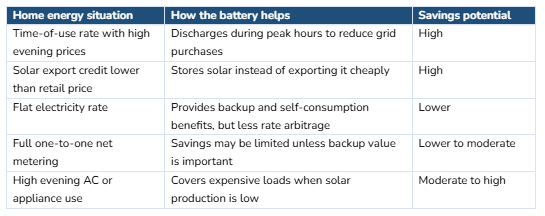
Time-of-Use Rates Explained
A time-of-use rate changes the price of electricity depending on when it is consumed. Instead of paying the same price all day, the homeowner may pay less during off-peak hours and more during peak hours.
The names vary by utility, but many plans use categories like off-peak, mid-peak, and peak. Some plans also include seasonal changes, with summer peak pricing that is higher than winter pricing.
Solar batteries are useful in this structure because they give the homeowner more control. Instead of buying electricity from the grid during the expensive window, the home can use stored energy from solar production or, where allowed and economically sensible, charge from the grid during lower-cost periods.
Why Solar Alone May Not Be Enough
Solar panels reduce energy bills by producing electricity during daylight hours. But solar production and household demand do not always line up perfectly.
A common pattern looks like this:
- Morning: the home uses power before solar production is strong.
- Midday: solar production is high, but the home may be empty or using less energy.
- Evening: solar production falls while lights, appliances, cooking, HVAC, and electronics turn on.
Without a battery, the homeowner may export extra midday solar and then buy electricity back during peak evening hours. With a battery, more of that midday energy can stay on-site and be used later.
To understand the difference between solar production, inverter power, and stored battery energy, read LINIOTECH guide on kW vs kWh in battery storage.
Example: How Peak-Hour Battery Savings Work
Let’s use a simple example. A home has solar panels and a battery with about 10kWh of usable stored energy. In the evening, the homeowner usually uses 8kWh of electricity during peak hours.
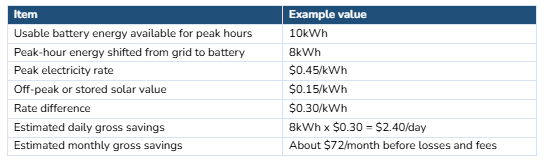
This is only a simplified illustration. Real results depend on the utility tariff, battery round-trip efficiency, solar production, battery settings, seasonal usage, export credits, and whether the battery is being reserved for outage backup.
Still, the example shows the core idea: the battery is most valuable when it moves enough energy away from expensive peak periods.
What Size Battery Is Needed for Peak-Hour Savings?
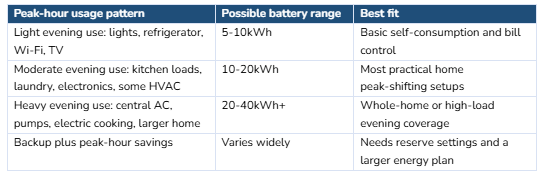
The right battery size depends on how much electricity your home normally uses during the expensive rate window. A small battery can offset lights, Wi-Fi, refrigerator loads, and electronics. A larger battery may be needed if you want to cover air conditioning, cooking, laundry, or well pump use during peak hours.
Start by checking your utility data for the exact peak window. Then estimate how many kWh your home uses during that window. That number gives you the first clue about battery capacity.
For deeper battery sizing around inverter output and runtime, use LINIOTECH guide on how much battery storage a 10kW inverter needs.
Battery Power Matters Too
Capacity in kWh tells you how much energy the battery stores. Power in kW tells you how much load the battery and inverter can support at one time. You need both for a good peak-hour savings strategy.
For example, a battery may have enough stored energy to cover an evening, but the inverter still needs enough output to run the loads operating at that moment. If the home turns on air conditioning, cooking equipment, a dryer, and a well pump together, the system may reach a power limit even if the battery still has energy remaining.
This is why compatibility matters. Before selecting a battery, review voltage range, discharge current, BMS communication, inverter output, and backup-load requirements. LINIOTECH battery and inverter compatibility guide explains these checks in more detail.
Using Solar Batteries With Hybrid Inverters
A hybrid inverter is usually the control center for a solar-plus-storage system. It manages solar production, battery charging, battery discharge, grid connection, and backup operation depending on the system design.
For peak-hour savings, the inverter settings are extremely important. The system may need to prioritize solar self-consumption, charge the battery before the peak window, reserve some capacity for backup, or discharge only during specified rate periods.
LINIOTECH hybrid solar inverter solutions are designed to support modern solar-plus-storage configurations where batteries, solar panels, and grid power need to work together intelligently.
Should the Battery Charge From Solar or the Grid?
Most homeowners prefer charging from solar because it increases self-consumption and reduces the need to buy electricity back from the utility. This is especially attractive when exported solar is credited at a lower value than imported electricity.
In some areas, grid charging during off-peak hours may also be allowed and economically useful. For example, a battery might charge overnight at a lower rate and discharge during a high-rate evening period. However, not every utility plan allows grid charging for all programs, and incentive rules may limit how batteries can charge or export.
The safest approach is to check the local tariff, net-metering rules, interconnection agreement, incentive requirements, and inverter programming options before choosing a dispatch strategy.
AC-Coupled vs DC-Coupled Storage for Peak-Hour Savings
Both AC-coupled and DC-coupled battery systems can help with peak-hour bill control, but the better option depends on the project.
An AC-coupled battery is often easier to add to an existing solar system because it can work alongside an existing solar inverter. A DC-coupled system can be a strong option for new installations where the solar array, hybrid inverter, and battery are designed together from the beginning.
If you are adding batteries to a current solar setup, review LINIOTECH article on AC-coupled vs DC-coupled battery storage before deciding on the system architecture.
When Solar Batteries Save the Most Money
Solar batteries are usually more financially attractive when the home has a clear mismatch between solar production and expensive evening energy use. The stronger the mismatch, the more useful the battery becomes.
Savings potential is strongest when the home has time-of-use rates, weak export credits, high evening loads, limited one-to-one net metering, or a desire to combine bill savings with backup power. The battery becomes not just an emergency tool, but a daily energy-management asset.
A good candidate might be a homeowner who produces extra solar during the day but still pays high peak rates after sunset. Another strong candidate is a household with summer evening air-conditioning use, where the peak period overlaps with cooling demand.
For summer cooling loads specifically, peak-hour savings can be very relevant because air conditioning often overlaps with the most expensive part of the day. Battery sizing should account for both evening kWh demand and inverter output, not only total daily consumption.
When Solar Batteries May Not Save Much
Solar batteries are not equally valuable in every rate structure. If your utility offers full one-to-one net metering and a flat electricity rate, the grid may already act like a financial credit system for your exported solar. In that case, the bill-saving value of a battery may be lower, although backup power may still justify the investment.
Savings may also be limited if the rate difference between peak and off-peak periods is small, if the battery is too small to cover meaningful peak usage, or if the system is programmed poorly. A battery sitting full all day may be helpful for emergency backup, but it is not creating daily bill savings unless it is actually being used to shift energy.
How to Calculate Your Own Peak-Hour Savings
The best calculation starts with your actual utility bill and interval usage data. Do not rely only on average monthly kWh, because peak-hour savings depend on timing.
- Find your utility rate schedule and identify the peak, off-peak, and mid-peak prices.
- Check your hourly or 15-minute usage data to estimate how much electricity you buy during peak hours.
- Estimate how many peak-hour kWh the battery can realistically cover after reserving backup capacity.
- Multiply the shifted kWh by the difference between peak and off-peak value.
- Adjust for round-trip efficiency, seasonal solar production, taxes, fixed charges, and system cost.
This calculation is not perfect, but it gives a much better starting point than asking whether a battery will “save money” in general. The real question is how many expensive kWh the battery can avoid each day.
Residential Example: Evening Peak Load
Suppose a home has a peak window from 4 p.m. to 9 p.m. During that window, the home typically uses electricity for air conditioning, refrigerator cycling, dinner preparation, lights, TVs, laptops, and laundry.
If the home uses 12kWh during the peak window and the battery can cover 8kWh of that demand, the home buys only 4kWh from the grid during expensive hours. If solar recharges the battery the next day, the cycle repeats.
This daily use case makes solar batteries attractive for many homeowners: store energy when it is available and use it when electricity is expensive.
Commercial Note: Peak-Hour Bills vs Demand Charges
For homes, peak-hour savings usually come from time-based energy rates. For businesses, the bigger issue may be demand charges, which are based on the highest power draw during a billing period. A commercial battery can reduce those peaks by discharging during short high-demand events.
This topic deserves separate coverage because commercial savings depend on load profile, demand-charge structure, battery power rating, and controls. For larger projects, LINIOTECH industrial and commercial energy storage systems are the more relevant destination.
Choosing a Battery for Peak-Hour Savings
The best battery is not always the biggest one. The best battery is the one that matches the home’s rate structure, evening load, solar production, inverter output, and backup reserve goals.
For many residential projects, LiFePO4 batteries are a strong option because they are widely used in modern home energy storage systems and are designed for repeated charge and discharge cycles. A modular battery design can also make it easier to expand capacity later if the home adds more electrical loads.
Homeowners comparing wall-mounted storage can explore LINIOTECH power storage wall battery options, while larger battery-bank configurations can be planned around rack LiFePO4 battery modules.
Common Mistakes to Avoid
The most common mistake is buying a battery without understanding the utility rate. If the rate plan does not reward load shifting, the battery may still be useful for backup, but the bill-saving claim should be treated carefully.
Another mistake is keeping too much battery capacity reserved for backup all the time. Backup reserve is important, but if the battery never discharges during peak hours, it cannot reduce daily peak purchases. The right reserve setting depends on local outage risk and the homeowner’s comfort level.
A third mistake is ignoring inverter output. A battery may have enough kWh to cover the evening, but the inverter must also supply enough kW for the loads running at once. Large HVAC loads, pumps, and electric heating appliances should be reviewed carefully before assuming the system can cover the full peak window.
Final Thoughts
So, can solar batteries lower peak-hour electricity bills? Yes, they can - but only when the rate structure and system design support that goal.
A battery is most useful when it stores solar energy or low-cost electricity and uses it during expensive peak periods. This can reduce grid purchases, improve solar self-consumption, and make the home less exposed to evening price spikes. The same system can also provide backup power during outages, which adds value beyond monthly bill savings.
Before choosing a battery, check your utility rate, peak-hour usage, export credits, battery capacity, inverter output, and backup reserve settings. When those pieces line up, solar storage can become a practical daily savings tool - not just an emergency power source.
To compare solar batteries, inverters, and complete storage options for your home, explore LINIOTECH energy solutions and build a system around your actual electricity usage, not a guess.
FAQs
Can a solar battery lower my electricity bill?
Yes, a solar battery can lower your electricity bill if it helps you avoid buying electricity during expensive peak periods or increases the value of your solar self-consumption. Savings depend on your rate plan, battery size, solar production, and system settings.
What are peak hours for electricity?
Peak hours are the periods when electricity costs more because demand on the grid is higher. Many utilities place peak periods in the late afternoon or evening, but the exact schedule depends on the local rate plan.
How does a battery help with time-of-use rates?
A battery can charge during lower-cost periods or from daytime solar production, then discharge when grid electricity is more expensive. This shifts energy use away from peak pricing.
Is a solar battery worth it with flat electricity rates?
The bill-saving value may be lower with flat rates, especially if full net metering is available. However, the battery may still be worthwhile for backup power, self-consumption, and resilience.
How many kWh of battery storage do I need for peak-hour savings?
Start with your peak-window usage. If your home uses 8-12kWh during the expensive window, a battery with enough usable capacity to cover most of that demand may make sense. Larger homes or homes with heavy HVAC use may require more.
Can I charge a battery from the grid at night?
Some systems can charge from the grid, but utility rules, incentive programs, and inverter settings vary. Always confirm whether grid charging is allowed and whether it affects credits or program eligibility.
Does a battery work without solar panels?
Some batteries can operate as standalone storage and charge from the grid, but pairing storage with solar often creates stronger self-consumption and backup benefits.
Will a battery save money if I have one-to-one net metering?
Savings may be smaller if your utility gives full retail credit for exported solar and charges a flat rate. In that situation, backup power may be the stronger reason to add storage.
Can a solar battery run air conditioning during peak hours?
It can, but AC loads require careful sizing. The battery capacity, inverter output, startup surge, and backup reserve must all be checked before relying on battery power for cooling.
What is the difference between peak shaving and load shifting?
Load shifting moves energy use from expensive times to cheaper times. Peak shaving reduces short periods of high power demand. Homes usually focus on load shifting, while businesses often use batteries for demand-charge peak shaving.