
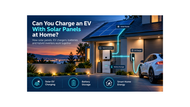
Can You Charge an EV With Solar Panels at Home?
Posted by LINIOTECH on Sep 8th 2026
Yes, you can charge an electric vehicle with solar panels at home. In most residential systems, the solar panels produce electricity during the day, the inverter converts that solar power into usable home electricity, and the EV charger delivers power to your vehicle.
The important detail is that most home EV charging is not as simple as connecting solar panels directly to the car. A practical setup usually needs solar panels, an inverter, an EV charger, proper electrical wiring, and sometimes battery storage if you want to charge when the sun is not shining.
For many homeowners, solar EV charging is attractive because it can reduce dependence on grid electricity, improve solar self-consumption, and make EV ownership feel more connected to clean home energy. But the right setup depends on when you charge, how much you drive, your roof space, your utility rate plan, and whether you want backup power during outages.
This guide explains how solar EV charging works, what equipment is needed, whether you need a battery, and how to estimate the number of solar panels required for your daily driving.
Quick Answer: Can Solar Panels Charge an EV?
Yes. Solar panels can help charge an EV at home when your solar system is connected to a compatible inverter, electrical panel, and EV charging station. If you charge during sunny hours, your EV can use solar energy directly through the home electrical system. If you charge mostly at night, you may need the grid or a home battery system to store daytime solar energy for later use.
How Solar EV Charging Works at Home
A home solar EV charging system usually follows this energy path:
- Solar panels generate DC electricity from sunlight.
- A solar inverter or hybrid inverter converts the electricity for home use.
- The home electrical panel distributes power to household loads and the EV charger.
- The EV charger safely manages charging power to the vehicle.
- The vehicle onboard charger converts AC power into DC power for the EV battery.
If the home also has battery storage, excess solar power can be stored first and used later for the house or EV charging. This is where LINIOTECH residential energy storage systems and hybrid solar inverters become especially relevant.
The EV does not know whether every electron came directly from the panels, the battery, or the grid. What matters is the system design and energy flow. Smart controls, solar production, battery settings, utility rates, and charging schedule all determine how much of the EV charging is actually powered by solar energy.
What Equipment Do You Need to Charge an EV With Solar?
A reliable solar EV charging setup usually includes the following components.
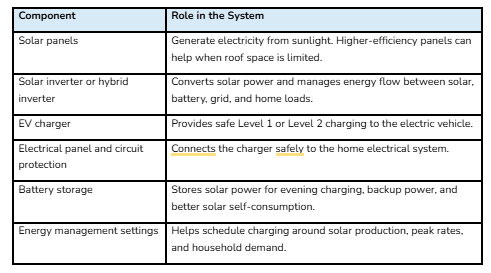
For homeowners comparing charger options, start with LINIOTECH Electric Vehicle EV Charger collection. For solar generation, review the bifacial solar panel solutions available for projects where long-term output and durability matter.
Can You Connect Solar Panels Directly to an EV Charger?
For normal home use, solar panels are not usually connected directly to an EV charger. Solar panels produce DC electricity that changes throughout the day depending on sunlight, temperature, shading, and system conditions. A home EV charger normally needs a stable electrical supply from the home electrical system.
That is why the inverter and electrical design matter. The inverter converts solar energy into usable power, and the EV charger manages the charging session safely. If the home is grid-tied, the grid can help balance power when solar production drops. If the home is off-grid, batteries become much more important because the system must keep voltage and power stable without grid support.
In short: solar panels can power EV charging, but they normally do so through a properly designed solar, inverter, panel, and charger setup - not through a simple direct panel-to-car connection.
Level 1 vs Level 2 Charging With Solar
Solar can support both Level 1 and Level 2 home charging, but the experience is very different.
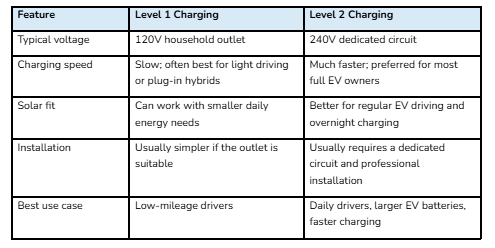
For a deeper charger-speed comparison, link this article to the September guide Level 1 vs Level 2 EV Charging: What’s the Difference? once that post is live.
How Many Solar Panels Do You Need to Charge an EV?
The number of solar panels depends mainly on three things: how far you drive each day, how efficient your EV is, and how much usable solar energy your location produces.
A simple planning formula is:
Daily EV energy needed = Daily miles driven x EV energy use per mile
Solar panels needed = Daily EV energy needed / Usable energy per panel per day
For rough planning, many EVs use around 0.25 to 0.35 kWh per mile depending on vehicle size, driving speed, temperature, terrain, tires, and cabin heating or cooling. A conservative early estimate is 0.30 kWh per mile.
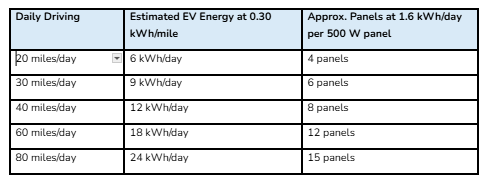
This table is not a final design. It assumes a 500W panel producing about 1.6 usable kWh per day after sunlight and system-loss assumptions. Actual output depends on location, season, panel angle, roof direction, shading, inverter efficiency, and local weather.
For a deeper solar sizing article, internally connect this topic to LINIOTECH guide How Many Solar Panels for a 10kW Inverter? and to the bifacial solar panel collection.
Daytime Charging vs Nighttime Charging
This is the biggest practical question for solar EV charging.
Charging During the Day
If your EV is parked at home during sunny hours, solar charging is more straightforward. The solar array can produce power while the vehicle is plugged in, helping the charger use available solar energy instead of pulling as much power from the grid.
Daytime charging is especially useful for people who work from home, have flexible schedules, own more than one vehicle, or can charge on weekends.
Charging at Night
If you drive during the day and charge the EV after sunset, the solar panels are no longer producing. In that case, the energy may come from the grid unless you have a battery storage system that saved daytime solar production.
This is where a home battery can make solar EV charging more useful. LINIOTECH power storage wall battery solutions and rack LiFePO4 battery modules can support broader home energy storage designs where solar energy is stored for later use.
Do You Need a Battery to Charge an EV With Solar?
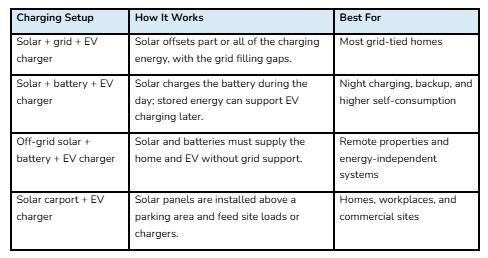
No, a battery is not always required. Many homes use grid-tied solar panels with an EV charger. During sunny hours, solar production can offset EV charging. When solar is not enough, the grid supplies the difference.
However, battery storage becomes more useful when you want to:
- Charge your EV after sunset using stored solar energy
- Increase solar self-consumption instead of exporting excess power
- Reduce charging during expensive peak-rate periods
- Keep selected home loads running during outages
- Support a more resilient solar-plus-storage system
- Prepare for future energy needs such as a second EV or electrified appliances
For homeowners focused on bill savings, connect this section to Can Solar Batteries Lower Peak-Hour Electricity Bills?. For system design, also link to AC-Coupled vs DC-Coupled Battery Storage.
Solar EV Charging System Options
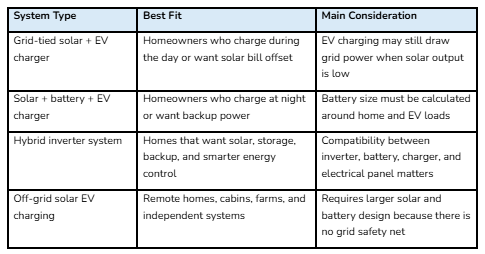
A hybrid inverter can be a strong choice when the homeowner wants the solar system, battery bank, grid connection, and backup loads to work together. Review LINIOTECH hybrid inverter solutions and the blog Battery and Inverter Compatibility: What to Check Before You Buy for planning details.
Can Your Home Electrical Panel Handle Solar EV Charging?
A solar EV charging plan should always include electrical capacity. A Level 2 charger can be one of the larger electrical loads in a home, especially when charging at 32A, 40A, or 48A. The home’s service panel, circuit breaker, wiring, and load calculation must be checked before installation.
This is not only about whether solar panels produce enough energy. It is also about whether the electrical system can safely support the charger alongside air conditioning, water heating, cooking, laundry, and other household loads.
A licensed electrician should confirm circuit requirements, charger amperage, local code requirements, outdoor rating, grounding, and permit needs.
Will Solar Panels Make EV Charging Cheaper?
Solar panels can reduce the effective cost of EV charging, especially when a homeowner charges during solar production hours or uses battery storage to shift solar energy into evening use. The savings depend on the solar system cost, local sunlight, net metering rules, utility rates, time-of-use pricing, and driving habits.
For example, a driver who needs 9 kWh per day for commuting may be able to offset much of that charging with daytime solar production. A driver who needs 25 kWh per day, charges only at night, and has limited roof space may need a more detailed system design.
The goal is not simply to install as many panels as possible. The better goal is to match solar generation, EV charging behavior, battery capacity, and utility rates into one energy strategy.
Can You Charge an EV Off-Grid With Solar Panels?
Yes, but off-grid EV charging requires a much more careful design than grid-tied home charging. The system must provide enough solar production and battery storage for both the home and the vehicle without relying on the grid.
Off-grid EV charging should account for:
- Daily household electricity use
- Daily EV driving energy
- Cloudy-day reserve capacity
- Inverter output power
- Battery charge and discharge limits
- Solar array size
- Seasonal sunlight changes
- Backup generator integration if required
For off-grid planning, it can help to review 10kW Off-Grid Inverter: What Can It Run? and How Much Battery Storage Does a 10kW Inverter Need? before designing an EV charging load into the system.
Smart Charging: The Missing Piece in Solar EV Charging
Smart charging makes solar EV charging more practical. Instead of charging the vehicle at full power whenever it is plugged in, the charger or energy management system can help align charging with solar production, lower electricity rates, or available home capacity.
Useful smart charging goals include:
- Charge more during sunny hours
- Delay charging until off-peak utility periods
- Limit charger output when the home is using heavy loads
- Avoid unnecessary peak demand
- Prioritize essential home loads during backup conditions
- Track energy use for better planning
As homes add EVs, batteries, heat pumps, induction cooking, and backup loads, energy management becomes more important than simply choosing the highest-amperage charger.
Best LINIOTECH Setup for Solar EV Charging
A strong LINIOTECH solar EV charging setup may include:
- A Level 2 EV charger for faster home charging
- Bifacial solar panels for solar generation
- A hybrid inverter to manage solar, battery, grid, and backup operation
- LiFePO4 battery storage for evening use and backup support
- A correctly sized electrical panel and dedicated charger circuit
- A charging schedule that matches solar production and utility rates
Start with the Electric Vehicle EV Charger collection, then pair the charger with the right bifacial solar panels, home energy storage system, and hybrid inverter for a complete solar-plus-storage design.
Common Mistakes to Avoid
Mistake 1: Assuming Solar Panels Charge the EV Directly
Most home systems charge the EV through the inverter, electrical panel, and EV charger. Direct panel-to-car charging is not the normal residential setup.
Mistake 2: Ignoring Nighttime Charging
If the vehicle is usually charged after sunset, solar panels alone may not reduce grid use as much as expected unless the system includes battery storage or favorable net-metering rules.
Mistake 3: Undersizing the Solar Array
An EV can add a major new load to the home. Daily miles should be converted into kWh before estimating solar panel needs.
Mistake 4: Forgetting the Electrical Panel
A Level 2 EV charger must be installed safely. The home’s panel, breaker, wiring, and local code requirements should be reviewed by a qualified professional.
Mistake 5: Not Planning for Future Loads
A home may add a second EV, battery storage, heat pump, electric water heater, or electric cooking later. Good design leaves room for future energy needs when possible.
Solar EV Charging Checklist
- Estimate daily EV driving miles.
- Convert daily driving into kWh needed for charging.
- Check your current solar production or available roof space.
- Decide whether you will charge during the day or mostly at night.
- Choose between grid-tied solar, solar-plus-battery, or off-grid design.
- Confirm Level 1 or Level 2 charger needs.
- Check electrical panel capacity and installation requirements.
- Match the EV charger with compatible solar, inverter, and battery equipment.
- Plan internal load management for high-demand appliances.
- Review utility rates, peak pricing, and solar export rules.
Final Thoughts
So, can you charge an EV with solar panels at home? Yes - and for many homeowners, it is one of the smartest ways to combine clean transportation with clean home energy.
But the best system is not just a few panels and a charger. A reliable solar EV charging setup should consider solar production, charging time, battery storage, inverter capacity, electrical-panel limits, utility rates, and backup power goals.
If you want simple home charging, start with a properly installed LINIOTECH EV charger. If you want more energy independence, pair it with solar panels, LiFePO4 battery storage, and a hybrid inverter so your EV, home, and backup power system work together.
A well-designed solar EV charging system can help reduce grid dependence, make better use of daytime solar power, and prepare your home for the next stage of electrification.
FAQs
Can solar panels charge an electric car?
Yes. Solar panels can generate electricity that supports EV charging through a home solar inverter, electrical panel, and EV charger. The system may also use grid power or battery storage depending on timing and system design.
Do I need a special EV charger for solar panels?
You usually need a compatible home EV charger, not necessarily a solar-only charger. The charger should be properly installed and matched with the home electrical system. Smart charging features can make solar charging more effective.
Can I charge my EV directly from solar panels?
In most residential systems, no. Solar panels normally feed an inverter and home electrical system first. The EV charger then manages charging to the vehicle.
Do I need a battery to charge my EV with solar?
Not always. If you charge during sunny hours, grid-tied solar can offset EV charging. If you charge mostly at night or want backup power, battery storage becomes more useful.
How many solar panels do I need to charge an EV?
It depends on daily driving, EV efficiency, local sunlight, and panel wattage. A driver using around 9 kWh per day for commuting may need roughly 6 high-output panels under favorable assumptions, but final sizing should be based on local conditions.
Is Level 2 charging better for solar EV charging?
Level 2 is usually better for full EV owners because it charges faster and can recover more driving range overnight or during a solar charging window. Level 1 may still work for low-mileage drivers or plug-in hybrids.
Can I charge an EV with solar panels during a power outage?
Only if the system is designed for backup or islanded operation. A standard grid-tied solar system may shut down during an outage unless it includes compatible backup equipment and battery storage.
Will solar EV charging reduce my electricity bill?
It can, especially if you charge during solar production hours or use battery storage to avoid peak-rate periods. Savings depend on utility rates, solar output, net-metering rules, and charging behavior.
Can one solar system power both my house and my EV?
Yes, but the system must be sized for both household loads and EV charging. EV charging can add a significant new energy demand, so solar array size and battery capacity should be recalculated.
What is the best setup for solar EV charging at home?
For many homeowners, the best setup is a Level 2 EV charger paired with solar panels, a hybrid inverter, and optional LiFePO4 battery storage. The right configuration depends on driving habits, roof space, budget, and backup power goals.