
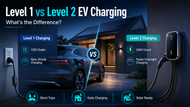
Level 1 vs Level 2 EV Charging: What’s the Difference?
Posted by LINIOTECH on Sep 3rd 2026
For many new EV owners, the first charging question is simple: can I use a regular wall outlet, or do I need a dedicated home EV charger?
That question usually comes down to Level 1 vs Level 2 EV charging. Both can charge an electric vehicle at home, but they are not built for the same lifestyle. Level 1 charging is simple and slow. Level 2 charging is faster, more practical for daily driving, and usually the better long-term setup for fully electric vehicles.
For homeowners who want dependable charging at home, the decision also connects with electrical capacity, charging schedule, solar production, battery storage, and future energy upgrades. That is why LINIOTECH Electric Vehicle EV Charger collection is best understood as part of a broader home energy system, not just a plug on the wall.
This guide explains the real difference between Level 1 and Level 2 EV charging, when each option makes sense, and how to choose the right charging setup for your home.
Quick Answer: Level 1 vs Level 2 EV Charging
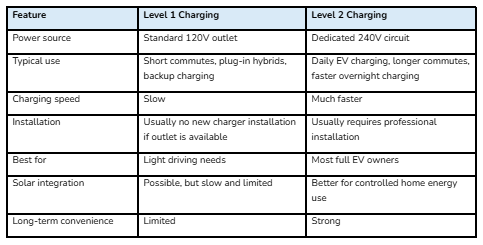
Level 1 EV charging uses a standard 120V household outlet and is best for short daily driving, plug-in hybrids, emergency charging, or people who do not need to recover much range overnight. Level 2 EV charging uses a 240V circuit and is much faster, making it the better choice for most full EV owners, longer commutes, multiple drivers, and homes that want reliable overnight charging.
A simple way to think about it is this: Level 1 can work if your EV is parked long enough and your daily mileage is low. Level 2 is the better fit when you want your EV ready every morning without planning your life around a slow outlet.
What Is Level 1 EV Charging?
Level 1 EV charging uses a standard 120V household outlet. It is the simplest way to charge an electric vehicle because it usually relies on the portable charging cord that comes with the vehicle.
For someone who drives only a short distance each day, Level 1 can be enough. The vehicle can stay plugged in overnight and slowly recover the energy used during the day. This works especially well for plug-in hybrid vehicles because their batteries are smaller than full battery-electric vehicles.
The weakness is speed. Level 1 charging can feel painfully slow when the battery is low, the vehicle has a large battery pack, or the driver needs to recover significant range before the next morning.
Level 1 Charging Is Usually Best For
- Plug-in hybrid drivers with small battery packs
- EV owners who drive fewer miles per day
- Homes where the vehicle stays parked for long periods
- Temporary charging while waiting for a Level 2 charger installation
- Emergency or backup charging
- Drivers who do not need fast daily charging
Level 1 is useful, but it is not always comfortable as a main charging method. Once a household depends on an EV for commuting, errands, weekend trips, and family schedules, slow charging becomes a real limitation.
What Is Level 2 EV Charging?
Level 2 EV charging uses a 240V electrical supply, similar to the type of circuit used by large home appliances such as dryers or ovens. This allows the charger to deliver more power to the vehicle than a standard outlet can provide.
Because Level 2 charging is faster, it is the preferred home-charging setup for many full EV owners. Instead of waiting through multiple nights to recover range, many drivers can plug in after work and wake up with enough charge for the next day.
LINIOTECH UL Electric EV Charger LTN-AC010K-US-A is an example of a 240V AC home charging product, with 40A rated current and 9.6kW output listed in its product specifications. That type of charging output is much more suitable for daily EV ownership than relying only on a standard wall outlet.
Level 2 Charging Is Usually Best For
- Full battery-electric vehicles
- Longer daily commutes
- Families with one or more EVs
- Drivers who want predictable overnight charging
- Homeowners planning solar EV charging
- People who want better charging control and future-ready infrastructure
How Much Faster Is Level 2 Charging?
Level 2 is not just slightly faster than Level 1. In many real home situations, it can be several times faster.
The exact result depends on the charger output, the vehicle’s onboard charger, battery size, state of charge, temperature, and charging limits set by the vehicle. Still, the practical difference is easy to understand: Level 1 may add only a small amount of range per hour, while Level 2 can add meaningful daily driving range during an evening or overnight charging window.
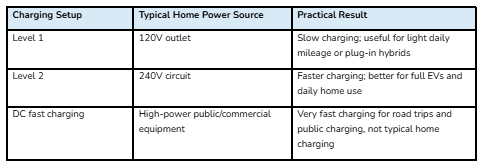
This is why Level 2 charging is usually the practical upgrade. It gives the driver more flexibility. You do not need to plug in at the perfect time every day, and you are less likely to wake up with less range than you expected.
Is Level 1 Charging Enough for Daily Driving?
Level 1 can be enough when your daily mileage is low and your vehicle is parked for many hours. For example, if a driver only uses the EV for local errands or a short commute, the slower charge rate may still recover the day’s usage overnight.
But Level 1 becomes less practical when you drive more miles, return home with a lower battery, share the EV with another driver, or need the car ready again quickly. It also becomes frustrating when weekend driving is heavier than normal and the vehicle cannot recover range fast enough before Monday.
A good rule is to match the charger to your real routine, not the best-case routine. If your EV only works because you always remember to plug in early and never have unexpected driving, the charging setup is probably too slow for your lifestyle.
When Should You Upgrade to a Level 2 EV Charger?
You should strongly consider a Level 2 charger if your EV is a main household vehicle, if your commute is moderate to long, or if you want reliable overnight charging without depending on public charging stations.
A Level 2 charger is also a better fit if you are planning a solar-powered home, adding battery storage, or preparing the house for more electric loads in the future.
If your goal is to connect EV charging with solar production or stored energy, LINIOTECH Residential Energy Storage System options can help you think beyond charging speed and plan around energy availability, backup power, and daily usage timing.
Level 1 vs Level 2: Cost Difference
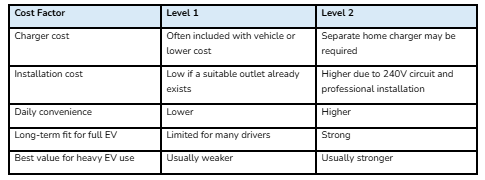
Level 1 usually has the lowest upfront cost because it may use an existing outlet and the charging cord supplied with the vehicle. The tradeoff is time. You save on installation but accept slow charging.
Level 2 usually costs more upfront because it may require a dedicated 240V circuit, suitable breaker, proper wiring, charger mounting, and professional installation. The benefit is convenience, faster charging, and better long-term usability.
For many EV owners, the real question is not only “Which charger is cheaper?” The better question is “Which charger will actually support my driving routine for the next several years?”
Does Level 2 Charging Require a Panel Upgrade?
Not always. Some homes already have enough electrical capacity for a Level 2 charger. Others may need circuit changes, load management, or a panel upgrade. This depends on the home’s service capacity, existing loads, charger amperage, local code requirements, and the installation location.
Because a Level 2 EV charger is a major electrical load, installation should be reviewed by a qualified electrician. The electrician can check whether the panel has enough capacity, whether the wiring path is practical, and whether the charger should be hardwired or plugged into a suitable receptacle.
For broader system planning, the same compatibility mindset applies to solar and storage equipment. LINIOTECH guide on Battery and Inverter Compatibility explains why voltage, power output, communication, and safety checks matter when energy equipment is expected to work together.
How Charger Amperage Affects Charging Speed
A 240V charger can come in different amperage ratings. Higher amperage can deliver more power, but only if the electrical system and the vehicle can support it.
The basic formula is simple:
Volts x Amps = Watts
For example, a 240V charger at 40A can provide up to about 9.6kW before accounting for real-world vehicle and system limits. That is why a 40A Level 2 charger can be a strong home-charging option for many EV owners.
To understand why kW is a power measurement and kWh is an energy measurement, read LINIOTECH guide on kW vs kWh in Battery Storage. The same concept applies to EV charging: charger kW tells you how quickly energy can flow, while battery kWh tells you how much energy the EV can store.
Level 2 vs DC Fast Charging: Are They the Same?
No. Level 2 charging and DC fast charging are different.
Level 2 charging is AC charging. It is commonly used at homes, workplaces, hotels, apartments, and long-term parking locations. DC fast charging uses high-power equipment that sends DC electricity more directly to the vehicle battery and is mainly used for public charging, highway stops, and quick top-ups.
For daily ownership, home Level 2 charging is usually more important than occasional DC fast charging. Public fast charging is useful on road trips, but most EV owners want the car ready before they leave home.
Can You Use Solar Panels With a Level 2 EV Charger?
Yes. A Level 2 EV charger can be part of a solar-powered home, but solar EV charging is not simply about connecting panels directly to the car.
A real solar EV charging setup needs the right energy flow. Solar panels generate DC power. An inverter converts solar energy for household use. The EV charger supplies AC power to the vehicle. The vehicle’s onboard charger then manages the charging process for the EV battery.
For homeowners planning this type of system, LINIOTECH Bifacial Solar Panel options can support solar generation, while a compatible Hybrid Inverter helps manage solar, battery, grid, and backup energy flows.
The best solar EV charging setup depends on when the vehicle is parked at home. If the EV is home during peak solar hours, it may use solar power directly through the home energy system. If the EV is usually away during the day and charges at night, battery storage becomes more important.
Do You Need a Battery for Solar EV Charging?
You do not always need a home battery to charge an EV with solar energy, but a battery can make solar charging more flexible.
Without battery storage, your EV charging is most solar-friendly when the vehicle charges during the day while the panels are producing. With battery storage, solar energy can be stored and used later, including during evening charging windows.
This is where EV charging connects directly with LINIOTECH battery-storage content. The article Can Solar Batteries Lower Peak-Hour Electricity Bills? explains how stored energy can be shifted to higher-value times of day, while AC-Coupled vs DC-Coupled Battery Storage explains how battery architecture affects new and existing solar systems.
Which Is Better for Apartments and Shared Parking?
For apartments, condos, and shared parking areas, Level 2 charging is usually more practical than Level 1 because multiple drivers may need dependable charging access. However, installation can be more complex because property management, parking assignment, metering, billing, wiring distance, and local electrical rules may all matter.
In shared settings, a charger should be selected for durability, access control, cable management, and safe installation. Outdoor or semi-outdoor placement may also require attention to enclosure rating and weather exposure.
For private parking, garages, and driveway installations, LINIOTECH IP65 Waterproof UL Certified EV Charger is relevant to review because the product page highlights indoor/outdoor suitability and a weather-resistant enclosure.
Which Is Better for Home Backup Planning?
EV charging can become one of the largest electrical loads in a home. That matters when the house also has solar battery backup, a hybrid inverter, HVAC equipment, well pumps, refrigeration, or other essential loads.
During a grid outage, most homeowners will not want an EV charger to drain the home battery unless charging the car is a priority. A good energy plan separates daily convenience from emergency backup strategy.
For that reason, EV owners with solar storage should also review Whole-Home vs Essential-Load Battery Backup. That guide explains why every load does not always need to be backed up during an outage.
How to Choose Between Level 1 and Level 2 EV Charging
The best charger depends on your driving pattern, vehicle type, home electrical setup, and long-term energy goals.
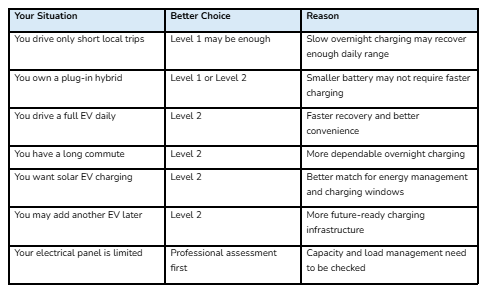
EV Charger Installation Checklist
Before installing a Level 2 EV charger, review these points with a qualified professional:
- Is the electrical panel able to support the charger load?
- Does the charger require hardwired installation or a compatible receptacle?
- What amperage is appropriate for the vehicle and home?
- Is the charger location convenient for daily parking?
- Is outdoor weather protection required?
- Does the charger connector match the vehicle and region?
- Will the home add solar panels, battery storage, or another EV later?
- Should charging be scheduled for off-peak electricity hours?
This checklist keeps the decision practical. The best EV charger is not only the fastest one. It is the one that fits the vehicle, the home, the electrical system, and the owner’s daily routine.
Why Level 2 Charging Fits the Modern Solar Home
EV charging is becoming part of whole-home energy planning. A homeowner may want to run HVAC, charge an EV, store solar energy, lower peak-hour bills, and keep essential loads operating during outages. These goals all affect each other.
Level 2 charging gives the home energy system more control. Charging can be scheduled overnight, during off-peak hours, during strong solar production, or around battery-storage priorities. That makes it a better match for homes that are moving toward solar-plus-storage and smarter energy management.
LINIOTECH supports this bigger picture with EV chargers, solar panels, hybrid inverters, and LiFePO4 battery systems. Start by reviewing the Electric Vehicle EV Charger collection, then compare the charger with your home’s electrical capacity, solar plans, and storage goals.
Final Thoughts
Level 1 and Level 2 charging can both charge an electric vehicle, but they solve different problems.
Level 1 is simple, low-cost, and acceptable for light driving needs. It can be enough for plug-in hybrids, short commutes, and backup charging. But for many full EV owners, it becomes too slow once the vehicle becomes part of everyday life.
Level 2 charging is faster, more convenient, and better suited for daily home charging. It is also the stronger option for homeowners planning solar EV charging, off-peak charging, battery storage, and future electrical upgrades.
If you want a reliable home charging setup that fits modern EV ownership, explore LINIOTECH Electric Vehicle EV Chargers and plan your charger, electrical capacity, solar system, and storage options as one connected energy strategy.
FAQs
What is the main difference between Level 1 and Level 2 EV charging?
Level 1 charging uses a standard 120V household outlet and charges slowly. Level 2 charging uses a 240V circuit and charges much faster, making it better for most full EV owners.
Is Level 1 charging enough for an electric car?
Level 1 can be enough for short daily driving, plug-in hybrids, or occasional charging. It may not be enough for long commutes, large EV batteries, or drivers who need faster overnight charging.
Is Level 2 charging worth it at home?
For most full EV owners, yes. Level 2 charging gives faster recovery, better daily convenience, and more flexibility for off-peak charging or solar-assisted charging.
Does a Level 2 EV charger need a 240V outlet?
Yes, Level 2 charging uses 240V power. Depending on the charger, it may be hardwired or connected through a compatible 240V receptacle. Professional installation is recommended.
Can I install a Level 2 charger without upgrading my electrical panel?
Sometimes yes, but it depends on your home’s electrical capacity and existing loads. A qualified electrician should evaluate the panel before installation.
How fast does a Level 2 charger charge an EV?
Charging speed depends on charger power, vehicle limits, battery size, and conditions. In general, Level 2 is much faster than Level 1 and is better suited for overnight home charging.
Can solar panels power a Level 2 EV charger?
Yes, solar panels can support EV charging as part of a properly designed home energy system. The setup usually includes solar panels, an inverter, the home electrical system, and an EV charger.
Do I need a battery to charge my EV with solar?
Not always. If your EV charges during the day, solar can help directly. If you usually charge at night, battery storage can help store solar energy for later use.
Is Level 2 charging the same as DC fast charging?
No. Level 2 is AC charging commonly used at homes and workplaces. DC fast charging is higher-power public or commercial charging designed for quick charging on the road.
Which EV charger should I choose for home use?
Choose based on your vehicle, daily mileage, available electrical capacity, installation location, and future solar or battery-storage plans. For most full EV owners, Level 2 is the better long-term choice.