
How Many Solar Panels Do You Need to Charge an EV?
Posted by LINIOTECH on Sep 11th 2026
Most EV owners do not need enough solar panels to charge an empty electric vehicle battery every day. They need enough solar production to replace the energy they use from daily driving.
For many homes, that may mean around 6 to 12 modern solar panels for typical daily EV use. The exact number depends on daily mileage, vehicle efficiency, panel wattage, available sunlight, charging losses, and whether the system includes battery storage.
This is why the question is not only, “How many solar panels does an EV need?” A better question is:
How many kilowatt-hours does your EV need each day, and how much solar energy can your roof or ground-mounted array produce?
This guide explains how to estimate the number of solar panels needed to charge an EV at home and how to connect EV charging with solar panels, battery storage, and the right charger setup.
Quick Answer: How Many Solar Panels Are Needed to Charge an EV?
A practical daily-driving solar setup often needs about 6 to 12 solar panels, assuming modern 400W to 550W panels, normal daily driving, and decent sunlight. A full charge from empty in one day may require many more panels, but most EV drivers top up the energy they used that day rather than charging from 0% to 100% every time.
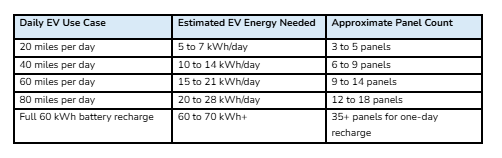
These are planning estimates, not final system designs. Real projects need local solar-production data, roof layout, electrical design, charger specs, inverter limits, and utility rules.
Why There Is No Single Panel Count for Every EV
Two people can own the same EV and need very different solar systems. One driver may travel 20 miles per day and charge slowly at home. Another may drive 80 miles per day, use cabin heating or cooling heavily, and need faster Level 2 charging at night.
The number of panels depends on several variables:
- How many miles you drive each day
- How many kWh your EV uses per mile
- The wattage of the solar panels
- Peak sun hours in your location
- Roof orientation, shading, and available space
- Solar inverter and charger configuration
- Whether you charge during the day or at night
- Whether you use battery storage
LINIOTECH Electric Vehicle EV Charger collection is a useful starting point for the charging side of the system, but the solar-panel count should be calculated from the EV’s daily energy demand.
Step 1: Estimate How Much Energy Your EV Uses
EV energy use is usually measured in kWh per mile or kWh per 100 miles. A more efficient EV may travel about 4 miles per kWh, while a larger SUV, truck, or less efficient model may use more energy for each mile.
For simple planning, use this formula:
Daily EV energy needed = daily miles driven × kWh per mile
If your EV uses 0.30 kWh per mile and you drive 40 miles per day:
40 miles × 0.30 kWh per mile = 12 kWh per day

For a more accurate estimate, check your vehicle’s dashboard, owner manual, or EPA efficiency rating. Use real driving data when possible because highway speed, weather, tires, elevation, and cabin climate control can all change energy use.
Step 2: Estimate Solar Production Per Panel
Solar panels are rated in watts under standard test conditions, but real-world daily energy production depends on sunlight, temperature, panel orientation, shading, inverter losses, wiring losses, and soiling.
A simple planning formula is:
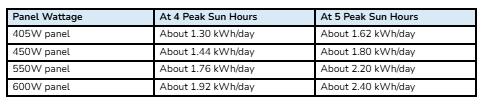
Daily energy per panel = panel wattage × peak sun hours × performance factor ÷ 1,000
For early planning, many homeowners use a performance factor around 75% to 85%. This helps account for normal system losses before electricity reaches the charger or home loads.
Example using a 450W solar panel, 4.5 peak sun hours, and an 80% performance factor:
450W × 4.5 × 0.80 ÷ 1,000 = 1.62 kWh per panel per day
For higher-yield systems, review LINIOTECH bifacial solar panel solutions, especially where a ground mount, solar carport, or reflective installation surface can improve total generation.
Step 3: Calculate the Number of Panels
Once you know daily EV energy use and daily solar production per panel, the panel count is straightforward:
Number of solar panels = daily EV kWh needed ÷ daily kWh produced per panel
- Example: 40 miles per day in an average EV
- Daily driving: 40 miles
- EV efficiency: 0.30 kWh per mile
- Daily EV energy: 12 kWh
- Panel size: 450W
- Peak sun hours: 4.5
- Performance factor: 80%
- Daily production per panel: 1.62 kWh
Calculation:
12 kWh ÷ 1.62 kWh per panel = 7.4 panels
In real planning, you would round up. That means about 8 solar panels in this example.
Example Panel Counts by Daily Driving Distance
The table below uses a 450W panel, 4.5 peak sun hours, and an 80% performance factor. It assumes an average EV energy use of 0.30 kWh per mile.
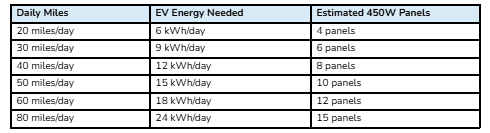
This is why daily mileage matters more than battery size. A driver with a large EV battery but a short commute may need fewer panels than someone with a smaller EV who drives long distances every day.
How Many Panels to Fully Charge an EV Battery?
A full charge from empty is a different calculation. Many EV batteries hold 50 to 100 kWh or more. If you want to fully recharge a 60 kWh EV battery from solar in one day, the panel count becomes much larger.
Using the same 450W panel example at 1.62 kWh per panel per day:
60 kWh ÷ 1.62 kWh per panel = about 37 panels
After charging losses and design margin, the real number may be higher. This is why most home solar EV charging designs are not sized around a full empty-to-full battery recharge every day. They are usually sized around daily driving energy.
For homeowners who already read LINIOTECH article on Can You Charge an EV With Solar Panels at Home?, this article is the next step: calculating how much solar capacity the EV actually needs.
Level 2 Charging Does Not Always Mean More Solar Panels
A common mistake is assuming that a faster charger automatically requires more solar panels. That is not always true.
A Level 2 EV charger can deliver power faster than a standard outlet, but your total solar-panel need still depends mainly on how many kWh the vehicle uses over time. If the same EV needs 12 kWh per day, the solar array must replace about 12 kWh per day whether the EV charges slowly or quickly.
The difference is charging speed and electrical capacity. A stronger Level 2 charger may need a dedicated circuit, panel capacity, and proper installation planning. For a deeper charger-level comparison, read LINIOTECH’s September guide: Level 1 vs Level 2 EV Charging: What’s the Difference?.
LINIOTECH UL Electric EV Charger LTN-AC010K-US-A is especially relevant for readers comparing higher-power home charging options.
Can You Charge an EV Directly From Solar Panels?
In most home systems, the EV does not connect directly to individual solar panels. The power flows through a solar inverter, hybrid inverter, service panel, battery system, or EV charger depending on the system design.
A typical solar EV charging setup may look like this:
- Solar panels generate DC electricity
- The inverter converts or manages the power for home use
- The home electrical system supplies the EV charger
- The EV charger delivers controlled power to the vehicle
If battery storage is included, extra solar energy can be stored during the day and used later when the vehicle is parked at night. This is where solar EV charging becomes much more flexible.
For system design around solar panels, batteries, and inverters, explore LINIOTECH hybrid inverter solutions and residential energy storage systems.
Do You Need Battery Storage to Charge an EV With Solar?
You do not always need a home battery to charge an EV with solar. If your EV is parked during sunny hours, the charger can use solar production while the system is generating power, depending on the system configuration and local utility setup.
However, battery storage becomes useful when:
- The EV is usually away from home during the day
- You charge mostly at night
- Electricity rates are higher during peak hours
- You want backup power during outages
- You want to store extra solar instead of sending it back to the grid
- You want more control over when solar energy is used
This connects directly with LINIOTECH power storage wall battery and rack LiFePO4 battery module options. For readers comparing energy units, review kW vs kWh in Battery Storage to clarify the difference between charging power and stored energy.
Solar EV Charging With a Battery: Example
Imagine a homeowner drives 40 miles per day and needs about 12 kWh of EV energy. Their solar panels produce most of that energy during the afternoon, but the EV is normally parked at home after 6 p.m.
Without battery storage, the homeowner may depend more on grid charging at night. With a properly designed battery system, some of the daytime solar energy can be stored and then used later for EV charging, home loads, or backup needs.
This does not mean the home battery must fully charge the EV from empty. In many cases, the goal is to shift part of the EV charging load away from expensive peak hours or store extra solar for evening use.
For rate-focused planning, review LINIOTECH’s August blog: Can Solar Batteries Lower Peak-Hour Electricity Bills?.
How Many Solar Panels for Common EV Charging Scenarios?
The following examples are useful for early planning. They assume 450W panels, 4.5 peak sun hours, and an 80% system performance factor. Adjust final panel counts for local conditions.
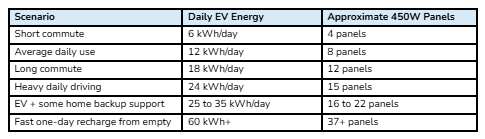
This is why a solar EV charging plan should be designed around a realistic use case, not a generic panel count.
What If You Have a 10kW Solar System?
A 10kW solar array can produce a meaningful amount of daily energy, but the exact output depends on location and system performance. As a rough example, a 10kW array with 4.5 peak sun hours and an 80% performance factor could generate about 36 kWh per day.
10kW × 4.5 × 0.80 = 36 kWh/day
That may be enough to cover typical daily EV charging and some household energy use, depending on the home. However, the system must still be balanced with inverter capacity, battery capacity, circuit design, and charging schedule.
For solar array sizing around inverter systems, see LINIOTECH guide: How Many Solar Panels for a 10kW Inverter?. For inverter load planning, review 10kW Off-Grid Inverter: What Can It Run?.
Can an Off-Grid Solar System Charge an EV?
Yes, but off-grid EV charging needs more careful sizing than grid-tied charging. An EV is a large electrical load, and adding it to an off-grid home can change the required solar array, battery bank, inverter output, and backup strategy.
An off-grid EV charging design should check:
- Daily EV kWh requirement
- Home energy requirement
- Battery storage capacity
- Inverter output capacity
- Solar production in winter and cloudy seasons
- Generator backup or secondary charging plan
- Load management during high-demand periods
This is where LINIOTECH AC-Coupled vs DC-Coupled Battery Storage guide is useful, because solar-storage architecture affects how energy moves between the panels, battery bank, house loads, and EV charger.
How Roof Space Affects the Panel Count
The number of panels is not only an energy calculation. It is also a space calculation. Higher-wattage panels can reduce the number of modules needed, which matters for homes with limited roof space.
For example, a 12 kWh/day EV charging target may need:
- About 9 panels using 405W modules
- About 8 panels using 450W modules
- About 7 panels using 500W modules
- About 6 to 7 panels using 550W modules
The best choice depends on panel dimensions, roof layout, shading, mounting type, and budget. Ground-mounted arrays and solar carports may also be good options for EV owners because they can provide space for larger arrays while physically aligning with vehicle parking.
What About Bifacial Solar Panels for EV Charging?
Bifacial solar panels can be useful for EV charging projects where the installation captures reflected light from the rear side of the module. This can be especially relevant for solar carports, ground mounts, light-colored surfaces, and commercial EV charging areas.
LINIOTECH’s bifacial solar panel collection includes 405W, 450W, and 550W module options, which allows buyers to compare panel wattage and project size while planning solar EV charging. Product-focused readers can also review the Seraphim 550W Bifacial Solar Panel pallet for a higher-wattage example.
Solar Panels, EV Charger, and Electrical Panel Capacity
Solar panel count answers the energy question. The EV charger and home electrical panel answer the power and installation question.
Before installing a Level 2 charger, homeowners should confirm:
- Available electrical panel capacity
- Breaker size and dedicated circuit requirements
- Charger amperage settings
- Wiring distance from panel to charger
- Indoor or outdoor installation conditions
- Utility requirements and permits
- Compatibility with solar and battery system controls
Because a Level 2 charger can add a significant load to the home, this step should be reviewed by a qualified electrician before installation.
Should You Oversize the Solar Array for EV Charging?
Solar array oversizing can be useful when the home has growing energy needs, but oversizing should be intentional. EV charging can increase a household’s electricity demand significantly, especially if the vehicle replaces a gasoline car and is driven daily.
Reasons to slightly oversize the solar array may include:
- Future EV purchase
- Second EV in the household
- Battery storage expansion
- Heat pump or electric appliance upgrades
- Lower winter solar production
- Cloudy weather and seasonal variation
However, oversizing must stay within inverter input limits, utility interconnection rules, roof capacity, and electrical design requirements. A professional design should check solar-panel strings, inverter specifications, current limits, and safety equipment.
Common Mistakes When Sizing Solar Panels for EV Charging
Mistake 1: Sizing the System Around a Full Battery Every Day
Most drivers do not use a full EV battery every day. Daily mileage is usually a better starting point than full battery capacity.
Mistake 2: Ignoring Charging Losses
The energy pulled from the solar system or grid can be higher than the energy that ends up stored in the EV battery. Build in margin for losses.
Mistake 3: Confusing Charger Power With Daily Energy
A 9.6kW charger describes charging power. The daily solar-panel requirement depends on total kWh used over time.
Mistake 4: Forgetting Nighttime Charging
If the EV is not at home during sunny hours, solar-only charging may be limited unless the home uses net metering, managed charging, or battery storage.
Mistake 5: Ignoring the Home’s Existing Loads
Solar panels may also need to support lights, appliances, HVAC, battery charging, and backup loads. EV charging should be planned as part of the whole home energy system.
Best Setup for Charging an EV With Solar at Home
For many homeowners, the strongest setup is not just “solar panels plus charger.” It is a complete energy ecosystem:
- High-efficiency solar panels
- A properly sized EV charger
- A compatible inverter or hybrid inverter
- Battery storage if nighttime charging or backup power is important
- Smart charging schedule based on solar output or off-peak rates
- Professional electrical design and installation
That complete approach matches LINIOTECH product ecosystem: EV chargers, bifacial solar panels, residential energy storage, LiFePO4 battery modules, and hybrid inverters.
Final Thoughts
So, how many solar panels do you need to charge an EV?
For many drivers, the answer is around 6 to 12 modern solar panels for typical daily driving. Short commutes may need fewer panels, while long commutes, larger EVs, cloudy climates, and full-battery recharge goals may require a much larger array.
The best calculation starts with daily EV energy use, not battery size alone. Estimate how many kWh your EV needs each day, calculate how much energy each solar panel can produce in your location, and then build in margin for losses and future needs.
For the most reliable result, plan the full system together: solar panels, EV charger, inverter, battery storage, electrical panel capacity, and charging schedule.
LINIOTECH provides solar panels, EV chargers, LiFePO4 batteries, and hybrid inverter solutions for homeowners who want to connect electric driving with cleaner, smarter home energy. Explore LINIOTECH Electric Vehicle EV Charger and Bifacial Solar Panel collections to start building a solar-ready charging setup.
FAQs
How many solar panels are needed to charge an electric car?
Many EV owners may need about 6 to 12 modern solar panels for typical daily driving. The exact number depends on miles driven, EV efficiency, panel wattage, sunlight, and system losses.
Can a 5kW solar system charge an EV?
Yes, a 5kW solar system can offset a meaningful amount of EV charging, especially for moderate daily driving. Whether it covers all EV charging depends on daily mileage, sunlight, household loads, and charging schedule.
How many solar panels do I need to drive 40 miles per day?
If an EV uses about 0.30 kWh per mile, 40 miles needs about 12 kWh. With 450W panels producing roughly 1.62 kWh per day each, that works out to about 8 panels before site-specific adjustments.
Can I charge an EV directly from solar panels?
Most home systems do not connect panels directly to the EV. Solar energy usually flows through an inverter, home electrical panel, battery system, or EV charger depending on the design.
Do I need a battery to charge an EV with solar?
Not always. If the EV is home during sunny hours, solar can support daytime charging. Battery storage becomes more useful when charging at night, managing peak rates, or preparing for outages.
How many panels are needed to fully charge a 60 kWh EV battery?
Using 450W panels producing about 1.62 kWh per day, a 60 kWh recharge could require about 37 panels before adding margin for losses. Most homeowners size around daily driving rather than full empty-to-full charging.
Does Level 2 charging require more solar panels?
Not necessarily. Level 2 charging changes charging speed and electrical requirements, but the solar array size is mainly based on the total kWh the EV uses over time.
Are bifacial solar panels good for EV charging?
They can be a strong option, especially for ground mounts, solar carports, and reflective surfaces where rear-side generation can improve total energy yield.
Can solar panels charge an EV during a power outage?
Only if the system is designed for backup operation. Many grid-tied solar systems shut down during outages unless they include the correct inverter, battery storage, and backup configuration.
What is the best solar setup for EV charging?
A strong setup usually includes properly sized solar panels, a Level 2 EV charger, a compatible inverter, optional LiFePO4 battery storage, and professional electrical design.