
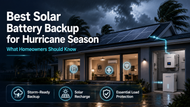
Best Solar Battery Backup for Hurricane Season: What Homeowners Should Know
Posted by LINIOTECH on Aug 17th 2026
Hurricane season can turn a normal home power system into a serious resilience problem. When the grid goes down, homeowners are worried about more than just the lights. They are thinking about refrigerators, freezers, phones, medical equipment, Wi-Fi, sump pumps, well pumps, fans, and in some cases air conditioning. That is why a home energy storage system is becoming a practical part of storm preparation, not just a clean-energy upgrade.
The best solar battery backup for hurricane season is not simply the largest battery you can buy. It is a well-designed system that matches your essential loads, inverter power, battery capacity, solar recharge capability, installation location, and outage goals. A small system may keep core essentials running for a day. A larger solar-plus-storage system may support longer outages and selected comfort loads when managed carefully.
This guide explains how to choose a storm-ready solar battery backup system, how much capacity you may need, when whole-home backup makes sense, and which mistakes homeowners should avoid before a hurricane arrives.
Quick Answer: What Is the Best Solar Battery Backup for Hurricane Season?
The best solar battery backup for hurricane season is a LiFePO4-based solar storage system sized around your essential loads, paired with a compatible hybrid inverter and enough solar input to recharge during multi-day outages. For many homes, a practical hurricane backup setup starts with 10kWh to 20kWh of usable battery storage for essentials and scales higher when air conditioning, well pumps, or whole-home backup are required.
A good hurricane backup system should include:
- Reliable LiFePO4 battery storage
- A compatible hybrid inverter with enough surge capacity
- A critical-load or whole-home backup plan
- Solar panels for daytime recharge
- Safe installation in a suitable indoor or outdoor-rated location
- Clear load management rules for extended outages
If you are still deciding between backing up the entire house or only selected circuits, read the LINIOTECH guide on whole-home vs essential-load battery backup as a supporting article for this topic.
Why Hurricane Backup Power Needs Different Planning
A short grid outage is inconvenient. A hurricane outage is different. Storms can damage distribution lines, delay fuel access, create heat and humidity problems, interrupt communication, and keep neighborhoods without utility power for longer than expected.
That changes the way you should think about backup power. Instead of asking only, “Can this battery run my home?” ask these better questions:
- Which loads must stay on no matter what?
- How many hours or days should the system support those loads?
- Can the battery recharge from solar after the storm passes?
- Can the inverter handle motor startup surge from pumps and compressors?
- Can I reduce or schedule large loads to extend runtime?
That is why a storm-ready battery backup plan should be designed around energy priorities, not just battery size.
Solar Battery Backup vs Generator for Hurricane Season
Generators have traditionally been the default hurricane backup option, but many homeowners now compare them with solar batteries because battery systems are quiet, automatic, fuel-free during operation, and easier to pair with solar panels. LINIOTECH already covers this broader comparison in its guide to residential energy storage systems vs generators.
For hurricane season, the main difference is how each option behaves during a long outage.
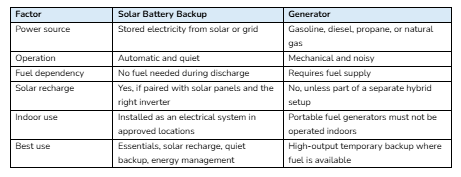
Many homeowners use a hybrid mindset: solar batteries for automatic daily backup and essential loads, and a generator only as a secondary long-duration fallback. But for homes that want cleaner, quieter, and more automated outage protection, a properly sized solar battery system can be the better long-term solution.
What Loads Should a Hurricane Battery Backup Run?
Before choosing battery size, list what must stay powered during a storm outage. These are usually called essential loads or critical loads.
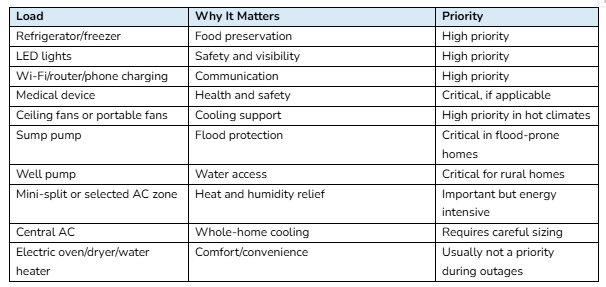
The key is not to run everything as usual. The goal is to keep the home safe, functional, and livable while preserving battery runtime.
For a more detailed blackout-focused article, connect this blog to the LINIOTECH guide on whether solar batteries can power a house during a blackout.
How Much Battery Storage Do You Need for Hurricane Season?
Battery storage is measured in kilowatt-hours, or kWh. A simple planning formula is:
Battery capacity needed = average load in kW x backup hours
For example, if your essential loads average 1.5kW and you want 12 hours of backup:
1.5kW x 12 hours = 18kWh
That simple math gives a starting point, but a real system should also account for battery depth of discharge, inverter losses, temperature, surge loads, reserve margin, and solar recharge. To avoid confusing power and energy, review the LINIOTECH article on kW vs kWh in battery storage.
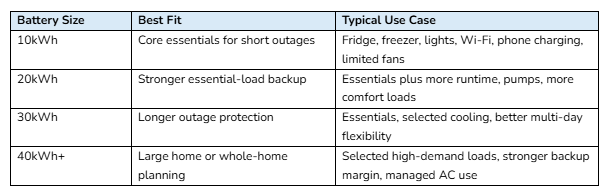
These are planning ranges, not final engineering numbers. A home with a well pump and central AC may need much more inverter power and storage than a smaller home only backing up refrigeration, lights, internet, and fans.
Example Hurricane Backup Scenarios
Scenario 1: Basic Essential Backup
A homeowner wants to keep a refrigerator, freezer, LED lights, Wi-Fi, phone charging, and a few fans running. If these loads average around 700W to 1,200W, a 10kWh battery may provide useful short-term backup, especially if the system can recharge from solar during the day.
- Best for: short outages, smaller homes, basic storm readiness
- Likely system focus: essential-load panel and conservative energy use
For this type of plan, a wall-mounted battery option from the LINIOTECH Power Storage Wall Battery category may be a practical starting point.
Scenario 2: Essentials Plus Well Pump
A rural home may need everything in the basic setup plus a well pump. The well pump can create a startup surge, so inverter sizing becomes just as important as battery capacity. A larger inverter or a properly designed split-phase system may be needed depending on the pump size and voltage.
This is where battery and inverter pairing matters. Before selecting equipment, review Battery and Inverter Compatibility: What to Check Before You Buy and confirm voltage range, discharge current, surge power, and BMS communication.
Scenario 3: Essentials Plus Air Conditioning
Air conditioning is often the biggest hurricane backup question. A small inverter-driven mini-split or selected cooling zone may be easier to support than a large central AC system. Central AC can require higher surge power and can drain battery capacity quickly if unmanaged.
For the AC-specific planning process, interlink this blog with LINIOTECH August article Solar Battery Backup for Air Conditioning: How Much Power Do You Need?.
Scenario 4: Whole-Home Hurricane Backup
Whole-home backup is possible, but it requires a stronger design. The system must handle larger simultaneous loads, motor surges, transfer equipment, battery discharge capability, and enough capacity to avoid draining too quickly.
For many homeowners, the better first step is to separate essentials from non-essentials. That gives the battery more useful runtime and reduces the risk of overload during a long outage.
Why Inverter Size Matters During Hurricane Outages
The battery determines how much energy you can store. The inverter determines how much power you can use at one time. Both matter during hurricane season.
For example, a home may have enough battery capacity on paper, but if the inverter cannot handle the startup surge of a well pump, refrigerator compressor, or AC system, the backup system may trip or fail to support the intended load.
If your system involves larger loads, read 10kW Off-Grid Inverter: What Can It Run? and How Much Battery Storage Does a 10kW Inverter Need? before choosing final equipment.
A strong hurricane backup inverter should be evaluated for:
- Continuous output rating
- Surge capacity and surge duration
- Split-phase 120/240V support, if required
- Battery voltage compatibility
- Maximum battery charge and discharge current
- Generator input, if a secondary backup source is planned
- Solar PV input limits
- Transfer capability for backup circuits
Explore LINIOTECH hybrid inverter solutions when planning a solar-plus-storage setup for outage protection.
Why Solar Recharge Matters After the Storm
A battery alone is a stored-energy device. Once it is discharged, it needs to be recharged. During hurricane season, solar recharge can be the difference between a one-night backup plan and a more resilient multi-day strategy.
Solar recharge depends on:
- Available sunlight after the storm
- Solar array size
- Roof condition and shading
- Inverter MPPT input limits
- Battery charge-current limits
- Daily household load
- Whether the system can operate safely in backup mode
For homes upgrading solar production, LINIOTECH bifacial solar panel solutions can be used as an internal link from the solar recharge section because panel output is central to post-storm battery recovery.
The important point is simple: a larger battery gives you stored energy, but solar panels help you rebuild that stored energy after the outage begins.
AC-Coupled or DC-Coupled for Hurricane Backup?
Homeowners with an existing solar system often ask whether they should add batteries using AC coupling or rebuild the system around DC-coupled storage. The right answer depends on the current inverter, backup goals, budget, wiring layout, and whether the system is new or being retrofitted.
For hurricane backup, the key question is not just efficiency. It is whether the solar system and battery can keep operating safely when the grid is down. Some grid-tied solar systems shut down during outages unless they are designed with proper battery backup and islanding protection.
Use the LINIOTECH guide to AC-coupled vs DC-coupled battery storage as a natural supporting link for this section.
Should You Choose a Wall Battery or Rack Battery?
Battery form factor also matters. A wall-mounted battery can be a clean choice for homes with limited space and a simple storage plan. Rack batteries can make expansion easier when more capacity is needed over time.
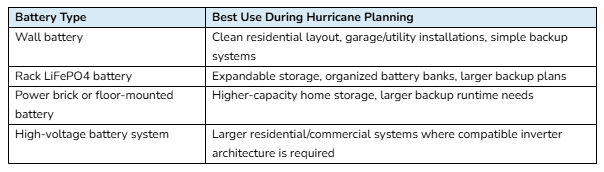
For modular storage, link readers to LINIOTECH Rack LiFePO4 Battery Module category. For residential wall-mounted systems, link to Power Storage Wall Battery.
Battery Chemistry: Why LiFePO4 Is a Strong Choice
For hurricane backup, homeowners want battery storage that is stable, long-lasting, and suitable for repeated cycling. LiFePO4, also called lithium iron phosphate or LFP, is widely used in modern solar storage because it offers a strong balance of cycle life, safety, and performance.
When comparing battery backup options, look beyond the headline kWh capacity. Also review:
- Battery chemistry
- Usable capacity
- Continuous discharge power
- Peak discharge support
- Operating temperature range
- Warranty terms
- Certifications
- BMS communication
- Inverter compatibility
A battery that looks large on paper may not be ideal if it cannot deliver the discharge current required by your inverter and storm loads.
How to Size a Hurricane Battery Backup System Step by Step
- List your essential loads. Include refrigerators, freezers, lights, internet, fans, medical devices, sump pumps, and well pumps.
- Record running watts. Use nameplate ratings or manufacturer data whenever possible.
- Identify surge loads. Mark equipment with motors or compressors, including pumps, refrigerators, freezers, and AC units.
- Choose backup duration. Decide whether you want 8 hours, 24 hours, 48 hours, or multi-day support.
- Calculate kWh needed. Multiply average load by desired runtime.
- Add design margin. Account for inverter losses, battery reserve, cloudy weather, and unexpected loads.
- Check inverter power. Make sure continuous and surge ratings match the load plan.
- Plan solar recharge. Estimate how much energy the panels can replace after the storm.
- Verify installation location. Choose equipment appropriate for heat, moisture, ventilation, and code requirements.
- Confirm professional installation. Backup power systems should be designed and installed according to applicable electrical codes and manufacturer instructions.
Hurricane Backup Power Mistakes to Avoid
Avoid these common mistakes before storm season arrives.
Mistake 1: Buying Battery Capacity Without Checking Inverter Power
A large battery cannot solve a small inverter problem. If the inverter cannot start the pump, compressor, or AC unit, the system will not perform as expected.
Mistake 2: Expecting One Battery to Run the Whole House for Days
A single battery may be excellent for basic essentials but unrealistic for full-home loads during a long hurricane outage. Runtime depends on the load, not just the battery label.
Mistake 3: Ignoring Air Conditioning Loads
Cooling can dominate battery use in hot, humid climates. If AC is required, size the system specifically around that load or use a smaller cooling zone.
Mistake 4: Forgetting Solar Recharge
A battery can only provide stored energy. Solar recharge improves resilience, especially when the grid remains down after the storm.
Mistake 5: Waiting Until a Storm Is Already Forecast
Battery backup requires planning, equipment availability, design, permits, installation, and testing. The right time to prepare is before hurricane threats appear on the forecast map.
Pre-Storm Battery Backup Checklist
- Fully charge the battery system before expected severe weather.
- Test backup mode before storm season.
- Confirm that critical circuits are connected correctly.
- Lower unnecessary energy use before and during the outage.
- Pre-cool the home if AC backup is limited.
- Freeze water bottles to help refrigerators and freezers stay cold longer.
- Check solar monitoring and battery app access.
- Keep emergency supplies, flashlights, and phone chargers ready.
- Review generator safety if using a generator as secondary backup.
- Document your load priorities with everyone in the household.
After the Storm: How to Stretch Battery Runtime
Once the grid is down, your behavior matters. A well-sized battery can still drain quickly if large loads are left unmanaged.
- Run only essential loads at first.
- Use fans before air conditioning when possible.
- Avoid electric ovens, dryers, and high-resistance heating loads.
- Run pumps and large appliances only when needed.
- Use daytime solar production to recharge the battery and complete higher-energy tasks.
- Monitor battery state of charge frequently.
- Keep reserve capacity for overnight hours.
Smart energy management is what turns a battery from emergency equipment into a practical storm-resilience system.
How LINIOTECH Supports Hurricane Backup Planning
LINIOTECH offers solar and storage components that can be combined into residential backup systems, including LiFePO4 batteries, hybrid inverters, solar panels, rack batteries, wall batteries, and complete storage solutions. The goal is not to sell one battery for every home. The goal is to match the system to the homeowner’s actual outage risk, load profile, and budget.
A complete storm-ready setup may include:
- Residential energy storage system for core backup planning
- Power storage wall battery for clean home installation
- Rack LiFePO4 battery modules for expandable battery banks
- Hybrid inverter for solar, battery, grid, and backup power control
- Bifacial solar panels for solar production and recharge
If your home is in a hurricane-prone region, the best time to design backup power is before the outage begins. Start with your load list, decide what must stay running, then choose battery capacity and inverter power around that real-world plan.
Final Thoughts
The best solar battery backup for hurricane season is the one that keeps your most important loads powered safely and predictably. For some homes, that means a 10kWh essential-load system. For others, it may mean 20kWh, 30kWh, 40kWh, or a larger whole-home setup with managed cooling and solar recharge.
Do not size a hurricane backup system by guesswork. Size it around your loads, runtime goal, inverter requirements, solar recharge potential, and installation environment.
A solar battery backup system can help protect your home from outage stress, food loss, communication failures, heat, and uncertainty during storm season. With the right LINIOTECH battery, inverter, and solar configuration, homeowners can move from reactive storm preparation to planned energy resilience.
To plan a backup system for your home, explore LINIOTECH residential energy storage solutions or contact the LINIOTECH team for guidance.
FAQs
What size solar battery do I need for hurricane season?
Many homes need at least 10kWh to 20kWh for essential-load backup, but homes with well pumps, central AC, or longer outage goals may need 30kWh, 40kWh, or more.
Can a solar battery run air conditioning during a hurricane outage?
Yes, but air conditioning must be sized carefully. A mini-split or selected cooling zone is often easier to support than a large central AC system.
Is solar battery backup better than a generator for hurricanes?
Solar batteries are quiet, automatic, and fuel-free during operation. Generators can provide high temporary output but require fuel and careful safety practices. Some homes use both.
Can solar panels recharge batteries after a hurricane?
Yes, if the solar array, inverter, and battery system are designed to operate during grid outages and the panels are not damaged or heavily shaded.
How long will a 10kWh battery last during an outage?
Runtime depends on the load. A 10kWh battery may run a 1kW average load for about 10 hours before losses and reserve margin, but heavy loads reduce runtime quickly.
Should I back up the whole house or only essential loads?
Essential-load backup is usually more efficient for long outages. Whole-home backup is possible but requires more inverter power, battery capacity, and load management.
What appliances should I prioritize during hurricane outages?
Prioritize refrigerators, freezers, lights, communication devices, medical equipment, fans, sump pumps, and well pumps. Avoid unnecessary high-demand appliances.
Do I need a hybrid inverter for solar battery hurricane backup?
A hybrid inverter is often the best choice for solar-plus-storage backup because it can manage solar, battery, grid, and backup loads in one system.
Are LiFePO4 batteries good for hurricane backup?
Yes. LiFePO4 batteries are widely used in solar storage because they offer strong cycle life, stable performance, and reliable energy storage for repeated use.
When should I install a solar battery backup system for hurricane season?
Install and test the system well before a storm is forecast. Backup power systems require planning, proper equipment selection, installation, and commissioning.