

10kWh Battery, What It Can Run and How Long It Lasts
Posted by LINIOTECH on Nov 9th 2026
A 10kWh battery can run your essential loads for a full day or longer, or your whole home for about 7 hours. The difference comes down to what you plug into it. Keep the refrigerator, lights, internet, phone chargers and a furnace fan running, and a 10kWh battery easily covers 24 hours or more. Add central air, an electric dryer or an electric range, and that same battery drains before dinner.
That range confuses many buyers, so this guide replaces guesswork with real numbers. You will see how much usable energy a 10kWh battery actually delivers, how that compares with the electricity an average home uses per day, and exactly how long common appliances run on it.
We use the LINIOTECH 10 kWh LiFePO4 Power Reserve battery as our reference throughout, since its 10.24 kWh capacity and 51.2V design match the most common 10kWh home battery format on the market. The math works the same for any quality 10kWh lithium battery.
What a 10kWh Battery Actually Delivers
A 10kWh battery stores 10 kilowatt-hours of energy, but you never get every one of them at the outlet. Two factors trim the real number.
Depth of discharge (DoD). LiFePO4 batteries tolerate deep discharges far better than older lithium chemistries, but most systems keep a reserve to protect cell life. The LINIOTECH 10 kWh battery, for example, is rated for 8,500+ cycles at 80% DoD. Running it to 80% to 90% each cycle is the sweet spot between usable energy and lifespan.
Inverter losses. Your battery stores DC power and your home runs on AC. A hybrid inverter converts one to the other at roughly 90% to 95% efficiency, so a little energy turns into heat along the way.
Put those together and a 10.24 kWh battery delivers about 8 to 9 kWh of usable AC power per full cycle. Every runtime figure in this guide uses 8.5 kWh as the working number.
Capacity is only half the story. A battery's kW rating limits how many appliances can run at the same moment, while kWh sets how long they run. This 51.2V battery supports up to 150A of continuous discharge, or about 7,680 watts. Our guide to kW vs kWh in battery storage breaks that difference down, and our explainer on 48V vs 51.2V LiFePO4 batteries covers why 51.2V has become the standard for home storage.
How Many kWh Does a House Use Per Day?
The average U.S. home uses about 28 kWh of electricity per day. According to the U.S. Energy Information Administration, monthly consumption per residential customer averaged 865 kWh in 2024. Divide that by 30.4 days and you get roughly 28.4 kWh daily.
Warm-climate states run much higher. EIA's 2024 state data puts Texas homes at about 1,096 kWh per month, which works out to roughly 36 kWh per day. Air conditioning, space heating and water heating drive most of that gap, and EIA end-use estimates put those three loads at about 43% of residential electricity use.
Here is what that means for a 10kWh battery with 8.5 kWh of usable power:
- Average U.S. home, normal use: about 7 hours of whole-home power.
- Average Texas home, normal use: about 5.5 to 6 hours.
- Essentials only: 24 to 48 hours, depending on which loads you keep.
The takeaway is simple. A 10kWh battery is not built to replace the grid for a whole house. It is built to keep the loads that matter running through an outage, or to shift your evening usage away from expensive peak hours. Your own utility bill shows your daily average; if you want to size beyond a single battery, our guide on what size solar battery you need for your home walks through the full process.
How Long a 10kWh Battery Runs Common Appliances
The table below shows how long one appliance runs on its own using 8.5 kWh of usable energy. For appliances that cycle on and off, we use average daily energy rather than peak watts, because that reflects real-world use.
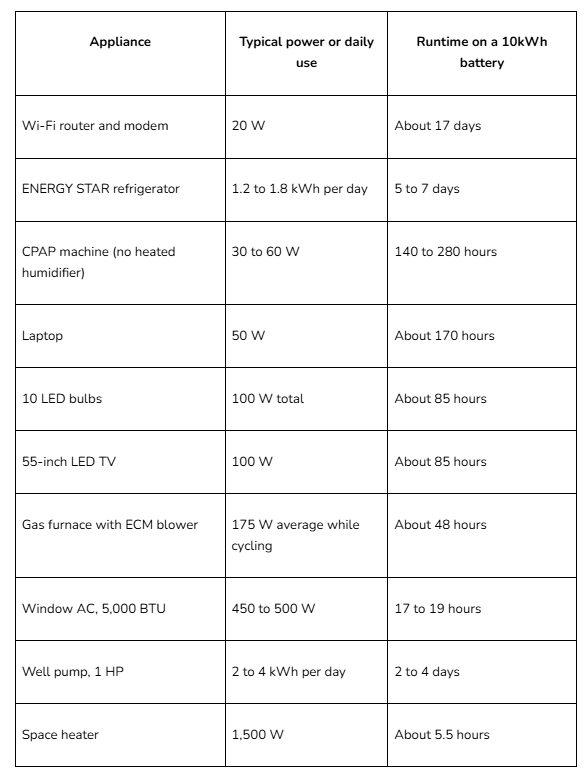
Wattages are typical ranges; check the nameplate or label on your own appliances for exact figures.
Two patterns stand out. Electronics and lighting barely dent a 10kWh battery. Anything that makes heat or cold with electricity, such as central AC, space heaters and water heaters, drains it in hours. That single insight drives every smart 10kWh battery backup plan. For a closer look at cooling loads, see our guide to solar battery backup for air conditioning, and for heating, our guide to battery backup for your furnace.
Real Outage Scenarios: How Long Will a 10kWh Battery Last?
Nobody runs one appliance at a time during an outage. These four household profiles show how long a 10kWh battery lasts when several loads share it.
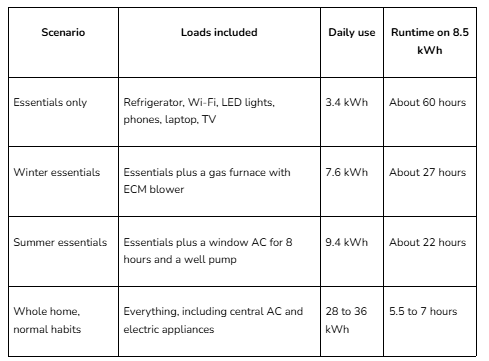
The gap between the first and last rows is the whole story. With smart load choices, a single 10kWh home battery carries a household through 1 to 2.5 days. Treat it like the grid and it lasts an afternoon.
That is why most installers wire a 10kWh battery to a critical loads panel instead of the main panel. The panel limits the battery to circuits you choose ahead of time, so nobody accidentally drains it with the dryer. Our comparison of whole-home vs essential-load battery backup explains how to pick those circuits.
Is 10kWh Enough for Your Home?
A 10kWh battery is the right size for many homes, but not all of them. Use these two lists as a quick check.
10kWh is usually enough if:
- Your outages typically last less than a day.
- You heat and cook with gas, so heating and cooking barely touch the battery.
- You want backup for essentials, not the whole house.
- Your goal is peak-hour savings. A typical 4 p.m. to 9 p.m. peak window uses 5 to 8 kWh in many homes, which fits inside one 10kWh battery. Our guide to how solar batteries lower peak-hour electricity bills shows how that works.
You likely need 20kWh or more if:
- Your home is all-electric, including heat pump heating or an electric water heater.
- You want central AC to run during summer outages.
- Someone in the house relies on powered medical equipment.
- Outages in your area regularly stretch past two days.
Start at 10kWh, expand later
The best 10kWh batteries are modular. The LINIOTECH 10 kWh battery connects in parallel with identical units up to 16 batteries, or 160 kWh total, so you can start with one and add capacity as your needs or budget grow. Plan for expansion from day one by choosing an inverter large enough for your future system.
Pair it with solar
A 10kWh solar battery becomes far more useful when panels refill it every day. A home solar array produces roughly 4 to 5 kWh per installed kilowatt on a clear Texas day, so a 6 kW array can recharge a 10kWh battery by early afternoon and still power the house. During a multi-day outage, that turns a 27-hour battery into an open-ended backup. Browse complete battery and inverter setups in our residential energy storage system.
How to Choose the Right 10kWh Home Battery
Not every 10kWh lithium battery suits every home. Install location, inverter pairing and climate matter as much as capacity. Here is how the 10kWh options in our power storage wall battery collection compare.
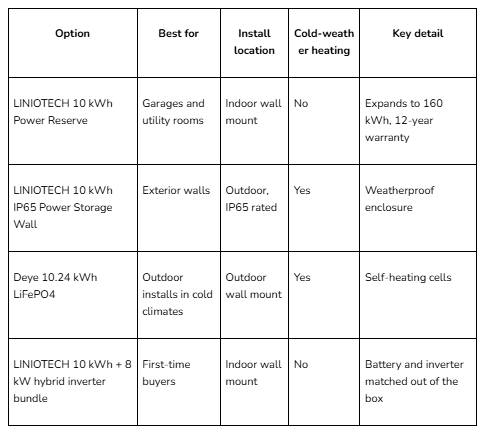
For protected indoor spaces, the 10 kWh Power Reserve covered earlier in this guide is the most flexible choice. If the battery must hang on an exterior wall, choose the 10 kWh IP65 outdoor-rated power storage wall or the Deye 10.24 kWh self-heating wall battery, since LiFePO4 cells should not charge below freezing without built-in heating. Buyers starting from scratch can skip the matching work entirely with the LINIOTECH 10 kWh battery and 8 kW hybrid inverter bundle.
Before you buy any 10kWh battery, check these five points:
- Usable capacity and rated DoD. Compare cycle life at the same depth of discharge, not headline numbers.
- Inverter compatibility. Confirm the battery is approved for your inverter and supports closed-loop communication. Our battery and inverter compatibility checklist covers what to verify.
- Certifications. Look for UL 1973 at the battery level, and ask your installer which system-level listing your local permit office requires.
- Climate rating. Outdoor batteries in freezing regions need self-heating and a weatherproof enclosure.
- Expansion path. Make sure you can add identical units later without replacing the first one.
Make Every Kilowatt-Hour Count
A 10kWh battery will not replace the grid for an entire house, and it does not need to. Wired to the right circuits, it keeps food cold, lights on, the internet connected and heat running for one to two and a half days. Paired with solar, it recharges every afternoon and handles peak-hour usage that would otherwise land on your bill. Start with an honest look at your daily kWh, decide which loads truly matter, and size from there.
When you are ready to pick the right battery for your home, LINIOTECH makes it simple. From our base in Cypress, Texas, we supply LiFePO4 home batteries, matched hybrid inverter bundles and expandable storage systems built for real outage loads, backed by a team that answers the phone. Call 800-978-0161 or email sales@liniotech.com, tell us what you want to keep running, and we will match you with a 10kWh battery setup that fits your home today and grows with it tomorrow.
Frequently Asked Questions
How long will a 10kWh battery last during a power outage?
A 10kWh battery delivers about 8.5 kWh of usable power. That runs essential loads like a refrigerator, Wi-Fi, lights and phone chargers for roughly 60 hours. Add a gas furnace or window AC and expect 22 to 27 hours. Running the whole house normally drains it in about 7 hours.
Can a 10kWh battery run a whole house?
Only for a few hours. The average U.S. home uses about 28 kWh per day, so a single 10kWh battery covers roughly a quarter of a normal day. It works best on a critical loads panel that powers your most important circuits.
Can a 10kWh battery run central air conditioning?
Yes, but briefly. A 3-ton central AC draws 3,000 to 3,500 watts while the compressor runs, which gives about 2.5 to 3 hours of compressor time. The inverter must also handle the compressor's startup surge.
How many 10kWh batteries do I need?
Multiply the kWh you want to back up per day by the number of days you want covered, then divide by 8.5. A home that needs 15 kWh per day for two days needs about 30 kWh, or three 10kWh batteries.
How many years does a 10kWh LiFePO4 battery last?
A quality LiFePO4 battery rated for 8,500 cycles at 80% depth of discharge could cycle daily for well over 15 years on paper. The warranty term, such as 12 years on the LINIOTECH 10 kWh battery, is the more practical planning figure.
How long does it take to charge a 10kWh battery?
Charging time depends on the inverter and power source. A hybrid inverter charging at 5 kW refills a 10kWh battery in about 2 hours from the grid. A mid-size solar array typically refills it by early afternoon on a clear day.