
Do You Need a Battery to Charge an EV With Solar?
Posted by `LINIOTECH on Sep 14th 2026
No, you do not always need a battery to charge an electric vehicle with solar panels. If your EV is parked at home during the day, your solar panels can help supply charging power directly while the sun is producing electricity. A home battery becomes more useful when you want to charge at night, reduce peak-hour electricity costs, store excess solar energy, or keep charging options available during outages.
That is the simple answer. The smarter answer is that the right setup depends on your charging schedule, utility rate plan, solar system size, battery capacity, and the way your home manages power.
For many homeowners, the best system is not just an EV charger or just a solar array. It is a complete energy setup that connects solar panels, an EV charger, a hybrid inverter, and optional LiFePO4 battery storage. LINIOTECH supports this type of integrated planning with electric vehicle charger solutions, bifacial solar panel options, and home energy storage systems designed for modern solar-plus-storage applications.
This guide explains when you can charge an EV with solar without a battery, when battery storage makes sense, and how to think about system size before buying equipment.
Quick Answer: When Do You Need a Battery?
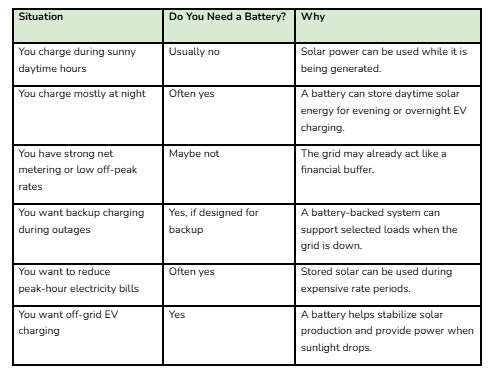
The key idea is simple: solar panels create electricity when sunlight is available, but many EV owners charge after work or overnight. A battery helps shift solar energy from the time it is produced to the time you actually need it.
How Solar EV Charging Works Without a Battery
A solar EV charging setup without battery storage usually works best when your car can charge while your solar panels are producing power. During sunny hours, electricity from the solar array can help supply your home loads and EV charger. If solar production is lower than the charger demand, the grid can supply the difference. If solar production is higher than the home and charger demand, extra power may be exported to the grid depending on your local utility rules.
This setup can be simple and cost-effective because it does not require a separate battery bank. It may be enough for homeowners who work from home, have flexible charging schedules, or can leave the EV plugged in during the day.
It becomes less ideal when the EV is away during the day and returns home after solar production has dropped. In that situation, solar panels may reduce your annual electricity usage, but your actual EV charging session may still pull heavily from the grid at night.
When You May Not Need a Battery for Solar EV Charging
A battery is not always the first upgrade a homeowner needs. In some cases, it is better to start with the right solar array and a properly installed Level 2 EV charger.
1. Your EV Is Home During the Day
If the vehicle is parked at home during sunlight hours, the charger can use solar production more directly. This is common for remote workers, retirees, second vehicles, fleet vehicles parked during the day, or households where one EV is usually at home.
2. You Only Need a Small Daily Top-Up
Many EV owners do not need to fully charge the vehicle every day. If you drive 25 to 40 miles per day, your daily energy need may be much smaller than the full size of the EV battery. That makes daytime solar top-ups easier to support without a large home battery.
3. Your Utility Offers Favorable Solar Credits
In some locations, exported solar energy can still provide useful bill credits. If your utility structure makes exported solar financially attractive, battery storage may be less urgent. The calculation changes in areas with weak export credits, high evening rates, or demand-based charges.
4. You Want the Lowest Upfront Cost
Solar panels plus a Level 2 charger are usually simpler than a full solar-plus-battery installation. If the main goal is daily charging cost reduction, not backup power or evening solar use, starting without a battery may make sense.
To understand charger speed and voltage before deciding on a solar battery, review LINIOTECH’s guide on Level 1 vs Level 2 EV charging. A correctly sized charger is the foundation of a useful home charging setup.
When a Battery Makes Solar EV Charging Better
A battery becomes more valuable when your charging pattern does not match your solar production window. It also helps when electricity prices, backup needs, or grid limits make direct solar charging less practical.
1. You Charge Mostly at Night
This is the biggest reason homeowners consider battery storage for EV charging. Solar panels generate most of their energy during the day, while many EVs are plugged in after work. A battery can store excess daytime solar and make some of that energy available later.
2. You Want to Use More of Your Own Solar Power
Without a battery, unused solar power may flow to the grid. With a battery, more of that energy can stay on-site and be used for evening loads, overnight loads, or selected EV charging. This is often called increasing solar self-consumption.
3. Your Peak Electricity Rates Are High
In time-of-use rate areas, electricity can be more expensive in the evening, when air conditioning, cooking, home appliances, and EV charging may overlap. Battery storage can reduce the amount of grid energy used during those expensive periods.
For a deeper explanation, read LINIOTECH guide on whether solar batteries can lower peak-hour electricity bills. The same load-shifting logic applies when EV charging is part of the home energy profile.
4. You Want Backup Power During Outages
A grid-tied solar system without battery backup may shut down during an outage for safety reasons. A properly designed battery-backed system can keep selected circuits powered and may allow limited solar charging when the grid is down. The system must be designed correctly with compatible inverter, battery, transfer, and load-management equipment.
5. You Are Planning a Larger Energy System
EV charging often pushes a home into a larger energy category. Once you add air conditioning, electric cooking, heat pumps, battery backup, and EV charging, the system needs careful planning. Battery storage can help manage energy flow, but it must be sized around real loads.
Battery vs No Battery: Practical Comparison
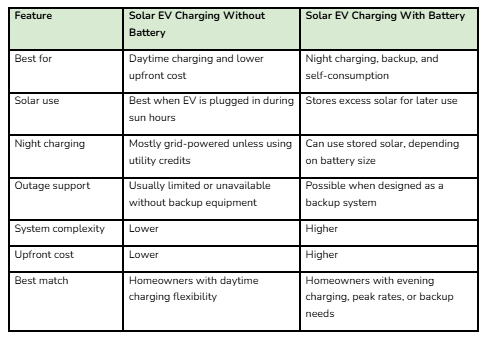
Neither option is automatically better. The right choice depends on the household’s charging schedule and energy goals.
How Much Energy Does an EV Need Each Day?
Before deciding whether you need a home battery, estimate how much energy the EV actually needs each day. The calculation is usually more useful than looking only at the full EV battery size.
A simple formula is:
Daily EV charging energy = Miles driven per day × kWh per mile
For many planning examples, an EV may use roughly 0.25 to 0.35 kWh per mile depending on vehicle efficiency, speed, weather, terrain, tires, and driving habits. A conservative early estimate is 0.30 kWh per mile.
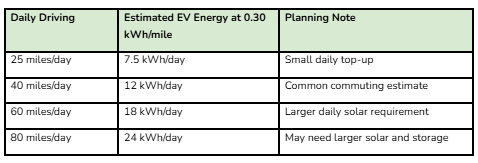
This number is not the same as the EV’s full battery size. A vehicle may have a 60kWh, 75kWh, or larger battery pack, but most drivers only replace the energy used that day.
For a more detailed panel-count calculation, use the LINIOTECH guide on how many solar panels you need to charge an EV. That article covers solar panel wattage, daily driving, and solar production assumptions in more depth.
Can a Home Battery Fully Charge an EV?
Technically, a large enough home battery system can transfer substantial energy to an EV. Practically, most homeowners should not think of the home battery as a complete EV fuel tank.
Many EV battery packs are much larger than a single home storage battery. A 10kWh home battery may provide a useful top-up, but it will not fully charge a 60kWh or 80kWh EV battery from empty. A 20kWh or 30kWh home battery can support more meaningful charging, but the system still needs to account for home loads, inverter output, charger power, and reserve capacity.
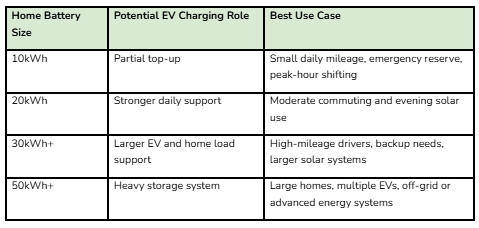
This is why battery sizing should focus on daily energy use, not just the maximum size of the EV pack. For homeowners comparing storage capacity, LINIOTECH power storage wall batteries and rack LiFePO4 battery modules provide useful starting points for modular energy storage planning.
The Role of a Level 2 EV Charger
Most solar EV charging setups become more practical with a Level 2 charger. Level 1 charging uses a standard household outlet and is slow. Level 2 charging uses a higher-voltage circuit and can add energy much faster, which makes it more useful for daily driving.
However, faster charging also means higher power demand. If a Level 2 charger is operating at the same time as air conditioning, cooking equipment, laundry, and other loads, the electrical system needs to be planned carefully.
LINIOTECH EV charger collection includes AC charging options for home and private parking applications, including UL electric EV charger equipment and an IP65 waterproof EV charger station for users comparing charger form factor, installation location, and charging requirements.
The Role of the Hybrid Inverter
A hybrid inverter is often the control center of a solar-plus-storage system. It helps manage power from solar panels, batteries, the grid, and home loads. When EV charging is added, the inverter and energy-management settings become even more important.
A solar EV charging system may need to decide when to:
- Send solar power directly to home loads
- Charge the stationary home battery
- Support EV charging
- Export extra solar energy to the grid
- Import grid power when solar and battery output are not enough
- Reserve battery energy for backup loads
This is why compatibility matters. Before designing an EV charging setup with solar and storage, review the LINIOTECH guide on battery and inverter compatibility and explore compatible hybrid solar inverter solutions. The inverter must match the battery voltage range, communication method, charging profile, and power requirements.
Daytime Charging vs Night Charging
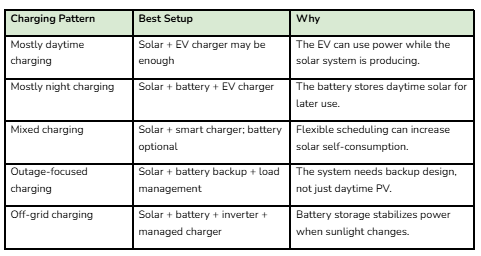
For many households, the best first question is not “Do I need a battery?” It is “When will the EV usually be plugged in?” That one answer can change the whole system design.
Do You Need AC-Coupled or DC-Coupled Storage?
If the home already has solar panels, AC-coupled storage may be considered because it can often be added to an existing solar system without redesigning the entire DC solar array. If the system is being designed from the beginning, DC-coupled or hybrid inverter-based storage may be more efficient and integrated in some cases.
There is no universal answer. The right architecture depends on the existing equipment, backup goals, inverter compatibility, battery voltage, utility rules, and EV charging behavior.
For a deeper breakdown, read LINIOTECH comparison of AC-coupled vs DC-coupled battery storage. That guide is especially useful for homeowners who already have solar panels and are now adding EV charging or battery backup.
Sizing a Battery for Solar EV Charging
A simple way to estimate battery capacity is to start with daily EV energy use, then decide how much of that energy you want to cover from stored solar.
Battery capacity needed = Daily EV kWh target + home backup reserve + design margin
Example: if you want to support 12kWh of EV charging after sunset and still reserve 5kWh for essential home loads, the system may need more than 17kWh of usable battery capacity after accounting for efficiency losses and depth-of-discharge settings.
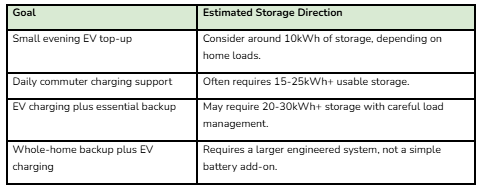
For homeowners still learning the difference between power and stored energy, read LINIOTECH kW vs kWh battery storage guide. EV charging makes this distinction important because charger power and battery capacity are not the same thing.
What About Charging During an Outage?
Charging an EV during a grid outage is possible only if the solar and battery system is designed for backup operation. A standard grid-tied solar system may not keep running during an outage. A backup-capable system needs the right inverter, battery, isolation equipment, wiring, and load-management strategy.
Even when outage charging is possible, the EV charger may need to be limited. A full-power Level 2 charger can consume a large share of available inverter output and battery capacity. In many backup situations, it is smarter to prioritize essential home loads first, then use remaining solar and battery power for EV top-ups.
A practical outage plan may reserve battery power for:
- Refrigeration
- Lights
- Internet and communications
- Well pump or sump pump
- Medical or essential devices
- Limited EV charging if extra energy is available
For load-priority planning, LINIOTECH guide on whole-home vs essential-load battery backup is a useful companion article.
Is a Bidirectional EV the Same as a Home Battery?
No. A bidirectional EV can act as a mobile storage resource only when the vehicle, charger, wiring, transfer equipment, and software all support that function. A standard Level 2 EV charger is normally designed to charge the car, not power the home.
Bidirectional charging is an important trend, but it should not be confused with a stationary home battery system. A dedicated home battery is designed to integrate with solar storage, backup circuits, inverter settings, and daily home energy management. A bidirectional EV may support vehicle-to-home or vehicle-to-grid use only in compatible systems.
For most homeowners today, the practical decision is still whether to pair solar panels and an EV charger with stationary battery storage.
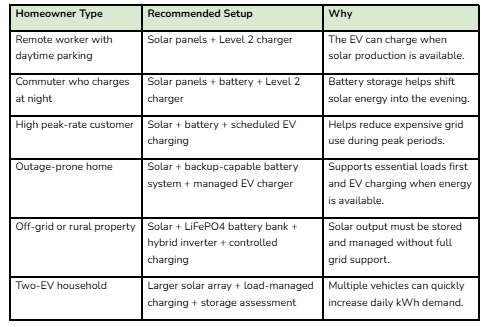
Best System Setups by Homeowner Type
Common Mistakes to Avoid
Mistake 1: Thinking Solar Panels Charge the EV at Night
Solar panels do not produce energy after sunset. Night charging uses grid power unless a battery stores solar energy or utility credits offset the energy cost.
Mistake 2: Sizing the Battery Around the Full EV Pack
You usually do not need enough stationary storage to charge the EV from empty fully. Most homeowners should size around daily driving needs, backup reserve, and rate-management goals.
Mistake 3: Ignoring Charger Power
Battery capacity is measured in kWh, but charger power is measured in kW. A high-power charger can drain a small battery quickly if the system is not controlled.
Mistake 4: Forgetting Home Loads
The EV is not the only load in the house. Air conditioning, refrigerators, water pumps, cooking appliances, and laundry can overlap with charging demand.
Mistake 5: Mixing Equipment Without Checking Compatibility
Solar panels, EV chargers, batteries, inverters, and monitoring systems must be selected as one energy ecosystem. Voltage, current, wiring, communication protocols, backup settings, and utility requirements all matter.
So, Do You Need a Battery?
You probably do not need a battery if your EV can charge during the day, your solar export credits are strong, and your main goal is simply to reduce grid electricity use.
You should strongly consider a battery if you charge at night, have expensive peak-hour rates, want outage backup, want to increase solar self-consumption, or are building a more advanced solar-plus-storage energy system.
The best approach is to design the system around real daily driving, charger power, home loads, solar production, and backup goals. That keeps the system practical instead of oversized or underpowered.
Build a Smarter Solar EV Charging System With LINIOTECH
EV charging is becoming part of the home energy system, not a separate appliance. The right setup should consider solar production, battery storage, inverter capacity, charger speed, and utility rates together.
LINIOTECH provides the key components for that ecosystem, including electric vehicle chargers, bifacial solar panels, LiFePO4 battery storage, rack battery modules, and hybrid inverter solutions for homeowners and installers planning solar-powered EV charging.
Whether you want simple daytime charging or a more complete solar-plus-battery setup, LINIOTECH can help match the EV charger, solar array, inverter, and battery storage around your actual energy needs.
Final Thoughts
You do not always need a battery to charge an EV with solar panels. If the car is home during the day, direct solar charging can work well. But if you charge at night, want backup power, or want to use more of your own solar energy, battery storage becomes much more valuable.
A home battery does not have to replace the full EV battery. Its job is usually to shift solar energy, protect essential loads, reduce expensive grid usage, and make the charging system more flexible.
The smartest solar EV charging setup is the one designed around your actual schedule: when you drive, when you charge, how much solar you produce, and how much backup power you want available.
FAQs
Do I need a battery to charge an EV with solar panels?
No. If your EV charges during sunny daytime hours, solar panels can help power the charger directly. A battery is more useful when you charge at night, want backup power, or want to store excess solar energy.
Can solar panels charge an EV at night?
Solar panels do not produce electricity at night. Nighttime EV charging uses the grid unless you have stored solar energy in a battery or are offsetting energy through utility credits.
How big of a battery do I need for EV charging?
It depends on daily driving, charger power, home loads, and backup goals. A daily commuting top-up may require much less storage than a full EV battery recharge.
Can a 10kWh battery charge an EV?
Yes, but only as a partial top-up for most EVs. A 10kWh battery is much smaller than many EV battery packs, so it is better for daily support, peak-hour shifting, or emergency charging than full recharging.
Is it better to charge an EV directly from solar or from a battery?
Direct solar charging is efficient when the EV is plugged in during the day. Battery charging is better when you need to use daytime solar energy later in the evening or overnight.
Do I need a hybrid inverter for solar EV charging?
A hybrid inverter is not always required for basic grid-tied solar EV charging, but it is usually important when battery storage, backup power, and advanced energy management are part of the system.
Can I charge an EV during a power outage?
Only if the solar and battery system is designed for backup operation. A standard grid-tied solar system may shut down during outages unless backup-capable equipment is installed.
Does an EV charger drain a home battery quickly?
It can. A Level 2 charger is a high-power load, so system settings may need to limit charging power or prioritize essential loads when running from battery storage.
Is solar EV charging worth it without a battery?
It can be worth it if you can charge during sunny hours or your utility credits make exported solar valuable. If you mostly charge at night, battery storage may improve solar self-consumption.
What is the best setup for solar EV charging at home?
For many homes, the best setup is solar panels, a properly installed Level 2 EV charger, a compatible hybrid inverter, and optional LiFePO4 battery storage sized around daily driving and backup goals.