
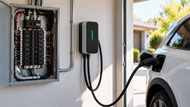
Can Your Electrical Panel Handle a Level 2 EV Charger?
Posted by LINIOTECH on Sep 28th 2026
A Level 2 EV charger can make home charging much faster and more convenient, but it also adds a serious electrical load to the home. Before installation, one of the most important questions is simple: can your electrical panel handle it?
The answer depends on your panel size, existing household loads, spare breaker space, charger amperage, wiring, local electrical code, and whether the system uses load management. Some homes can support a Level 2 charger without major upgrades. Others may need a lower-amperage charger, a smart energy-management setup, a subpanel, or a full electrical service upgrade.
This guide explains how to think about electrical panel capacity for Level 2 EV charging before you buy equipment or schedule installation. For charger options, start with the LINIOTECH Electric Vehicle EV Charger collection, then match the charger to your home’s electrical capacity and daily driving needs.
Quick Answer: Can a Standard Panel Handle a Level 2 EV Charger?
Many homes can support a Level 2 EV charger, but not every panel has enough available capacity for high-amperage charging. A 240V Level 2 charger may use anything from a modest 16A charging rate to a stronger 40A or 48A setup, depending on the equipment and vehicle. Higher charging amperage usually means faster charging, but it also requires more panel capacity.
- A newer 200A panel often has a better chance of supporting Level 2 charging, but it still needs a load calculation.
- A 100A panel may support a lower-amperage Level 2 charger in some homes, but not always.
- Homes with electric HVAC, electric water heating, electric ranges, pool pumps, or multiple large loads may have less spare capacity.
- A licensed electrician should perform the final load calculation and confirm code-compliant installation.
The goal is not simply to install the highest-amperage charger possible. The goal is to choose a charger that fits your vehicle, your panel, your driving pattern, and your future energy plans.
What Does a Level 2 EV Charger Need?
A Level 2 EV charger generally uses a 240V circuit in residential applications. That is the same voltage class used by many heavy household loads, such as electric dryers, ovens, water heaters, and some HVAC equipment.
If you are still comparing charger types, read LINIOTECH’s guide on Level 1 vs Level 2 EV Charging first. That article explains the difference between slow 120V charging and faster 240V home charging.
For Level 2 charging, the key electrical factors are:
- Voltage: usually 240V for residential Level 2 charging
- Charger amperage: often 16A, 24A, 32A, 40A, or 48A depending on the charger
- Circuit size: selected by the electrician based on the EVSE rating and code requirements
- Breaker space: Level 2 typically needs a two-pole breaker
- Wiring path: from the panel to the garage, driveway, or parking area
- Mounting location: indoor, garage, wall-mounted, pedestal, or outdoor-rated setup
LINIOTECH UL Electric EV Charger LTN-AC010K-US-A is listed with 240V AC, 40A rated current, and 9.6kW output, making panel capacity a key part of the installation conversation.
Level 2 Charger Amps and Power Output
A charger’s power output depends on voltage and current. The basic formula is:
Power in watts = volts x amps
At 240V, the difference between a 16A charger and a 40A charger is significant.
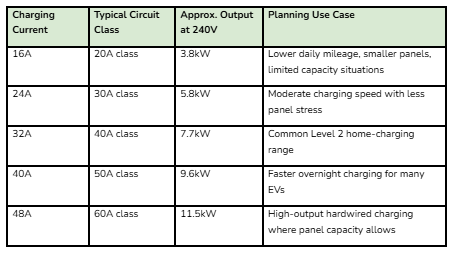
This table is for planning only. Actual circuit sizing depends on charger specifications, local code, wire length, conductor type, installation method, and professional electrical design. Do not size wiring or breakers from an online article.
Why Electrical Panel Capacity Matters
Your electrical panel distributes electricity to the home’s circuits. Every major appliance already uses part of the available service capacity. When you add a Level 2 charger, the home may be adding one of its largest continuous electrical loads.
That is why a charger cannot be evaluated only by looking for an empty breaker slot. A panel may have physical space for a breaker but still lack enough electrical capacity for another large load.
Important existing loads include:
- Central air conditioning or heat pumps
- Electric water heater
- Electric range or oven
- Electric clothes dryer
- Pool pump or spa equipment
- Well pump
- Workshop equipment
- Existing solar, battery, generator, or subpanel connections
This is similar to solar and battery design: the headline number does not tell the whole story. For a deeper explanation of power and energy terms, review kW vs kWh in Battery Storage. The same kW thinking applies to EV chargers because charger power is part of the home’s total electrical load.
Signs Your Panel May Be Ready for Level 2 Charging
Your panel may be a good candidate for Level 2 charging if several of these are true:
- The home has a modern electrical service with available capacity after load calculation.
- There is room for a two-pole breaker or space to add a properly designed subpanel.
- Large household loads are not already pushing the panel near its practical limit.
- The charger location is reasonably close to the panel, reducing installation complexity.
- You are willing to select charger amperage based on the home’s available electrical capacity.
Even then, the final decision should come from a licensed electrician. A visual inspection alone is not enough.
Signs You May Need a Panel Upgrade or Load Management
You may need extra planning if your home has:
- An older 100A service with many electric appliances
- No available two-pole breaker space
- A full panel or outdated electrical equipment
- Multiple high-demand electric loads already installed
- Plans to add more EVs, heat pumps, induction cooking, or battery storage later
- A charger location far from the main panel
- Known breaker trips or electrical issues
In some homes, a full panel upgrade may be the best long-term solution. In others, a lower-amperage charger or smart load management can be more cost-effective.
Can a 100A Panel Handle a Level 2 EV Charger?
Sometimes, yes. But a 100A panel needs a careful load calculation before adding Level 2 charging.
A 100A home with gas heating, gas water heating, no pool equipment, and moderate electrical demand may be able to use a lower-amperage Level 2 charger. A 100A home with electric heat, electric water heating, central AC, an electric range, and other large loads may have little room left.
This is where charger selection matters. A homeowner may not need the maximum charging speed if the vehicle is parked overnight for 8 to 12 hours. A 16A, 24A, or 32A Level 2 charging setup may meet the real driving need with less pressure on the panel.
Can a 200A Panel Handle a Level 2 EV Charger?
A 200A panel often gives homeowners more flexibility, but it still does not guarantee unlimited capacity. The electrician must consider the home’s total load and plans.
For example, a 200A panel may already serve electric HVAC, a heat pump water heater, induction cooking, a pool pump, a workshop, and other heavy loads. In that case, the available capacity for EV charging may still be limited.
The best practice is to size the charger to the household’s real charging needs rather than assuming the largest output is automatically better.
What Is an Electrical Load Calculation?
An electrical load calculation estimates how much power the home may need based on building size, appliances, heating and cooling equipment, and other electrical loads. For EV charging, this calculation helps determine whether the panel can safely support the charger.
A proper load calculation considers:
- Main service rating
- Existing breaker layout
- Large appliance ratings
- Continuous loads
- Heating and cooling equipment
- Existing solar or battery equipment
- Future electrical upgrades
- Local code and utility requirements
This is not a DIY guessing exercise. The load calculation is the part that protects the charger, the vehicle, the home wiring, and the electrical panel.
Does a Level 2 EV Charger Need a Dedicated Circuit?
In a normal residential installation, a Level 2 EV charger is installed on a dedicated circuit. That means the charger has its own wiring path and breaker instead of sharing a circuit with outlets, lighting, or other appliances.
This matters because EV charging can run for many hours at a steady load. Sharing that circuit with other loads can create overload risk and nuisance tripping.
For a charger such as the LINIOTECH IP65 Waterproof EV Charger, which is designed for indoor or outdoor wall-mounted use, the installation should match the charger specifications and the site conditions.
How Load Management Can Help Avoid a Panel Upgrade
Load management is one of the most important EV charging topics right now. Instead of forcing every home into a larger electrical service, some systems can reduce or pause charging when the home is using too much power.
Load management may help by:
- Limiting charger output to match available capacity
- Reducing charging speed during high household demand
- Scheduling charging during off-peak hours
- Prioritizing essential home loads over EV charging
- Supporting future solar and battery integration
This topic connects closely with the LINIOTECH article Can Solar Batteries Lower Peak-Hour Electricity Bills?, because timing and control can affect both charging cost and total household demand.
Does Solar Power Eliminate the Need for Panel Capacity?
No. Solar panels can reduce how much grid electricity your home uses over time, but they do not automatically remove the need for a correctly sized EV charging circuit.
If your EV charger is connected to the home electrical system, the charger circuit still needs to be designed safely. Solar production can help offset energy consumption, but panel capacity and circuit design remain separate installation questions.
That said, solar can improve the economics of EV charging. If your EV is home during the day, solar panels may supply part of the charging energy directly. If you charge mostly at night, battery storage may help store solar energy for later use. For more detail, read Can You Charge an EV With Solar Panels at Home? and Do You Need a Battery to Charge an EV With Solar?.
For solar-ready homes, LINIOTECH bifacial solar panels, home energy storage systems, and hybrid inverter solutions can support a broader energy plan beyond basic EV charging.
Can a Home Battery Help With EV Charging?
A home battery can help with EV charging in certain setups, but it should not be treated as a magic fix for every panel-capacity problem.
Battery storage may help when the goal is to:
- Use stored solar energy after sunset
- Reduce charging during expensive peak-rate periods
- Support essential home loads during outages
- Improve energy independence
- Coordinate EV charging with solar production and household demand
However, charging a large EV battery from a home battery can drain stored energy quickly. The system should be designed around real driving needs, charger output, battery capacity, and backup priorities. For planning backup loads, see Whole-Home vs Essential-Load Battery Backup.
Example: How Charger Amperage Changes the Panel Conversation
Two homeowners may both want Level 2 charging, but their best setups can be different.
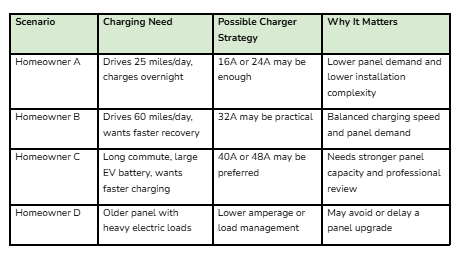
This is why EV charger selection should start with daily driving and panel capacity, not only maximum charging speed.
Does Plug-In vs Hardwired Affect Panel Requirements?
Plug-in and hardwired chargers can both require a properly sized circuit. The main difference is how the charger connects to the electrical system, not whether it needs electrical capacity.
Some higher-output chargers are hardwired, while many plug-in chargers use outlets such as NEMA 14-50 or NEMA 6-50 depending on the model. LINIOTECH’s IP65 EV charger page lists NEMA plug options, while also emphasizing wall-mounted use and electrical protections.
The next article in this September EV charging cluster should cover Hardwired vs Plug-In EV Charger: Which Is Better? as a dedicated buyer-intent topic.
What to Check Before Installing a Level 2 EV Charger
Before buying or installing a Level 2 charger, collect the information your electrician or energy advisor will need.
- Your electrical panel rating, such as 100A, 150A, 200A, or higher
- Available breaker space in the panel
- Distance from the panel to the parking location
- Vehicle charging limit and connector type
- Desired charging speed and daily mileage
- Existing large electric loads in the home
- Whether you plan to add solar, battery storage, or another EV later
- Indoor or outdoor charger location
- Local code, permitting, and utility requirements
For charger hardware, compare LINIOTECH Electric Vehicle EV Charger collection with your vehicle requirements and installation plan.
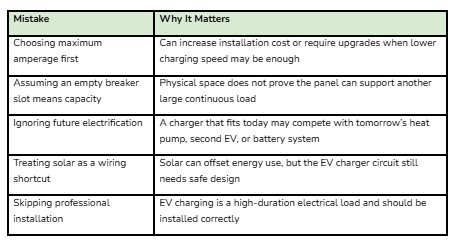
Common Mistakes to Avoid
Choosing the Right Level 2 Charger for Your Home
The best Level 2 charger is the one that fits both your vehicle and your home’s electrical system. For many homeowners, a 32A or 40A charger provides strong overnight charging without chasing unnecessary speed. For others, a lower-amperage setup may be smarter because it matches daily mileage and avoids major electrical upgrades.
A good EV charger plan should answer five questions:
- How many miles do you drive per day?
- How many hours is the vehicle parked at home?
- What amperage can your panel safely support?
- Do you want solar-assisted or battery-supported charging?
- Will you add another EV or home electrification upgrades later?
If you are building a solar-ready charging setup, pair the charger decision with your solar and storage plan. The article How Many Solar Panels Do You Need to Charge an EV? can help estimate solar generation needs, while Battery and Inverter Compatibility explains why system components must be matched correctly.
Build a Safer EV Charging Setup With LINIOTECH
A Level 2 EV charger is more than a wall-mounted accessory. It becomes part of your home’s electrical and energy-management system. That is why panel capacity, charger amperage, installation location, solar production, and battery storage should be planned together.
LINIOTECH provides EV chargers, solar panels, LiFePO4 battery storage, hybrid inverters, and related energy solutions for homeowners who want reliable charging and a more complete energy setup. Explore the LINIOTECH EV charger collection or contact LINIOTECH to discuss the right equipment path for your home.
Final Thoughts
So, can your electrical panel handle a Level 2 EV charger? It might, but the answer depends on more than panel size.
A safe installation should consider charger amperage, service capacity, existing household loads, breaker space, wiring distance, code requirements, and future energy plans. Some homes are ready for Level 2 charging with minimal work. Others need load management, lower-amperage charging, a subpanel, or a service upgrade.
The smartest approach is to match charging speed to real driving needs. A properly selected Level 2 charger can provide convenient overnight charging without overbuilding the system or creating unnecessary electrical stress.
For a future-ready setup, think beyond the charger. Plan the EV charger, solar panels, battery storage, and hybrid inverter as one home energy system.
FAQs
Can I install a Level 2 EV charger on a 100A panel?
Sometimes, but only after a professional load calculation. Some 100A homes can support lower-amperage Level 2 charging, while others may need load management or a service upgrade.
Do I need a 200A panel for a Level 2 EV charger?
Not always. A 200A panel often provides more flexibility, but many successful installations depend on load calculation, charger amperage, and existing household loads.
How many amps does a Level 2 EV charger use?
Residential Level 2 chargers commonly operate at charging currents such as 16A, 24A, 32A, 40A, or 48A, depending on the equipment and vehicle.
Does a Level 2 EV charger need a dedicated circuit?
Yes, a Level 2 charger is normally installed on a dedicated circuit with its own breaker and wiring path. The final design must follow local code and charger specifications.
Can solar panels power a Level 2 EV charger?
Solar panels can help supply EV charging energy, especially during daytime charging. However, the charger still needs a properly designed circuit and safe installation.
Can a battery help charge my EV at night?
Yes, battery storage can store solar energy for later use, but the system must be sized carefully because EV batteries can require substantial energy.
Will a Level 2 charger increase my electricity bill?
It can increase electricity use, but charging at home may still be more convenient and cost-effective than relying only on public charging. Solar and off-peak charging can improve savings.
Is a 40A EV charger enough for home charging?
For many EV owners, a 40A Level 2 charger provides strong overnight charging. The right amperage depends on daily mileage, vehicle limits, parking time, and panel capacity.
What happens if my panel cannot handle the charger?
Options may include using a lower-amperage charger, adding load management, installing a subpanel, or upgrading electrical service. A licensed electrician should recommend the safest path.
Should I buy the charger before checking my panel?
It is better to check your panel and installation requirements first. That helps avoid buying a charger that is too large, incompatible, or more expensive to install than necessary.